

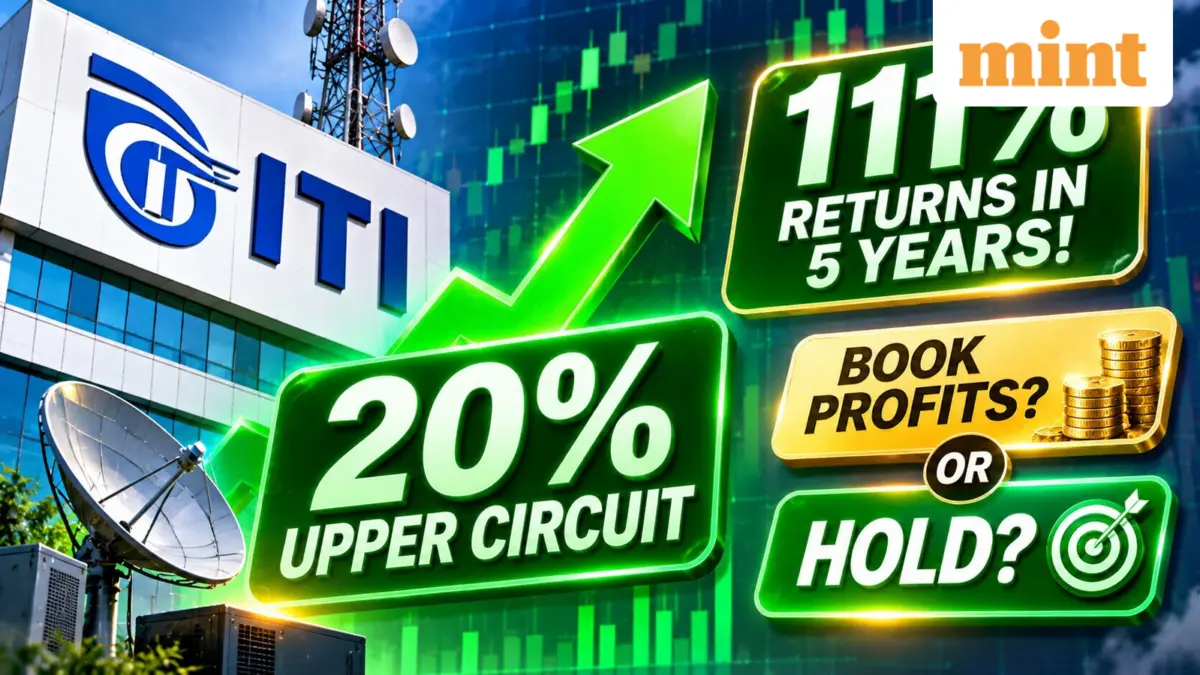
ITI Limited, the premier state-owned telecommunications equipment manufacturer in India, witnessed a dramatic surge in its stock price during Monday’s trading session, hitting the 20% upper circuit as investor interest peaked. The stock opened at ₹216.25 on the National Stock Exchange (NSE), representing a slight uptick from its previous close of ₹215.95 on Friday. As the session progressed, a wave of buying pressure propelled the share price to an intraday high of ₹259.14 on November 2, locking it at the maximum permissible daily limit. This explosive movement comes at a time when the broader Indian equity markets are navigating a period of heightened volatility, yet finding support from heavyweight corporate earnings and favorable global cues.
The rally in ITI shares was not an isolated event but occurred within the context of a broader recovery on Dalal Street. The Indian benchmark indices, the BSE Sensex and the NSE Nifty 50, both opened significantly higher on Monday. This optimism was largely fueled by a robust performance from Reliance Industries following its latest earnings announcement, coupled with a notable decline in international crude oil prices, which traditionally eases inflationary concerns for the Indian economy. The 30-share BSE Sensex surged by 764.72 points to reach 75,216.80 in early trade, while the 50-share NSE Nifty advanced by 201.40 points to settle at 23,255.90. This tide of positive sentiment provided the necessary backdrop for mid-cap and small-cap stocks like ITI to experience outsized gains.
Surge in Trading Volume and Market Liquidity
One of the most striking features of Monday’s price action was the massive spurt in trading volume. Liquidity in the ITI counter reached extraordinary levels, with a combined total of 13.09 million shares changing hands across the National Stock Exchange and the Bombay Stock Exchange. This volume represents approximately 1.35% of the company’s total equity base, a figure that far exceeds its daily average trading volume. Such a surge often indicates institutional participation or a significant shift in retail sentiment, as investors react to perceived value or specific news triggers.
From a technical perspective, the high-volume breakout from the ₹215–₹220 range suggests a temporary reversal of the downward trend that has plagued the stock for much of the current calendar year. However, analysts caution that volume-driven spikes in public sector undertaking (PSU) stocks can sometimes be speculative, requiring a closer look at the underlying fundamentals to determine the sustainability of the move.
Historical Performance: From Multibagger to Consolidation
ITI Limited has long been categorized as a "multibagger" stock due to its impressive long-term performance. Over a five-year horizon, the stock has delivered a substantial return of 115.23%, more than doubling the capital of long-term investors. This growth was largely driven by the government’s renewed focus on "Make in India" and the strategic push for indigenous telecommunications infrastructure to bolster national security.
Despite this long-term success, the medium-term performance paints a more nuanced picture. Prior to Monday’s rally, ITI shares had been under considerable pressure. The stock has declined by approximately 16.64% on a year-to-date (YTD) basis and is down more than 20% over the past twelve months. Even on a three-year scale, the stock shows a marginal decline of 4.43%, reflecting a period of stagnation and correction following the post-pandemic bull run. The recent recovery—gaining 19.18% over the past week and 7.29% over the past month—suggests that the stock may be attempting to form a bottom after hitting a low of ₹211.10 on October 26.
Financial Analysis: Revenue Challenges and Land-Sale Gains
To understand the current valuation of ITI, one must delve into the specifics of its financial health. Harshal Dasani, Business Head at INVasset PMS, provided a critical breakdown of the company’s fiscal performance. According to the reported data for FY26, ITI’s revenue plummeted by 40%, falling to ₹2,184 crore. On an operational level, the business recorded a loss of approximately ₹156 crore, indicating that its core manufacturing and service activities were not generating a surplus.
The reported net profit of ₹293 crore for the period is particularly revealing. This profit was not derived from telecommunications contracts or equipment sales but was primarily the result of ₹832 crore in gains from land sales. Dasani points out that the trailing price-to-earnings (P/E) multiples of 60 to 100 times, which appear on financial screens, are misleading. He argues that investors are essentially paying a premium for the company’s real estate holdings rather than its performance as a telecom equipment manufacturer. "The current market price is a reflection of real estate value, not telecom equipment prowess," Dasani noted.
The June quarter of the current fiscal year followed a similar pattern, with revenue standing at ₹425 crore against a loss of ₹32 crore. This continued operational weakness highlights the disconnect between the company’s stock price volatility and its actual business productivity.
The Order Book and Execution Risks
The primary "bull case" for ITI Limited rests on its massive order book, which currently stands at approximately ₹13,900 crore. This represents nearly six years’ worth of revenue based on current run rates. A significant portion of this—₹6,956 crore—is tied to the BharatNet project, the government’s ambitious initiative to provide high-speed broadband connectivity to all 250,000 Gram Panchayats in India.

However, the existence of a large order book does not always translate to financial success. Critics point out that despite this substantial backlog, ITI’s revenue has continued to shrink. This suggests significant execution bottlenecks, delays in project implementation, or challenges in converting government contracts into realized income. Furthermore, the company has faced scrutiny regarding its internal processes. In FY26, the statutory auditor issued a "disclaimer of opinion," a serious accounting red flag. This disclaimer cited concerns over internal financial controls, inventory management, and the clarity of land titles. Additionally, the profit for the March quarter was recently revised via a corrigendum from ₹375 crore to ₹436 crore, adding to the perception of administrative instability.
Technical Outlook: Relief Rally or Trend Reversal?
Technically, ITI’s 20% jump is viewed by many market observers as a "relief rally" within a broader long-term downtrend. Before this week’s bounce, the stock was trading below all its major exponential moving averages (EMAs), including the 50-day, 100-day, and 200-day lines. Such a position usually indicates bearish sentiment.
The rally from the October 26 low of ₹211.10 has provided much-needed breathing room for existing shareholders. Harshal Dasani describes the current investment thesis as owning "a land bank with a factory attached." For those currently holding the stock, the recommendation from various analysts is to use the recent low of ₹211 as a strict stop-loss level. For new investors, the consensus suggests a "wait and watch" approach. Fresh capital might be better deployed once the company secures a clean audit report and demonstrates a quarter where the BharatNet orders finally reflect positively on the Profit and Loss (P&L) statement through actual revenue recognition.
The Strategic Importance of ITI in India’s Telecom Sector
Despite the financial and operational hurdles, ITI Limited remains a strategically vital asset for the Government of India. Founded in 1948 as India’s first Public Sector Undertaking, the company has six manufacturing units across the country—Bangalore, Naini, Rae Bareli, Mankapur, Palakkad, and Srinagar. It produces a wide range of products, including switching, transmission, access, and subscriber premises equipment.
In recent years, ITI has diversified into manufacturing products for the defense sector, electronic voting machines (EVMs), and solar panels. Its role in the "Digital India" campaign and the rollout of 4G and 5G technologies for Bharat Sanchar Nigam Limited (BSNL) ensures that it will remain a recipient of large-scale government tenders. The market’s periodic excitement about ITI often stems from the hope that the company will eventually streamline its operations and capitalize on these massive national projects.
Broader Implications for the PSU Space
The movement in ITI shares is also reflective of a larger trend within Indian Public Sector Undertakings. Over the last two years, PSU stocks have seen a significant re-rating as the government focuses on indigenization and capital expenditure. However, as seen with ITI, this re-rating has occasionally outpaced the actual earnings growth of these companies.
Investors are increasingly being advised to distinguish between "value" and "value traps" within the PSU sector. While ITI possesses immense assets and a strong order pipeline, the lack of operational profitability and the reliance on one-time gains (like land sales) to stay in the black remain points of concern for institutional investors.
Conclusion and Investor Sentiment
As ITI shares sit at their upper circuit, the immediate sentiment on Dalal Street is one of cautious optimism tempered by fundamental skepticism. The 20% surge has undoubtedly rewarded those who bought at recent lows, but the long-term trajectory of the stock will depend on whether the management can convert its ₹13,900 crore order book into sustainable, operationally-driven profits.
For the moment, the market appears to be pricing in the potential for future recovery and the inherent value of the company’s vast real estate holdings. However, until the "clean audit" and "revenue execution" milestones mentioned by analysts are met, ITI remains a high-risk, high-reward play in the volatile telecommunications equipment sector. Investors are encouraged to consult with certified financial advisors and maintain a disciplined approach to risk management, especially given the stock’s history of sharp corrections following rapid ascents.
Disclaimer: This report is for informational purposes only and does not constitute financial advice. The views expressed are based on market data and analyst commentary available at the time of writing. Investors should conduct their own research or consult with a certified expert before making investment decisions.
