

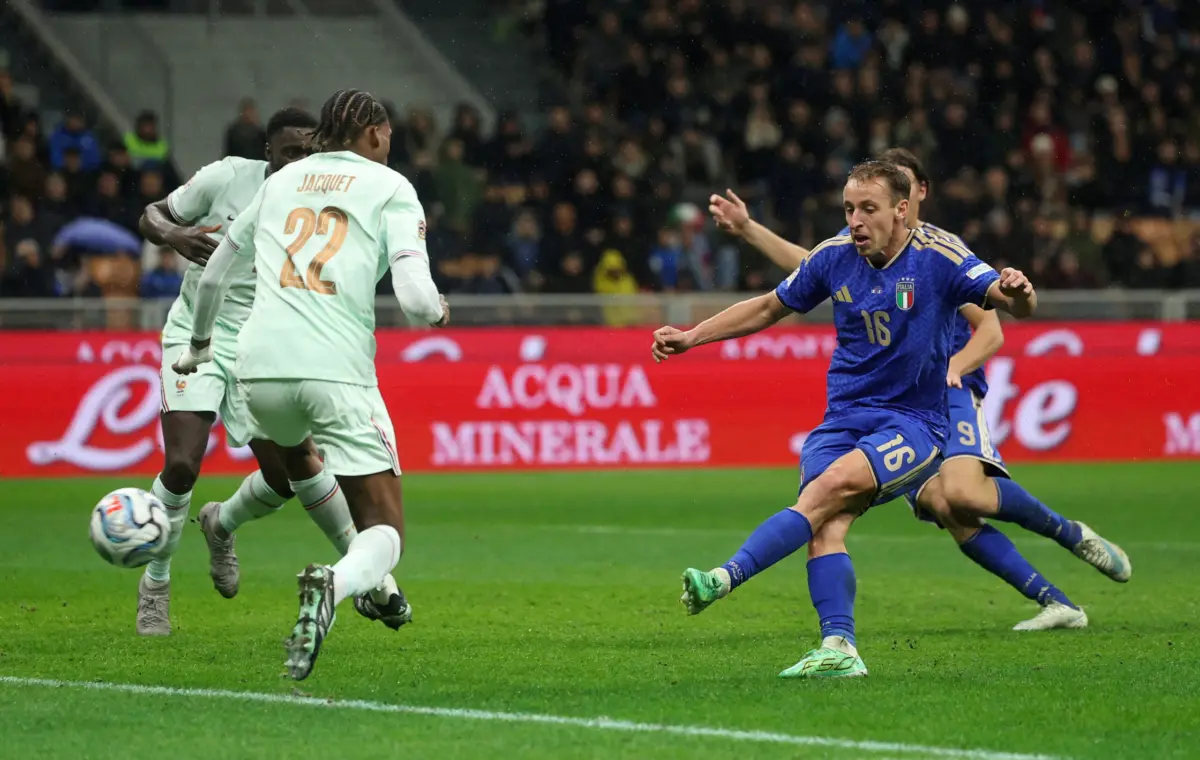
In a pulsating UEFA Nations League Group A1 encounter at a rain-soaked San Siro, Italy staged a remarkable second-half comeback to defeat France 3-1, inflicting the first defeat on Zinedine Zidane as France’s head coach and subsequently seizing control of their qualification destiny. Michael Olise initially put the visitors ahead, capitalizing on a rare error from Gianluigi Donnarumma, but a sensational double from rising star Francesco Pio Esposito and a crucial strike from Davide Frattesi propelled the Azzurri to a victory that sent them top of their group on head-to-head record.
Background and Context: The UEFA Nations League Landscape
The UEFA Nations League, established in 2018, was designed to replace often-uninspired international friendlies with competitive fixtures, providing an additional pathway to major tournaments and fostering a more dynamic international calendar. Its format divides European national teams into leagues based on their UEFA coefficient, with promotion and relegation between divisions. League A, the top tier, features four groups, the winners of which qualify for the Nations League Finals, a mini-tournament to crown the champion.
Entering Thursday’s crucial fixture, Group A1 was finely poised, featuring two of European football’s heavyweights, Italy and France, alongside Belgium and Turkiye. France, under new manager Zinedine Zidane, had enjoyed an unbeaten start to his tenure, demonstrating strong form and tactical discipline. Italy, led by Roberto Mancini in his second stint, were looking to build consistency and regain the swagger that saw them lift the Euro 2020 trophy, especially after the disappointment of missing the last two FIFA World Cups. Both teams were vying for supremacy at the top of the group, with Belgium lurking closely behind, making this match a pivotal moment in the race for the Nations League Finals.
France arrived in Milan with a formidable squad, though notably missing star attackers Kylian Mbappé and Ousmane Dembélé due to injury. These absences, while significant, also offered opportunities for other talents to step up, showcasing the depth of French football. Italy, on the other hand, presented a blend of seasoned campaigners and exciting young prospects, particularly in attack with the Esposito brothers, highlighting Mancini’s strategy of integrating youth. The historical rivalry between these two footballing giants, often marked by fierce contests and dramatic moments, added another layer of intensity to an already high-stakes encounter.
Match Chronology: A Thrilling Encounter at San Siro
The atmosphere at San Siro was electric, despite the persistent rain that swept across Milan. From the opening whistle, it was clear that both sides were committed to an attacking philosophy, setting the stage for an end-to-end spectacle.
France, eager to maintain their perfect record under Zidane, began with an assertive intensity, pressing Italy high and creating early opportunities. Within the first few minutes, Desire Doué rattled the side netting with a dangerous effort, signaling France’s attacking intent. Captain for the night, Adrien Rabiot, then tested Gianluigi Donnarumma with a well-struck shot, forcing the Italian custodian into an early save. Lucas Da Cunha followed suit, unleashing a rasping half-volley that flew narrowly wide, serving notice of France’s early dominance.
The visitors’ early pressure paid dividends in the 10th minute when Michael Olise broke the deadlock. In a moment of uncharacteristic misjudgment, Gianluigi Donnarumma attempted a short pass out from the back that went directly to Olise. The French forward, seizing the opportunity, skillfully skipped past a retreating defender before coolly slotting the ball into the net. It was Olise’s fifth goal in as many Nations League games, a remarkable individual scoring record in the competition, surpassed only by England captain Harry Kane’s seven goals. The goal stunned the home crowd and put Italy on the back foot.
Italy, initially struggling to find their rhythm against France’s energetic press, gradually began to assert themselves. Their response came in the 26th minute, courtesy of their first significant chance of the game. Nicolo Cambiaghi, demonstrating excellent wing play, drove purposefully to the byline before cutting back a precise cross into the box. There, Francesco Pio Esposito, the younger of the two Esposito siblings on the pitch, met the ball with a deft, instinctive touch, guiding it past Mike Maignan to restore parity. The goal erupted San Siro, injecting a renewed sense of belief and urgency into the Azzurri’s play.
The equalizer ignited a period of frantic, exhilarating football. Just two minutes later, Francesco Pio’s older brother, Sebastiano Esposito, threatened to complete a quickfire comeback, forcing a sharp, acrobatic save from Maignan. France, undeterred, continued to push forward. Bradley Barcola came agonizingly close to restoring France’s lead before the break, curling a shot from the edge of the box that struck the foot of the far post, leaving the score at 1-1 as the teams headed into halftime.
The second half mirrored the first in its intensity and open play. France again started brightly, with Rayan Cherki unleashing a powerful strike that Donnarumma brilliantly tipped onto the post, denying France for the second time by the woodwork. Immediately, Italy surged forward on the counter, and Maignan was called into action again, making a point-blank save from Cambiaghi to keep the scores level.
The drama escalated on the hour mark when Italy were awarded a penalty. Cambiaghi, a constant threat, was tripped by Malo Gusto inside the box. Sebastiano Esposito stepped up, aiming to join his brother on the scoresheet, but his powerful spot-kick flew wide of the target, leaving Italy frustrated and the score unchanged.
However, the Azzurri did not dwell on the disappointment for long. Just three minutes later, in the 63rd minute, Italy completed their turnaround. Federico Dimarco, having just been brought off the bench, delivered a dangerous cross into the box. Davide Frattesi, arriving with perfect timing, drilled a shot past Maignan, sending the San Siro faithful into raptures and giving Italy a hard-fought 2-1 lead.
The substitutions continued to pay dividends for Mancini. Fellow substitute Antonio Vergara, another fresh face, earned Italy a second penalty when he was tripped by Dayot Upamecano. This time, Francesco Pio Esposito stepped up, displaying composure beyond his years, and confidently drilled the ball into the bottom corner in the 80th minute, securing his brace and extending Italy’s lead to 3-1. The two-goal cushion proved decisive, allowing Italy to manage the final minutes and close out a momentous victory.
Tactical Analysis and Key Performances
Roberto Mancini’s tactical flexibility and astute use of substitutions were pivotal to Italy’s triumph. After a shaky start, Mancini’s side adapted, pushing higher and utilizing the width provided by players like Cambiaghi. The introduction of Federico Dimarco and Antonio Vergara from the bench proved to be game-changers, directly contributing to both the go-ahead goal and the insurance penalty. This depth and ability to influence the game from the sidelines underscored Mancini’s strategic prowess.
France, despite the absence of key offensive players, demonstrated their attacking pedigree. Their early dominance and the sheer number of times they struck the woodwork (three in total) suggested that on another day, the result could have been different. Zidane’s team showed flashes of brilliance, particularly in their transitional play and the individual quality of players like Olise, Cherki, and Barcola. However, defensive lapses, particularly the two penalty concessions, ultimately proved costly. This match will undoubtedly provide valuable lessons for Zidane as he continues to shape his French side.
Individually, Francesco Pio Esposito was undoubtedly the man of the match. His two goals, especially the composed penalty, showcased his burgeoning talent and composure under pressure. At just 19 years old, his performance against a team of France’s caliber signals a bright future for Italian football. Nicolo Cambiaghi’s relentless work rate and crucial assist were also instrumental, while Davide Frattesi’s timely goal underscored his importance as a dynamic midfielder. For France, Michael Olise was a constant threat, and his goal highlighted his clinical finishing. Gianluigi Donnarumma, despite his early error, redeemed himself with several crucial saves, particularly the one onto the post from Cherki, proving his mental resilience.
Broader Implications and Group Standings
The 3-1 victory sent Italy to the top of Group A1 with 10 points, level with France but ahead on their superior head-to-head record (having drawn 1-1 in the reverse fixture). Belgium are close behind with 9 points after inflicting a fifth straight defeat on rock-bottom Turkiye (who have 0 points). This result has profound implications for the final round of group games.
For Italy, this win is a massive psychological boost. It continues a strong start to Roberto Mancini’s second spell, extending their unbeaten run to four matches and, significantly, marking their first home win over France since 1962. It reaffirms their credentials as a top European side and puts them in an excellent position to qualify for the Nations League Finals, a competition they reached the semifinals of in the previous edition. The integration of young talents like the Esposito brothers and the resilience shown in coming from behind will fill Italian fans with optimism.
For France, this marks Zinedine Zidane’s first defeat as head coach, a moment that will prompt introspection. While the absences of Mbappé and Dembélé were keenly felt, the team’s inability to convert numerous chances and the defensive errors will be areas of focus. It presents Zidane with his first significant challenge in his new role, forcing him to analyze weaknesses and strategize for the crucial final group match. The loss also means France no longer control their destiny in the group, relying on other results to a certain extent.
Managerial Perspectives
While no immediate official statements were released, the implications for both managers are clear. Roberto Mancini will undoubtedly be lauded for his team’s character, tactical adjustments, and the successful integration of youth. His post-match remarks would likely emphasize the team’s fighting spirit and the importance of such a victory against a formidable opponent, while also acknowledging areas for continued improvement. The win solidifies his vision for the Azzurri.
Zinedine Zidane, on the other hand, would likely offer a pragmatic assessment. He would probably acknowledge Italy’s spirited comeback and the unluckiness of his side hitting the woodwork multiple times, but also stress the need for greater defensive solidity and clinical finishing. His focus would quickly shift to the next game, emphasizing the importance of learning from this defeat and preparing meticulously for the final group stage fixture to secure qualification.
Contextual Data: The UEFA Nations League and International Football
The evening’s results across Europe underscored the competitive nature of the Nations League. Elsewhere, England captain Harry Kane celebrated his record 126th cap for his country by scoring the match-winner from the penalty spot as England beat Croatia 2-1 at Wembley, securing their qualification for the Nations League last eight. Kane’s 92nd international goal further cemented his legendary status, surpassing Peter Shilton’s previous record for caps and extending his lead as England’s all-time top scorer. This simultaneous drama across the continent highlighted the high stakes and compelling narratives generated by the Nations League.
Looking Ahead: The Final Group Stage Matches
The stage is now set for a thrilling conclusion to Group A1. On Sunday, Italy will travel to face Belgium, who are still in contention with 9 points. A victory for Italy would guarantee their place in the Nations League Finals. Simultaneously, Turkiye will host France. France will need to win their match and hope for a favorable outcome in the Italy-Belgium clash to have any chance of progressing. The final matchday promises intense football as these European heavyweights battle for supremacy and a spot in the prestigious Nations League Finals.
