

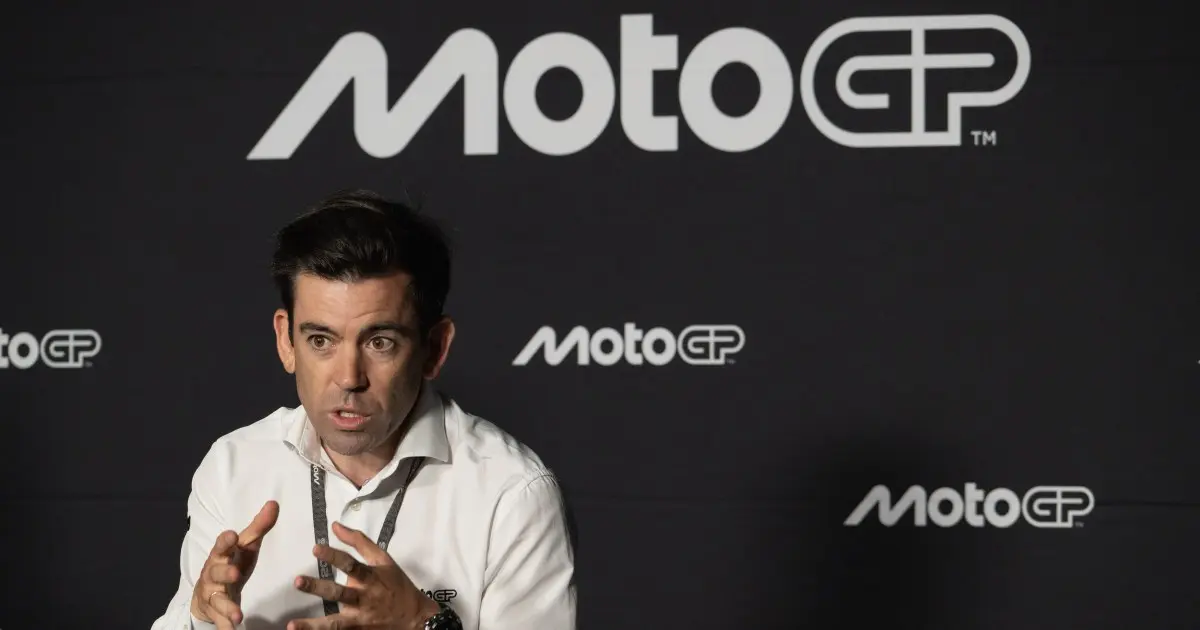
Doha, Qatar – In the wake of the contentious Qatar Grand Prix, which proceeded despite significant regional geopolitical tensions and the unprecedented withdrawal of a major manufacturer, MotoGP’s deputy chief Carlos Ezpeleta has staunchly defended the championship’s decision to hold the event. Ezpeleta acknowledged the natural concerns voiced by riders regarding travel to the Gulf but expressed surprise at Yamaha’s eleventh-hour pullout, emphasizing that the decision to race was rooted in rigorous assessments and official intelligence.
The 2026 Qatar Grand Prix, ultimately won by Aprilia Racing’s Italian rider Marco Bezzecchi, became a focal point of debate, not for its on-track action, but for the complex backdrop of security anxieties stemming from an escalating regional conflict. Ducati’s sprint winner Marc Marquez, finishing second, cemented a formidable 60-point championship lead with just two rounds remaining, yet the shadow of off-track developments loomed large over the sporting narrative.
Heightened Regional Tensions and the Postponement
The Middle East, a region pivotal to global commerce and energy, has been gripped by heightened geopolitical instability throughout 2026. The initial scheduling of the Qatar Grand Prix for April had to be abandoned as security concerns mounted, primarily driven by the intensification of the conflict involving Israel and various regional actors, and the subsequent increase in Houthi missile attacks targeting strategic assets in neighboring countries. This volatile environment had already prompted numerous international sporting and cultural events across the Gulf, particularly in Saudi Arabia, to be either postponed indefinitely or cancelled outright.
Among the high-profile casualties were several Saudi Arabian sporting events, including critical football fixtures, international tennis tournaments, golf championships, and cycling races. Most notably, the prestigious Dakar Rally 2027 was relocated out of Saudi Arabia following a series of Houthi attacks, including a significant incident on Riyadh’s international airport that reportedly resulted in 12 fatalities and over 300 injuries. These events underscored the very real and immediate threats perceived across parts of the Arabian Peninsula, creating a climate of apprehension for international travel and large-scale gatherings.
Against this backdrop, MotoGP faced immense pressure. The decision to postpone the Qatar Grand Prix from April to November 6-8 was a direct response to these escalating risks. Carlos Ezpeleta, speaking on Wednesday, revealed that the championship’s leadership had continuously monitored the situation, making it clear that a further cancellation or postponement would have been enacted had the security landscape deteriorated. “We can unequivocally say that it was the right decision to go ahead,” Ezpeleta told Reuters, highlighting the thoroughness of their safety evaluations.
MotoGP’s Rigorous Assessment and Rider Concerns
Ezpeleta detailed the exhaustive process undertaken by MotoGP to ensure the safety of all participants. The championship’s decision-making was predicated on a continuous stream of "official information" directly from the Qatari government, a key partner in hosting the event, and from various embassies with significant diplomatic representation within the MotoGP paddock. This multi-layered intelligence gathering aimed to provide the most accurate and up-to-date threat assessment, distinguishing factual intelligence from speculative reports.

“Obviously, it was normal that the riders showed their concerns,” Ezpeleta conceded. Professional athletes, like any individuals, are inherently sensitive to personal safety risks, especially when traveling to regions experiencing conflict. Reports from within the paddock indicated a significant level of anxiety among riders and team personnel in the weeks leading up to the November race date. Concerns ranged from the direct threat of missile attacks to the broader logistical challenges and psychological stress associated with operating in a conflict-adjacent zone.
Ezpeleta maintained that MotoGP management had actively worked to "mitigate those and confronted them to the best that we possibly could." While specific details of these mitigation efforts were not fully disclosed, they likely involved enhanced security protocols, regular briefings to teams and riders, direct channels for communication regarding safety updates, and assurances from Qatari authorities regarding the inviolability of the Lusail International Circuit and surrounding infrastructure. Qatar, a nation that has historically maintained a unique diplomatic stance and strong security infrastructure, provided assurances that it remained largely unaffected by the direct impacts of the Houthi attacks that plagued its Gulf neighbors. Ezpeleta noted that planning for the race had accelerated confidently after conditions reportedly improved in June and July, suggesting a period of sustained stability in Qatar itself.
“It’s just important in today’s day and age to follow official information and real intelligence versus speculation in the media and disinformation, which I think ultimately was what brought a lot of noise around the event itself,” Ezpeleta asserted, underscoring MotoGP’s reliance on verifiable facts over public conjecture.
Yamaha’s Unexpected Withdrawal
Amidst MotoGP’s assurances and the final preparations for the Grand Prix, a major disruption emerged: Yamaha’s withdrawal. The Japanese manufacturer, a cornerstone of the MotoGP championship for decades, announced its decision to pull out of the Qatar Grand Prix just days before practice sessions were due to begin. The official reason cited by Yamaha was "company-wide travel restrictions" for the Middle East. This meant that the factory Monster Energy Yamaha MotoGP team, along with any Yamaha-powered satellite entries, would not line up on the grid, reducing the competitive field to just 18 riders.
Ezpeleta did not mince words regarding MotoGP’s reaction. “I can say that the decision surprised us, given the level of detail that was put into the assessment and all the planning,” he stated. “All the questions that Yamaha had were answered.” This suggests that despite MotoGP’s efforts to address all concerns, Yamaha’s corporate risk assessment ultimately led to a different conclusion.
The implications of Yamaha’s withdrawal are multi-faceted. From a sporting perspective, the absence of a major factory team impacts the integrity of the championship, altering the competitive landscape and the distribution of points. For fans, it represents a diminished spectacle, with fewer riders and a prominent brand missing from the grid. From a commercial standpoint, such a high-profile withdrawal can raise questions about the stability and attractiveness of the championship to sponsors and broadcasters.
While Ezpeleta acknowledged Yamaha as a "great partner of the championship historically," he reiterated the surprise felt by MotoGP management. “We understand that it wasn’t a decision that was taken easily from their side, but it is a decision that was surprising to us for sure.” Yamaha’s decision likely stemmed from a broader, more conservative corporate policy regarding employee safety and liability in regions designated as high-risk, potentially overriding specific assurances related to a single event. It highlights the complex interplay between sports organizations, host nations, and global corporations in managing international events during periods of geopolitical uncertainty.
FIM’s Role and Potential Sanctions

The withdrawal of a factory team from a scheduled Grand Prix event is not without precedent, but it carries significant implications under the sporting regulations. MotoGP promptly announced that Yamaha’s non-participation would incur "sporting implications," with any consequences to be managed by the FIM (Fédération Internationale de Motocyclisme), the governing body of motorcycle racing.
Ezpeleta, however, refrained from speculating on the specific penalties Yamaha might face. “We just said that we would manage any contractual matters with Yamaha directly and any sporting conversations would be handled by FIM,” he clarified. This separation of concerns indicates that MotoGP, as the commercial rights holder, would address any breaches of commercial agreements, while the FIM would evaluate the sporting rule infractions.
Under FIM regulations, teams are generally obligated to participate in all rounds of the championship once entered. Non-participation without valid justification can lead to various sanctions, ranging from financial penalties to the loss of championship points, or even more severe measures depending on the specific circumstances and the FIM’s interpretation of the rules. Ezpeleta underscored this commitment, stating, “We continue to say that it’s a disappointment because I think one of the strengths of MotoGP as a championship is that all the riders, all the teams are committed for the full season. I would say as a rights holder that the teams are committed and obliged to show up at all the events and all races.”
Neither Yamaha nor the FIM responded to Reuters’ requests for comment on the matter, leaving the question of sanctions open. Interestingly, Yamaha’s Moto2 team did travel to Qatar, with rider Izan Guevara, who was second in the championship standings, competing in his race. However, Guevara ultimately suffered a technical issue and did not finish, adding another layer of mixed fortunes for the manufacturer in Qatar.
Communication and Future Challenges
The controversy surrounding the Qatar Grand Prix has also brought into sharp focus the critical importance of communication between MotoGP management, teams, and riders. Ezpeleta candidly acknowledged the need for improvement in this area. “We have to proactively push to improve communication, especially with the teams and the riders because they are obviously the most important part of the championship,” he admitted.
This sentiment echoes historical challenges faced by the sport in navigating sensitive geopolitical or environmental crises. Ezpeleta drew a parallel to the 2011 Japanese Grand Prix, which proceeded despite significant controversy following the Fukushima nuclear disaster. “There was a lot of controversy at the time, as was now with Qatar, guided by misinformation and speculation, rather than facts,” he recalled. “We continue to say that this was the right decision.”
The events in Qatar serve as a stark reminder of the complexities inherent in hosting global sporting events in an increasingly interconnected and volatile world. While MotoGP leadership is resolute in its defense of the decision to race, the episode highlights the ongoing challenge of balancing commercial interests, sporting integrity, and the paramount concern for human safety. It also underscores the divergent risk assessments that can arise between event organizers, governing bodies, and participating entities.
As MotoGP looks ahead, the lessons learned from the 2026 Qatar Grand Prix will undoubtedly inform future strategies for managing crises, enhancing communication, and reinforcing trust among all stakeholders. The incident reinforces the need for robust, transparent, and empathetic engagement with teams and riders, ensuring that their legitimate concerns are not only heard but also visibly and effectively addressed. The long-term implications for MotoGP’s calendar planning and its relationships with host nations in politically sensitive regions will be closely watched as the championship continues to navigate the intricate global landscape of international sport.
