

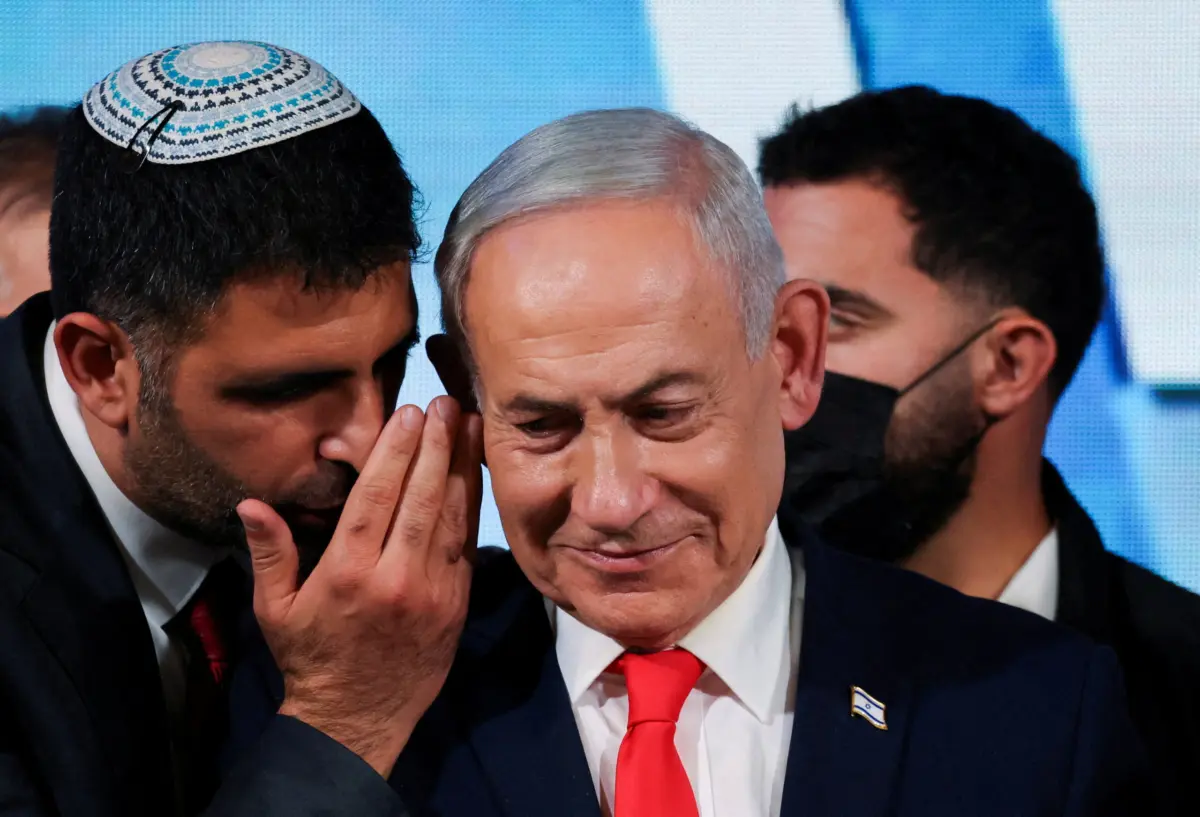
In a dramatic pivot from the acrimony that defined Israel’s October 2026 election campaign, incumbent Prime Minister Benjamin Netanyahu has unexpectedly shifted his rhetoric towards national unity. Despite his ruling coalition being decisively edged out by an opposition bloc, Netanyahu has publicly called for a broad-based government, even extending an olive branch to the very rivals he once vehemently attacked. This plea for cohesion, however, arrives shadowed by stark warnings of impending civil strife and existential threats, injecting a new layer of complexity and tension into the already volatile political landscape.
The immediate backdrop to this political maneuvering is the mandate issued by Israeli President Isaac Herzog on Saturday, October 30, 2026. Herzog formally tasked former Chief of Staff Gadi Eisenkot, leader of the centrist Yashar ("Straight") party and a prominent figure in the victorious opposition, with the arduous responsibility of forming a government capable of commanding a majority in the 120-seat Knesset. Eisenkot’s appointment marks a pivotal moment, signaling a potential end to Netanyahu’s protracted tenure and the beginning of a new political era.
Netanyahu’s Dual Strategy: Unity Calls Amidst Dire Warnings
Hours after President Herzog’s announcement, Prime Minister Netanyahu took to social media, publishing a video that painted a grim picture of Israel’s future. He claimed the nation faced a "genuine risk of civil war" if a government were to be established with the support of Arab parties, which he controversially accused of harboring intentions to "eliminate the State of Israel." This alarmist pronouncement, widely criticized by opposition figures as divisive and inflammatory, set a confrontational tone even as Netanyahu simultaneously advocated for unity.
Just two days later, on Monday, November 1, 2026, Netanyahu reiterated his theme of existential threat in a subsequent video message. He implored the leaders of the more successful opposition bloc to recognize the "needs of the hour" and join, under his leadership, a single unified government. His proposed grand coalition would include his traditional allies, the ultra-Orthodox parties, and his controversial far-right partners, Bezalel Smotrich and Itamar Ben-Gvir. This proposition highlights Netanyahu’s determination to remain at the helm, even as his political power wanes.
Daniel Levy, a former Israeli government adviser, characterized these overtures as classic political theater. "It’s all a game at the moment. It’s leverage, it’s one-upmanship, it’s psyops, it’s spin, it’s counter-spin," Levy remarked, underscoring the inherently protracted and intricate nature of Israeli coalition negotiations. Such complex horse-trading is a hallmark of Israel’s proportional representation system, which rarely yields a clear majority for any single party or bloc.
The October 2026 Election and the Path to a New Government
The October 2026 legislative elections concluded with a significant shift in parliamentary power. While specific seat allocations are still subject to final negotiations, the opposition bloc, coalescing around centrist and moderate right-wing parties, secured a plurality, surpassing Netanyahu’s Likud-led coalition. This outcome, following a campaign marked by unprecedented personal attacks and deep ideological rifts, reflected a public yearning for change amidst ongoing national crises.
President Herzog’s decision to task Gadi Eisenkot, a decorated military veteran and political newcomer in comparison to Netanyahu, with forming a government underscores the desire for a leader perceived as capable of bridging divides. Eisenkot’s Yashar party campaigned on a platform of national healing, robust security, and governmental reform, resonating with a populace exhausted by years of political deadlock and intense polarization.
For Eisenkot to succeed, he must secure the support of at least 61 members of the 120-seat Knesset. This typically involves complex negotiations, often requiring compromises on key policy issues and ministerial portfolios. The current speculation heavily centers on the role of the ultra-Orthodox, or Haredim, parties, whose bloc traditionally aligns with Netanyahu’s right-wing Likud.
The Ultra-Orthodox Kingmakers: A Shifting Allegiance?
The ultra-Orthodox parties, primarily Shas and United Torah Judaism (UTJ), have historically served as crucial kingmakers in Israeli politics. Their support for Netanyahu has often been contingent on policies safeguarding their community’s interests, most notably measures shielding young male yeshiva students from mandatory military conscription. This issue gained renewed urgency following a landmark Supreme Court ruling in June 2024, which ordered the conscription of ultra-Orthodox men, a decision that deeply unsettled their communities and threatened to unravel years of political arrangements.
Despite their traditional loyalty to Netanyahu, there are strong indications of a potential shift. United Torah Judaism (UTJ), notably, refused to endorse Netanyahu’s selection to build a government by the President, a move signaling their willingness to explore alternatives. Sources suggest that UTJ is now engaging in serious discussions with Eisenkot’s bloc. This potential realignment is reportedly being facilitated by a softening of objections from Avigdor Lieberman, a principal figure in the opposition and a long-standing nemesis of Netanyahu. Lieberman, known for his staunchly secular and nationalist stance, has historically opposed exemptions for ultra-Orthodox men and has expressed reservations about partnering with Arab parties. However, faced with the stark choice between an alliance with an Arab party or the continuation of Netanyahu’s rule and the prospect of yet another round of elections, Lieberman’s position appears to be evolving.

Israeli pollster Mitchell Barak, a former aide to Netanyahu, views the Prime Minister’s current maneuvering as a tactical response to a weakening position. "It’s political strategy, that’s all," Barak stated from Jerusalem. "But he’s negotiating from a weakened position. With the UTJ, Eisenkot’s got 67 seats," he explained, referring to the comfortable working majority Eisenkot could achieve with UTJ’s backing. "So, of course, Netanyahu’s going to do all he can to reinforce his bloc." This calculation underscores the critical nature of these negotiations, not just for the formation of a government, but for Netanyahu’s personal and political future.
The Shadow of October 7 and Calls for Accountability
The newly elected Knesset, sworn in on Tuesday, November 2, 2026, convenes under the immense shadow of the October 7, 2023, Hamas-led attack and the subsequent intense military campaign in Gaza, described by critics as a genocide, along with the multiple strikes and attacks launched by Israel on regional neighbors in the years since. Many of the incoming Members of Knesset (MKs) have direct personal ties to these events, including bereaved family members, reservists who served in the conflict, and advocates for the approximately 250 Israelis taken captive during the initial assault. Gadi Eisenkot himself lost a son and two nephews in the conflict that followed October 7, imbuing the parliamentary chamber with a palpable sense of grief, urgency, and a fervent desire for accountability.
The shared trauma and raw emotions surrounding October 7 are expected to heighten the intensity of parliamentary proceedings, particularly concerning questions of culpability and miscalculation. Attention is likely to focus sharply on Netanyahu, who faces accusations of numerous missed warnings and strategic failures leading up to the attack. Critics have also accused him of prolonging the subsequent conflict and sacrificing the welfare of the captives for his own political ends.
A key priority for the opposition bloc on the first day of parliamentary business is the installation of Matan Kahana, a member of Eisenkot’s Yashar party. Kahana is a keen advocate for a state inquiry into Netanyahu and his government’s alleged failings preceding the Hamas attack. Such an inquiry, long demanded by a significant segment of the Israeli public and political establishment, could have profound implications for Netanyahu’s legacy and potentially his legal standing.
Israeli political analyst Nimrod Flaschenberg noted the heightened emotional climate. "Having so many people connected so directly to October 7 is going to increase the temperature, but it’s become so politicized that a win for one side automatically becomes a loss for the other," Flaschenberg observed. "The bereaved family on the right can say we need to increase our militarism in honor of my son, and the bereaved family in the center says we need to enlist more people. Netanyahu can try to influence that but for the first time in a long time, he seems a bit lost."
Netanyahu’s Personal Stakes and Legal Jeopardy
Beyond the political struggle for power, Netanyahu faces significant personal challenges that are inextricably linked to his hold on office. Foremost among these are the multiple corruption charges for which he is currently on trial. These charges, involving allegations of bribery, fraud, and breach of trust, threaten his political legacy and personal freedom. While he has consistently maintained his innocence and even preemptively petitioned President Herzog, his former political rival, for clemency, losing the premiership would strip him of any political leverage that might influence the judicial process.
Secondly, and perhaps more pressingly in the current climate, is the question of his and his government’s culpability for the alleged failings ahead of the October 7 attack. An official state inquiry, if established under a new government, could expose systemic failures and assign responsibility, potentially leading to widespread public condemnation and further legal challenges for the former prime minister.
Implications for Israel’s Future
The current political deadlock and intense negotiations are regarded by many as critical to Netanyahu’s personal future, but also to the broader stability and direction of Israel. His claims of a pending civil war or destruction at the hands of regional adversaries, while viewed by some as political ploys, highlight the profound divisions within Israeli society. Ultimately, Netanyahu’s political and potentially personal fate now rests with an opposition that numerically outstrips his own and a volatile Knesset eager to scrutinize the mistakes of the past.
Daniel Levy succinctly summarized the prevailing sentiment within the opposition: "There’s no appetite on the other side to go in with Netanyahu for a unity government." He further speculated on the extreme conditions under which such an alliance might materialize: "The only real circumstances under which that happen is if he can create a security emergency." This chilling assessment follows recent reports in the UK press indicating daily phone calls from Netanyahu to the Trump administration, urging a renewed war on Iran, suggesting a desperate attempt to manufacture a crisis that could justify a national unity government under his continued leadership.
The formation of a new government under Gadi Eisenkot would usher in a period of intense scrutiny and potential reform. An inquiry into October 7, coupled with the enforcement of ultra-Orthodox conscription, would represent significant departures from the status quo maintained under Netanyahu. Such changes, while potentially healing some societal wounds, could also deepen existing fissures, particularly between secular and religious communities. The coming weeks will determine whether Israel embarks on a path of national reconciliation and accountability or remains ensnared in cycles of political instability and existential anxieties.
