

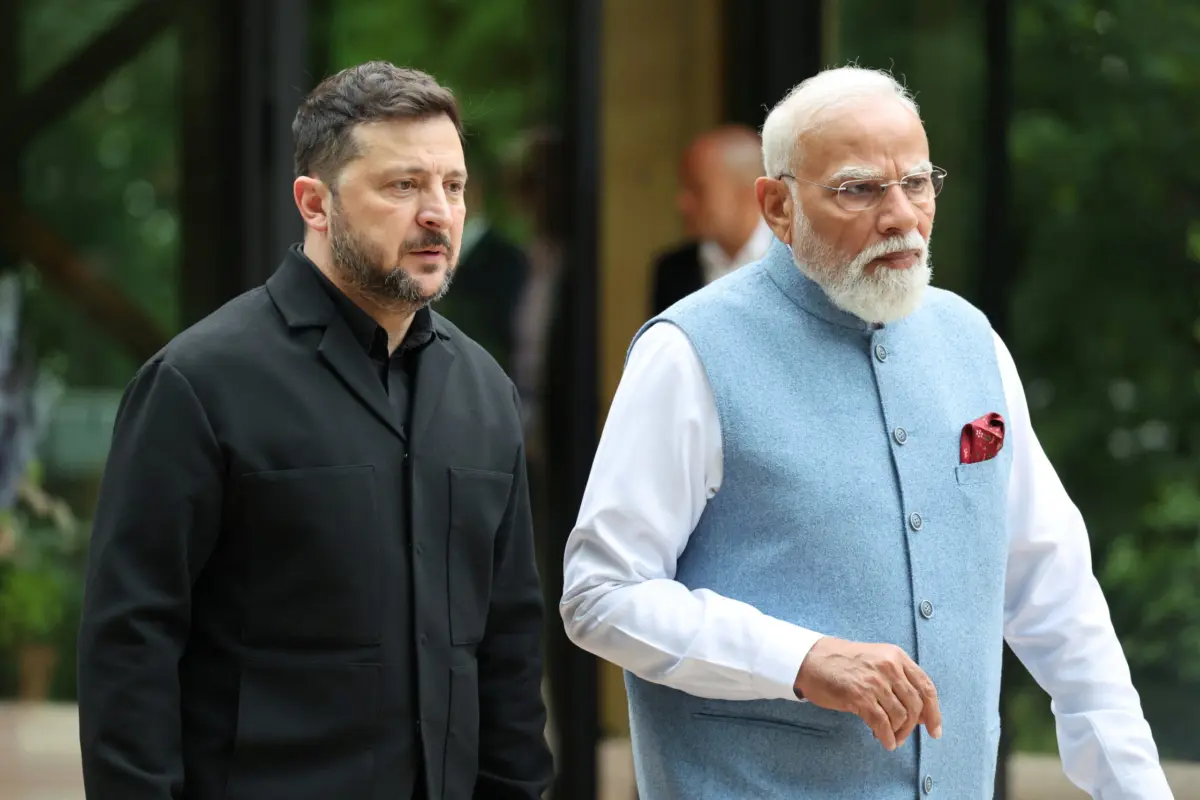
Ukrainian President Volodymyr Zelenskyy announced on Monday that India stands ready to help broker "food corridors" through the Black Sea, following a pivotal phone call with Indian Prime Minister Narendra Modi. This significant development precedes United States-mediated talks in Abu Dhabi, where Russian and Ukrainian delegations are set to reconvene after a nine-month diplomatic hiatus. Hours after the conversation between the two leaders, India’s External Affairs Minister Subrahmanyam Jaishankar engaged in discussions with his Russian counterpart, Sergey Lavrov, underscoring New Delhi’s increasingly active role in a conflict that has profoundly impacted global food security.
The Black Sea region has become a flashpoint in the ongoing conflict, with both Russia and Ukraine targeting one another’s port infrastructure. These assaults have severely disrupted the flow of essential grain and oilseed exports, which are vital for numerous import-dependent nations, particularly across Africa and South Asia. The ripple effects have been felt acutely in India, which has faced shortages and price volatility, especially for sunflower oil, a key commodity in its vast edible oil market. India’s offer marks a notable shift from its previously more reserved stance, signaling a strategic intent to leverage its unique diplomatic position.
India’s Emergent Diplomatic Role
For much of the conflict, India has navigated a complex geopolitical landscape, balancing its long-standing strategic ties with Russia with its burgeoning partnerships with Western nations. Its initial approach was characterized by "rhetorical calls for diplomacy and dialogue," as noted by Praveen Donthi, senior India analyst at the International Crisis Group. However, recent months have seen a discernible pivot towards more proactive engagement. This was evident during Jaishankar’s visit to Kyiv in September, a trip that laid the groundwork for discussions on potential de-escalation measures affecting Black Sea shipping and energy infrastructure.
The Indian proposal, though not formally published by New Delhi, has been floated by officials for several weeks. It reportedly encompasses a potential pause on strikes against Black Sea shipping and energy infrastructure, a comprehensive approach that Kyiv has found particularly appealing. Ukrainian Foreign Minister Andrii Sybiha characterized India’s proposal as "the broadest" among the four ceasefire proposals received by Kyiv, which also included overtures from Turkiye, Egypt, and the United States. While the US plan reportedly focuses solely on halting strikes on energy facilities, Ukraine insists on a combined truce covering both energy and Black Sea routes. Russia, conversely, has consistently rejected partial ceasefires, demanding a comprehensive peace agreement.
The Criticality of Black Sea Exports for Global Food Security
Before Russia’s full-scale invasion in February 2022, the Black Sea served as a crucial artery for global agricultural trade. Approximately one-third of the world’s grain exports transited through its waters, with Ukraine alone accounting for about a tenth of global wheat exports and 15 percent of maize. The disruption of these supply lines has had a cascading effect on international markets, contributing to significant spikes in global food prices and exacerbating food insecurity in vulnerable regions. The FAO Food Price Index, which tracks international prices of a basket of food commodities, saw record highs in 2022 following the initial invasion, although it has since moderated, the underlying vulnerabilities remain.
The Black Sea has effectively transformed into a two-way port war zone. Russia has escalated its attacks on Ukraine’s Odesa ports, which traditionally handle around 90 percent of Ukraine’s grain shipments. In retaliation, Ukraine has targeted Russian grain terminals. This intensified maritime conflict has crippled export capacities. By mid-August, attacks had reportedly shut down over 97 percent of Russia and Ukraine’s grain export capacity in the Azov and Black Sea basin, according to Reuters. Ukraine’s Ministry of Agriculture, in August, slashed its forecast for 2026-27 agricultural exports by more than half, to approximately 29.6 million tonnes, as reported by RBC-Ukraine, signaling the severe long-term impact on its agricultural sector and global supply.
Anatomy of the Previous Black Sea Grain Initiative
The most significant attempt to mitigate this crisis was the Black Sea Grain Initiative (BSGI), brokered by the United Nations and Turkiye in July 2022. This agreement allowed for the safe passage of nearly 33 million tonnes of foodstuffs from three Ukrainian ports (Odesa, Chornomorsk, and Pivdennyi) over a year. The BSGI was hailed as a vital mechanism for stabilizing global food markets and preventing humanitarian catastrophes. Under its framework, joint inspection teams, comprising representatives from Russia, Ukraine, Turkiye, and the UN, were established in Istanbul to monitor cargo vessels, ensuring they carried only authorized goods.
However, Russia withdrew from the initiative in July 2023, citing several grievances. Moscow argued that the deal was not fulfilling its original humanitarian purpose, claiming that a disproportionate amount of grain was reaching high-income countries rather than the most vulnerable. Crucially, Russia also contended that parallel agreements designed to facilitate its own agricultural and fertilizer exports were not being honored due to Western sanctions impacting banking, insurance, and logistics. Russia specifically highlighted the stalled progress on reconnecting its agricultural bank, Rosselkhozbank, to the SWIFT international payment system and the lack of guarantees for the safe passage of Russian ammonia through a pipeline to Odesa. The collapse of the BSGI immediately led to renewed uncertainty in global food markets and a surge in commodity prices.
Direct Economic and Human Stakes for India
India’s burgeoning interest in mediating the Black Sea conflict is not purely altruistic; it is also driven by direct economic and human costs. On November 3, India’s Ministry of External Affairs confirmed that five Indian nationals had been killed and two were missing in attacks on commercial vessels in the Black Sea, underscoring the severe human toll of the conflict on international shipping.
Economically, India is the world’s largest importer of vegetable oils, with a significant portion of its sunflower oil supply originating from Russia and Ukraine. The disruptions have hit India hard. Its edible oil imports collectively fell by 7 percent in September. More specifically, sunflower oil imports plummeted to 108,837 tonnes that month, the lowest figure since April 2022, according to Reuters. The logistical nightmare extends to canceled and delayed shipments; in October, a 20,000-tonne Russian cargo bound for India was canceled due to port infrastructure damage, with an additional 60,000 tonnes facing delays. Maximilian Hess, a fellow at the Foreign Policy Research Institute, highlighted this direct impact, stating, "For India, this is a priority because this has caused fluctuations in grain prices and increases. So there’s an alignment there."
Geopolitical Imperatives and Global Standing
Beyond immediate economic and humanitarian concerns, India’s proactive diplomatic push carries significant geopolitical weight. India’s unique position as one of the few major global powers maintaining working relationships with both Moscow and Kyiv offers it a rare window of opportunity for mediation. This "strategic autonomy" allows New Delhi to engage both sides, a factor that Ravi Joshi, a visiting fellow at the Observer Research Foundation and former civil servant, believes puts India in a strong position to advocate for peace.

Furthermore, India seeks to enhance its global prestige and diplomatic credibility. As Praveen Donthi of the International Crisis Group pointed out, India has faced criticism, including from figures like former US President Donald Trump, for its continued purchases of Russian oil, which some argue indirectly funds Russia’s war efforts. By actively mediating with concrete proposals, India aims to "gain geopolitical heft and credibility that might blunt some of the unwarranted criticism it received in the recent past," thereby adding "to its global prestige after having lost some sheen in the past year." India’s recent G20 presidency also saw it championing issues of global concern, including food security, further cementing its desire to play a constructive role on the world stage.
India’s Unique Position as a Credible Broker
India’s credibility as a potential broker is buttressed by several factors. Its non-aligned foreign policy tradition, often described as "multi-alignment" in the contemporary context, allows it to engage with various power blocs without being perceived as fully aligned with any single one. This neutrality has been demonstrated through its even-handed responses to maritime incidents in the Black Sea. In July, India summoned Moscow’s charge d’affaires to condemn a Russian strike on a merchant vessel that resulted in the deaths of 10 people, including four Indian crew members. Days later, it summoned Ukraine’s ambassador over the killing of an Indian seafarer in a Ukrainian drone strike on the MV Omorfi, as reported by PTI. Such actions reinforce its commitment to protecting its citizens and upholding maritime safety irrespective of the aggressor.
Economically, India is a crucial customer for both warring nations. In the 2025-26 marketing year, India imported a substantial 1.46 million tonnes of sunflower oil from Russia and 443,000 tonnes from Ukraine, according to the Indian Solvent Extractors’ Association (SEA). This significant trade volume, alongside large imports of Russian crude oil, gives India considerable leverage. Hess noted that Zelenskyy’s outreach to India was partly because "they have leverage over Moscow, and they are one of the few major buyers of its oil still." He also highlighted that "a large amount of Russian money sits in the Indian financial system, which Moscow wants to keep access to," providing further economic incentive for Russia to engage with Indian mediation efforts.
Formidable Obstacles and Competing Proposals
Despite India’s unique advantages, significant hurdles stand in the way of a successful mediation. Foremost among these is the lack of explicit public confirmation from New Delhi regarding the specific "food corridors" offer. Prime Minister Modi’s statement after his call with Zelenskyy was notably more circumspect, only reaffirming India’s commitment to contributing "in every possible way" towards a peaceful resolution, without mentioning food corridors or the Black Sea directly. This ambiguity leaves India’s firm commitment open to interpretation.
Ukraine itself harbors doubts about India’s neutrality, particularly regarding its continued purchases of Russian oil. Kyiv has repeatedly pressed New Delhi on this issue, a point that Jaishankar defended during his September visit, arguing that India’s energy needs would not dictate the course of the war. Hess observed that Zelenskyy’s engagement with India might also be a strategic move "to show India that it should perhaps revisit the state of its partnership with Moscow" and demonstrate "that Russia isn’t a trustworthy partner."
Logistically, India lacks a physical foothold in the Black Sea region, a critical element that facilitated the success of the 2022 grain deal. That initiative heavily relied on Turkiye, which controls access to the Black Sea through the Bosphorus Strait and hosted the joint inspection center in Istanbul. Any new corridor would necessitate a complex international framework involving ships, insurers, and inspection mechanisms that India cannot provide unilaterally.
The diplomatic field is also crowded. Turkiye, Egypt, and the US have all put forward proposals, and the upcoming Abu Dhabi talks are explicitly described by the Kremlin as trilateral, with Washington as the sole mediator. This multiplicity of initiatives could dilute the impact of any single proposal.
Crucially, the current intensity of the conflict poses a stark challenge. Unlike in 2022, Ukraine is now also actively striking Russian grain terminals, signaling an escalation in maritime warfare. Russia, for its part, unilaterally withdrew from the last grain deal, indicating a hardening stance. Hess pointed out that earlier attempts towards a standalone corridor failed "because Russia kept attacking Ukrainian ports," and that shipping only recovered when Ukraine effectively used naval drones to push Russia’s fleet away, illustrating the volatile and unpredictable nature of the conflict zone.
The Path Forward: Diplomacy Amidst Escalation
As Russian and Ukrainian delegations prepare to meet in Abu Dhabi, the core issue of territorial claims remains an insurmountable obstacle to a comprehensive peace agreement. Joshi noted that such territorial matters are "impossible to negotiate" at this stage. Hess further analyzed that Russia’s engagement in negotiations often serves "alternate aims other than an actual deal, but rather to affect the thinking and the positioning of other countries." He suggested that Russia’s purpose in engaging with Europe and the United States is primarily "to divide and conquer," while for Ukraine, it is "about trying to make others see the Russians as acting in bad faith."
With troop casualty numbers reportedly at record highs, Moscow may also be facing mounting domestic pressure, potentially influencing its diplomatic calculus. However, Russia has yet to offer any significant concessions, and has, in fact, increased its demands in certain areas. This intransigence, coupled with Ukraine’s unwavering stance on territorial integrity, suggests that any breakthroughs on broader peace remain distant.
Broader Implications for Global Stability and Food Markets
Should India succeed in brokering even a temporary Black Sea food corridor, the implications would be far-reaching. It would offer a much-needed reprieve for global food markets, potentially stabilizing prices and ensuring vital supplies reach vulnerable populations. For India, it would solidify its position as a serious and constructive player in global diplomacy, further elevating its status on the international stage and reinforcing its vision of a multipolar world order.
However, the fragility of such agreements in the face of ongoing hostilities remains a significant concern. The collapse of the previous BSGI serves as a stark reminder that without a fundamental shift in the conflict dynamics or a comprehensive peace settlement, any corridor arrangement is inherently vulnerable to renewed military action. The current diplomatic efforts, including India’s, are therefore not just about food security, but also about testing the limits of international mediation in a deeply entrenched and escalating conflict. The world watches closely to see if India’s diplomatic weight can indeed open a crucial humanitarian lifeline through the contested waters of the Black Sea.
