

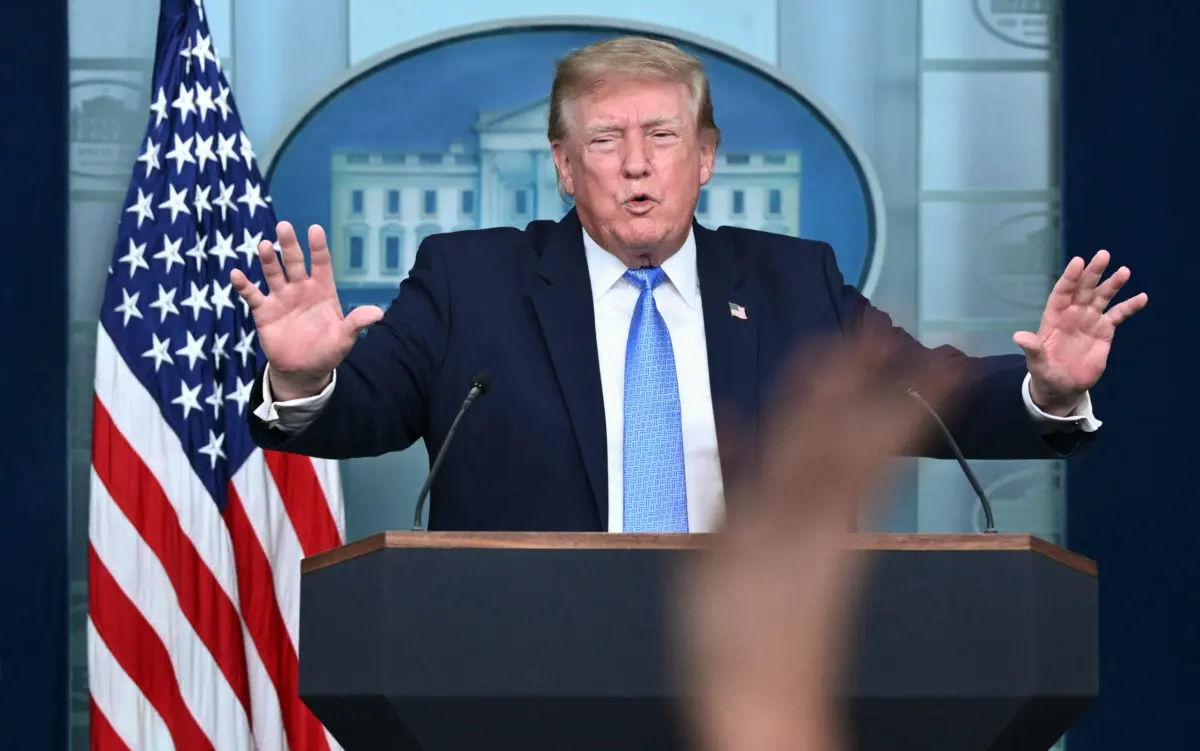
United States President Donald Trump has signaled a significant shift in rhetoric regarding the US-Israeli military campaign against Iran, declaring the conflict "effectively over" following discussions with Qatari mediators. However, this pronouncement is tempered by the simultaneous reaffirmation of a stringent naval blockade and the launch of new initiatives aimed at crippling Iranian trade, indicating a complex and potentially volatile "status quo" rather than a definitive cessation of hostilities. The declaration, made during a surprise briefing on Monday, arrives amidst intense regional pressure and a backdrop of nearly nine months of sporadic but impactful conflict that has destabilized the Middle East and roiled international commerce.
A Declaration of Victory, A Continuation of Pressure
President Trump’s remarks presented a dual message: a claim of decisive military victory against Iran, coupled with a commitment to maintain significant economic pressure at the behest of regional allies. "Iran, militarily, is effectively over. We’re just keeping it the status quo," Trump stated, asserting that the US had successfully dismantled Iran’s military capabilities. He clarified that this "status quo" would entail the continuation of the existing US naval blockade against Iranian ports, a measure that has severely restricted the Islamic Republic’s maritime trade. Furthermore, Trump announced the establishment of "Task Force Iron Gate," a new initiative designed to further choke off Iranian commerce by land and through the vital Caspian Sea.
The President attributed the decision to maintain this coercive posture to the preferences of key Arab partners in the region. "We’re doing that really at the behest of countries that are their neighbours," he explained. He explicitly named Qatar, Saudi Arabia, the UAE, Bahrain, and Kuwait as nations preferring "a continuation of the greatest naval blockade in the history of our country. Probably in the history of the world." This emphasis on allied interests underscores the intricate geopolitical calculations influencing US policy in the region, particularly the long-standing rivalry between Iran and its Gulf Arab neighbors.
Qatari Diplomacy: A Bridge in Troubled Waters
Trump’s statements followed a crucial meeting at the White House with Qatari Prime Minister and Foreign Minister Mohammed bin Abdulrahman bin Jassim Al Thani, who has emerged as a pivotal intermediary in the protracted conflict. Vice President JD Vance also participated in the high-level discussions, which focused extensively on the Iran conflict. The Qatari Prime Minister, in a social media post after the meeting, expressed gratitude "for the positive discussions on reaching a deal and bringing peace to the region," hinting at substantive progress behind closed doors.
Qatar’s role as a mediator is not new; the gas-rich Gulf state has historically positioned itself as a diplomatic bridge-builder in a turbulent region, often maintaining lines of communication with parties estranged from the West, including Iran. Its capital, Doha, has frequently hosted sensitive negotiations. In Monday’s closed-door meeting, Prime Minister Al Thani reportedly presented Trump with a "two-day framework" from Iran outlining conditions to end the war, signaling a potential, albeit fragile, pathway to de-escalation. This initiative highlights the critical need for third-party diplomacy to navigate the deep-seated mistrust and maximalist demands characterizing the US-Iran relationship.
Iranian Defiance and Conditions for Peace
While President Trump declared the conflict "effectively over," Iranian officials vehemently rejected his assessment, dismissing his remarks as a "distraction" and a sign of Washington’s desperation. Mohsen Rezaei, Secretary of Iran’s Supreme National Security Council, took to social media to lambaste the US position. "The war on Iran has already wrecked the US government. But Washington flails like a desperate gambler," Rezaei wrote, adding a defiant call: "FOLD YOUR HAND. STOP manufacturing FAKE NEWS about imaginary talks."
Separately, through Iran’s state-aligned Tasnim News Agency, Iranian President Masoud Pezeshkian conveyed that Supreme Leader Mojtaba Khamenei had called for an end to the current situation, which he characterized as "neither war nor peace." Pezeshkian reiterated Iran’s openness to further negotiations but stressed that the Islamic Republic would not be coerced into submission. "We will not surrender to force and bullying," he asserted, reflecting Tehran’s long-standing policy of resisting external pressure.
Iran has put forth seven conditions for ending the conflict, which underscore its comprehensive demands for a return to pre-conflict stability and economic normalcy. These conditions include the complete lifting of the US naval blockade, reparations for war-related damage incurred during the nine-month conflict, an end to all sanctions against its economy, and a cessation of hostilities across all fronts, encompassing related conflicts in Lebanon and Gaza. These demands represent a significant hurdle for any potential peace deal, as they require substantial concessions from the US and its allies.
A Timeline of Escalation and Entrenchment
The conflict, which the original report dates to February 28, has seen a rapid escalation and broadening of fronts, transforming into a multifaceted regional crisis.
- February 28: The "war on Iran" officially begins with US and Israeli attacks. While the specific triggers for this date are not detailed, it likely followed a period of heightened tensions and punitive measures.
- Initial Iranian Response: Almost immediately following the onset of US and Israeli strikes, Iran moved to shut down the Strait of Hormuz. This critical chokepoint, through which approximately one-fifth of the world’s total oil consumption and a significant portion of liquefied natural gas (LNG) passes, became a primary strategic target for Tehran to exert pressure on global energy markets and international shipping.
- Retaliatory Strikes: Iran responded to US and Israeli attacks with missile and drone fire targeting US military installations and interests in neighboring countries such as Qatar, Bahrain, Kuwait, and the UAE. These retaliatory strikes highlighted the risk of broader regional conflagration and placed US forces in the Gulf under direct threat.
- June 2025 – The Twelve-Day War: This specific period marked a more intense phase of the conflict. Following this engagement, President Trump claimed that Iran’s uranium enrichment program had been "obliterated." However, the subsequent re-emphasis on "curtailing Iran’s nuclear program" as a central premise for the ongoing war suggests either that the obliteration was not complete, or that the objective has shifted from destruction to containment and verification. Iran has consistently denied seeking nuclear weapons, maintaining that its uranium enrichment activities are solely for civilian energy generation purposes, a claim met with skepticism by the US and Israel.
- Emergence of Related Conflicts: The US-Iran conflict has also fueled pre-existing regional tensions. Saudi Arabia, a staunch rival of Iran, renewed its fighting with the Iran-backed Houthi movement in Yemen, adding another layer of complexity to the regional security landscape. Concurrently, Israel began its occupation of southern Lebanon, accompanied by deadly airstrikes, extending its long-standing conflict with Hezbollah, another Iranian-allied group. This expansion of fronts demonstrates the interconnected nature of regional proxy conflicts.
- Recent Developments (November 2026): In the days leading up to Trump’s briefing, the US offensive against Iran had grown more sporadic. Recent actions included "minor strikes" against Iran’s Qeshm Island, as confirmed by the Trump administration on November 7, 2026. Furthermore, a substantial $20 million reward was offered for "information about Iran’s nuclear program, including its facilities, equipment, and associated personnel," underscoring the enduring US concern about Tehran’s nuclear capabilities despite earlier claims of their obliteration. These intermittent actions indicate a strategy of sustained pressure rather than outright military withdrawal.
The Geopolitical Chessboard: Regional Dynamics and Allies’ Influence
The intricate web of regional alliances and rivalries plays a crucial role in shaping the conflict’s trajectory. The preference of Gulf Arab states—Saudi Arabia, UAE, Bahrain, Kuwait, and even Qatar (despite its mediating role)—for the continuation of the naval blockade is rooted in their long-standing apprehension about Iranian regional influence. These nations view Iran as a primary threat to their security and stability, citing its ballistic missile program, support for proxy groups, and alleged efforts to destabilize neighboring governments. For them, a robust US presence and economic pressure campaign against Iran serve as a critical bulwark against perceived Iranian expansionism. The blockade, in their view, degrades Iran’s economic capacity to fund such activities and project power.
Israel’s actions, particularly its occupation of southern Lebanon and airstrikes, demonstrate its parallel, and sometimes independent, strategic objectives. Israel views Iran as an existential threat, primarily due to its nuclear program ambitions and its support for groups like Hezbollah on Israel’s northern border. The ongoing operations in Lebanon are likely aimed at degrading Hezbollah’s capabilities and pushing its forces away from the Israeli border, aligning with Israel’s broader strategy of pre-emptive or retaliatory action against Iranian proxies.
President Trump’s framing of the continued blockade as a matter of "regional security" for US allies highlights the delicate balance he seeks to strike: appearing to de-escalate militarily while reassuring partners that their security concerns are still being addressed. "We have some great allies there, and we have to make sure they’re not hurt, and they would be hurt," he said, emphasizing that while "Iran’s been very much decapitated," it remains "the bully of the Middle East a little bit." This acknowledges the lingering threat perception among allies, justifying continued economic pressure.
Economic Repercussions and Global Impact
The nearly nine-month conflict and the sustained US naval blockade have had profound economic repercussions, both for Iran and the global economy. For Iran, the blockade, intensified by the newly announced Task Force Iron Gate targeting land and Caspian Sea trade, represents a comprehensive economic siege. The Strait of Hormuz shutdown significantly impacted Iran’s ability to export oil, its primary revenue source, leading to severe economic contraction, currency devaluation, and increased hardship for its population. The ongoing sanctions, including those targeting its financial and energy sectors, have further isolated Iran from the global economy, limiting its access to essential goods and technologies.
Globally, the conflict has injected significant volatility into energy markets. The threat or actual disruption of oil transit through the Strait of Hormuz invariably sends crude oil prices soaring, impacting consumers and industries worldwide. International shipping companies face increased insurance premiums and logistical challenges, leading to higher costs for goods and services. The uncertainty generated by the "neither war nor peace" scenario deters foreign investment in the region and disrupts established trade routes, contributing to global economic instability. The humanitarian impact within Iran, stemming from economic sanctions and trade restrictions, also raises concerns, potentially leading to shortages of medicine and food.
Analysis: A Volatile "Status Quo" or De-escalation?
President Trump’s declaration that the war is "effectively over" while simultaneously vowing to maintain and even intensify economic pressure presents a paradoxical strategic posture. This "status quo," characterized by a severe blockade and intermittent military strikes, is not a traditional end to conflict but rather a state of perpetual low-intensity confrontation.
The phrase "neither war nor peace," echoed by Iran’s Supreme Leader, precisely captures this precarious balance. It suggests a situation where direct, large-scale military engagements might be curtailed, but the underlying tensions and coercive measures remain. This approach carries inherent risks:
- Risk of Miscalculation: A continued blockade, especially with new measures like Task Force Iron Gate, could provoke Iran into unpredictable counter-actions, potentially triggering renewed military escalation.
- Sustainability of Pressure: While effective in the short term, the long-term sustainability of such an intense economic pressure campaign without a clear diplomatic off-ramp is questionable. Iran has historically shown resilience in the face of sanctions.
- Erosion of International Norms: The legality and broad international acceptance of such extensive blockades, particularly those impacting civilian trade, could be challenged, leading to diplomatic friction with other global powers.
- Humanitarian Concerns: Prolonged economic hardship due to sanctions and blockades can exacerbate humanitarian crises, potentially leading to regional instability through population displacement or unrest.
- The Nuclear Question: Despite Trump’s earlier claim of obliterating Iran’s nuclear program, the ongoing war’s premise is still curtailing it. This shifting narrative, coupled with the $20 million reward for information, indicates that the nuclear issue remains unresolved and a significant flashpoint.
From an analytical perspective, Trump’s statements could be interpreted as a strategic move to de-escalate a costly military engagement while preserving leverage. By declaring victory, he might seek to appease domestic audiences and fulfill a campaign promise, while the continued pressure satisfies regional allies and aims to compel Iran into negotiations on terms favorable to the US. However, the lack of a clear, long-term ceasefire commitment—as Trump himself stated, "I don’t guarantee anything… But if we do have to go back in, we are locked and loaded and ready to go"—underscores the inherent volatility of this "status quo."
The Path Forward: Diplomatic Deadlock or Breakthrough?
The current situation is a high-stakes diplomatic deadlock. Iran’s seven conditions for peace are comprehensive and demanding, requiring a complete reversal of US policy. The US, backed by its Gulf allies, seems committed to maintaining significant pressure, believing it has achieved military superiority and can dictate terms. The role of mediators like Qatar becomes even more critical in this environment. Their ability to shuttle proposals and interpret intentions between Washington and Tehran could be the only avenue for preventing further escalation.
The "two-day framework" presented by Qatar offers a glimmer of hope, but its details and the extent of concessions both sides are willing to make remain opaque. A genuine breakthrough would require a fundamental shift in approach from both the US and Iran: the US needing to offer a credible path to sanctions relief and a verifiable end to the blockade, and Iran needing to demonstrate verifiable commitments regarding its nuclear program and regional activities. Without such a shift, the region risks being trapped in a prolonged state of "neither war nor peace," with continuous tension, sporadic violence, and profound economic disruption as the new normal. The global community watches with apprehension, recognizing that stability in the Middle East has far-reaching implications for international security and prosperity.
