

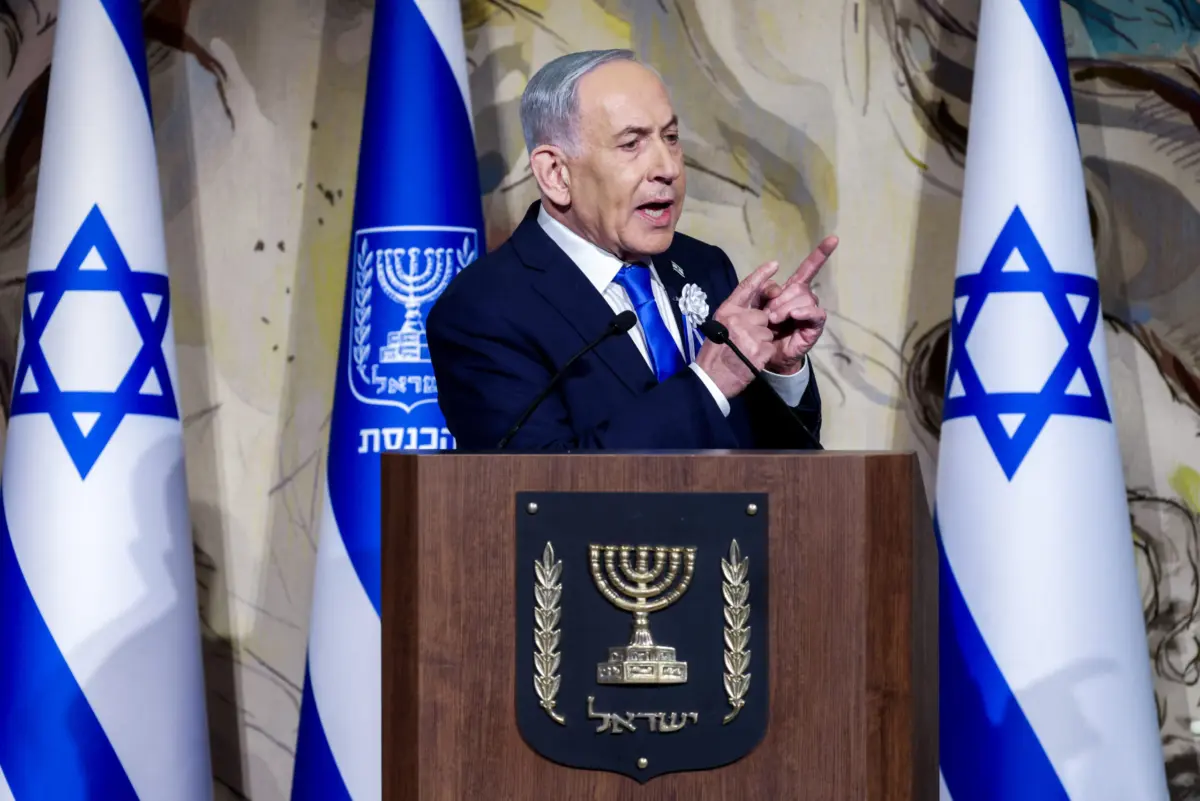
During the tumultuous swearing-in of Israel’s new parliament, the Knesset, on Tuesday, Prime Minister Benjamin Netanyahu issued a fervent call for a national unity government, specifically among Jewish Israelis, a strategic maneuver widely interpreted as an attempt to retain his grip on power. This appeal was met with immediate and vocal derision from the opposition bloc, which now holds a majority of seats but has yet to successfully form a government, manifesting in a cacophony of heckles, catcalls, and symbolic walkouts that underscored the profound divisions scarring Israeli politics.
Netanyahu predicated his plea for unity on what he described as pressing internal and external threats facing the nation. He explicitly cited the existential danger posed by Iran, a long-standing point of consensus across much of the Israeli political spectrum. However, his rhetoric quickly veered into contentious territory as he turned his attention inward, highlighting the increased representation of democratically elected Palestinian citizens of Israel in the Knesset. Without offering substantiating evidence, Netanyahu accused these lawmakers of harboring intentions to dismantle the state of Israel, a charge that immediately inflamed an already tense atmosphere and further alienated potential partners.
"We must do one thing – set aside every other consideration and form a national unity government. Only such a government will be able to meet challenges of this magnitude. It is impossible to handle them with a narrow government," Netanyahu declared, alluding to the precariousness of a potential minority government, a scenario many political analysts deem highly probable following the anticipated conclusion of protracted coalition negotiations. He further warned, "I say this because here in this parliament they are seriously talking about forming a narrow government like this, a government that includes within it terror supporters, haters of Israel, or that would be dependent on them," directly referencing the parties representing Palestinian citizens of Israel. This thinly veiled accusation drew immediate condemnation from across the political aisle, solidifying the opposition’s resolve against any alliance with the veteran leader.
A Tumultuous Inauguration and Immediate Repercussions
The Knesset’s swearing-in ceremony, traditionally a moment of solemn democratic transition, devolved into an unusually acrimonious spectacle, even by the often-contentious standards of Israeli politics. Analysts frequently observe that personality has long eclipsed party and policy in the Israeli political landscape, a trend that reached a zenith on this particular Tuesday. The session was punctuated by heated exchanges, epitomized by former Prime Minister Naftali Bennett, who was seen heckling Netanyahu and trading barbs with his wife, Sara, and his far-right ally, Itamar Ben-Gvir, known for his provocative rhetoric. Simultaneously, many of the Palestinian lawmakers, the direct targets of Netanyahu’s inflammatory accusations, staged a collective walkout in a powerful act of protest, leaving visible gaps in the parliamentary chamber.
The immediate aftermath of the session saw a significant political fallout. Gadi Eisenkot, the centrist former military chief who had been entrusted by Israel’s President with the initial mandate to form a new government following the indecisive election, swiftly cancelled previously scheduled coalition talks with Netanyahu. In a decisive statement, Eisenkot publicly declared Netanyahu "unfit for office," a pronouncement that delivered a severe blow to the embattled Prime Minister’s dwindling hopes of remaining in power. This move underscored the deep chasm of distrust and animosity that now separates Netanyahu from key figures in the opposition, making any prospective unity government involving him an increasingly remote possibility.
Background and Chronology of Political Stalemate
Israel’s political system, a parliamentary democracy, has been mired in an unprecedented period of instability, marked by a series of inconclusive elections. The recent election was the fifth national vote in less than four years, a stark indicator of the deep-seated divisions and an inability of political factions to forge stable governing coalitions. This cycle of elections has consistently failed to produce a clear majority for either the bloc supporting Netanyahu or the diverse coalition of parties committed to replacing him.
Following the latest electoral results, which once again left no single party with a clear path to forming a government, President Isaac Herzog initiated the traditional consultations with all elected party leaders. After careful deliberation, Herzog formally tasked Gadi Eisenkot, leader of the centrist National Unity party and a respected former Israel Defense Forces (IDF) Chief of Staff, with the critical mission of assembling a new governing coalition. This decision was a direct blow to Netanyahu, who had led the largest party, Likud, but lacked a viable path to a majority without contentious alliances.
Eisenkot’s mandate placed immense pressure on him to bridge ideological divides that span from secular centrists to religious conservatives and Arab-led parties. The Knesset swearing-in ceremony, occurring just days after Eisenkot received his mandate, was thus not merely a procedural event but a crucial test of the political atmosphere and the potential for compromise. Netanyahu’s unity call, delivered against this backdrop, was a desperate gambit to fracture the nascent opposition alliance and reposition himself as an indispensable leader in a time of perceived national crisis.
Netanyahu’s Strategic Gambit: A Unity Call Under Duress
Netanyahu’s call for a national unity government, particularly one that excluded Palestinian parties, can be understood as a multifaceted strategic maneuver born out of political desperation. Facing a potential exit from the premiership, he sought to frame the political impasse not as a crisis of leadership or policy, but as an existential threat requiring national solidarity. By invoking Iran and accusing Palestinian lawmakers of seeking Israel’s destruction, he aimed to rally support from the right-wing and religious Zionist parties, and potentially peel away more moderate elements from the opposition by playing on deeply ingrained security fears and nationalistic sentiments.
His emphasis on the impossibility of handling "challenges of this magnitude" with a "narrow government" was a direct attack on the viability of the diverse coalition Eisenkot was attempting to build. Netanyahu’s rhetoric implied that any government reliant on the support of Palestinian parties, even from the outside, would be inherently illegitimate and dangerous. This narrative, while inflammatory, has resonated with segments of the Israeli electorate that harbor deep suspicions about the loyalty and intentions of Palestinian citizens of Israel.
Beyond the immediate political landscape, Netanyahu’s motivations are inextricably linked to his ongoing legal battles. He faces charges of bribery, fraud, and breach of trust in three separate corruption cases. As Prime Minister, he has enjoyed significant political protection, including the ability to influence legislative processes and public discourse surrounding his trials. Should he be ousted from office, he would lose this crucial shield, potentially accelerating his legal proceedings and increasing the likelihood of conviction. Furthermore, a government not led by him would almost certainly launch a comprehensive inquiry into the intelligence and operational failures that preceded the devastating Hamas-led attack of October 7, 2023. Such an inquiry, potentially exposing serious governmental shortcomings under his leadership, represents another significant threat to his legacy and political future.
The Opposition’s Stance and the Coalition Conundrum
The opposition’s swift and visceral rejection of Netanyahu’s unity call stems from a deep-seated distrust and a fundamental belief that his continued leadership is detrimental to the country. The anti-Netanyahu bloc is a heterogeneous alliance comprising centrist parties like Eisenkot’s National Unity, left-leaning parties such as Labor and Meretz, and Arab parties like Hadash-Ta’al and Ra’am. While these parties hold vastly different ideological positions on social, economic, and even security matters, they are united by a singular objective: to end Netanyahu’s prolonged tenure as Prime Minister.
For many in the opposition, Netanyahu’s rhetoric, particularly his accusations against Palestinian lawmakers, is not merely political posturing but a dangerous form of incitement that deepens internal divisions within Israeli society. His historical record of divisive politics, his legal entanglements, and what they perceive as his prioritizing personal survival over national interest, make any genuine unity under his leadership impossible. Eisenkot’s unequivocal declaration that Netanyahu is "unfit for office" encapsulates this widespread sentiment within the opposition.
The task facing Eisenkot is formidable. To form a viable government, he must weave together a coalition that commands at least 61 seats in the 120-member Knesset. This requires delicate negotiations and significant compromises among parties that often disagree on core issues. For instance, securing the support of both centrist-right elements and Arab parties demands exceptional political dexterity. The challenge is not merely numerical but also ideological and personal, as leaders must overcome historical grievances and conflicting agendas to present a cohesive front capable of governing effectively. The political arithmetic dictates that without the cooperation or tacit support of Arab parties, forming a stable anti-Netanyahu government is exceedingly difficult, a reality that Netanyahu sought to exploit with his inflammatory rhetoric.
The Enduring Shadow of Personality Politics
The contentious Knesset session and the broader political deadlock are potent symptoms of a fundamental shift in Israeli politics: the pervasive influence of personality over party and policy. As noted by Roi Zur, an Israeli specialist in voting behavior and election strategies at the University of Essex, Netanyahu has played an unparalleled role in this transformation. "Netanyahu Americanised the party system in Israel and made Likud a populist party," Zur observed, highlighting how the country’s longest-serving prime minister reshaped not only his own party but the entire political discourse.
This "Americanization" refers to a move away from traditional, ideology-driven party loyalty towards a system where voters primarily identify with a charismatic leader. "It is a clear case in Israel that the person at the head of the list or the head of the party is very important, and politics evolve around the head of the party," Zur explained. He pointed to a shift in voter expression: "When you ask people, ‘Who are you voting for?’, they say, ‘I vote for Netanyahu, I vote for Bennett, I vote for Eisenkot,’ whilst in the past it was ‘I vote for Likud, I vote for Labor,’ and so on." This illustrates a profound change in how Israelis perceive and engage with their political system.
Dahlia Schneidlin, an American-Israeli pollster, corroborated this trend, noting that Israeli political campaigns have become increasingly personalized over the past few decades, even though elections are almost exclusively based on voting for a party slate, not individual candidates. This paradox means voters often prioritize the leader’s image and charisma over the party’s platform or ideological tenets. While leaders are crucial for attracting votes, Schneidlin emphasized that the Israeli electoral system almost invariably leads to coalition governments, demanding "political negotiating and bargaining skills" from leaders to unite disparate factions. Eisenkot’s success or failure will largely hinge on his ability to demonstrate these skills, rather than solely relying on his personal appeal.
Toxic Populism and Broader Implications
The emphasis on political personality, often overshadowing substantive policy debates, has fostered a culture where personal animosities contribute significantly to a form of populist politics easily consumed by a public eager to see itself as politically engaged. The well-known antagonism between Netanyahu and opposition stalwart Avigdor Lieberman, despite their broadly similar right-wing political positions, serves as a prime example of this phenomenon. Their personal feud has often taken precedence over potential policy alignments, further fragmenting the political landscape.
Yossi Mekelberg, a senior fellow at Chatham House, warned of the detrimental effects of this trend, labeling it "toxic populism." "The stress on the personal makes everything so much worse," Mekelberg stated. He argued that with party structures becoming increasingly centralized around their leaders, these figures can "become almost dictatorial and get to act without constraint." This unchecked power, he explained, makes it possible for a prime minister to accuse 19 elected members of the Knesset – a significant portion of the legislative body – of being "terrorist sympathizers," and for such accusations to be perceived as extraordinary but not entirely out of character for the current political climate. This normalisation of extreme rhetoric and personal attacks poses a significant threat to democratic norms and the health of public discourse.
The implications of this entrenched personality politics and the current political deadlock are profound. For governance, it portends continued instability, potentially hindering effective policy-making on critical issues ranging from security to the economy and social welfare. The deep divisions exacerbated by Netanyahu’s rhetoric risk further alienating Palestinian citizens of Israel, undermining efforts towards greater social cohesion and equality. Should Netanyahu be frozen out of power, his legacy will undoubtedly include the "Americanization" of Israeli politics and the entrenchment of personality-driven campaigns, a phenomenon that future leaders will grapple with. The looming inquiries into the October 7 failings, irrespective of who forms the next government, will also cast a long shadow, demanding accountability and potentially reshaping Israel’s security and political establishments. The immediate future of Israel’s leadership remains precariously balanced, teetering between the prospect of a fragile, diverse coalition and the potential for yet another round of inconclusive elections, all under the enduring and often divisive sway of individual personalities.
