

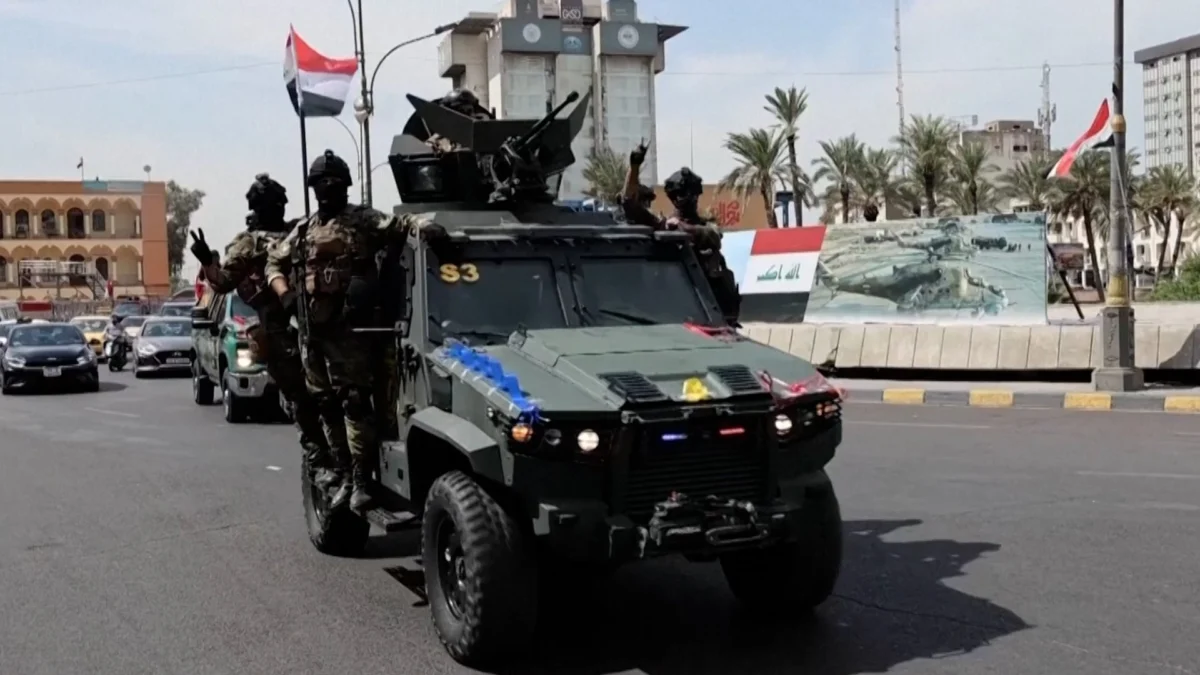
Baghdad and Najaf erupted in patriotic fervour on Wednesday, September 29, 2026, as Iraq’s security forces orchestrated grand parades to celebrate "Sovereignty Day," a newly established national holiday marking the complete withdrawal of United States military personnel from the country. This momentous occasion follows the departure of the last remaining US soldiers, officially concluding the US-led international coalition’s operation against the Islamic State of Iraq and Syria (ISIL), a mission that spanned over a decade. The streets of the capital, Baghdad, and the holy city of Najaf were adorned with national flags, as formations of Iraqi army units, police forces, and various security contingents marched in a powerful display of national strength and self-reliance, signifying a new chapter in Iraq’s post-conflict history.
The decision to designate September 29 as Sovereignty Day underscores the profound national sentiment surrounding the end of foreign military presence. For many Iraqis, this day represents the culmination of a long and often turbulent journey towards full national autonomy, free from the direct involvement of external forces in their security affairs. The parades, meticulously planned and executed, served not only as a celebration but also as a demonstration of the Iraqi Security Forces’ (ISF) enhanced capabilities and readiness to defend the nation’s borders and maintain internal stability independently. Senior Iraqi officials, including Prime Minister Mohammed Shia’ al-Sudani and President Abdul Latif Rashid, attended the ceremonies, delivering speeches that emphasized national unity, the sacrifices made, and the nation’s determination to build a prosperous and stable future.
A Decades-Long American Military Presence: A Historical Context
The departure of the final US troops on September 29, 2026, draws to a close a complex and often controversial chapter of American military involvement in Iraq, stretching back more than two decades. The initial US invasion in March 2003, under the Bush administration, aimed to dismantle Saddam Hussein’s regime, eliminate alleged weapons of mass destruction, and foster democracy in the region. The swift overthrow of Saddam’s government was followed by a protracted and bloody insurgency, sectarian violence, and a challenging nation-building effort. At its peak, the US military presence in Iraq exceeded 170,000 troops in 2007, during the "surge" operation designed to quell the escalating violence.
The first full withdrawal of US combat troops occurred in December 2011, under the Obama administration, fulfilling a Status of Forces Agreement (SOFA) signed in 2008. This initial departure was met with mixed reactions; while many Iraqis celebrated the end of occupation, concerns lingered about the nascent Iraqi security forces’ ability to maintain stability amidst persistent political fragmentation and regional influences. These concerns proved prescient, as the vacuum created by the withdrawal, coupled with widespread government corruption and sectarian policies, contributed to the rapid rise of ISIL in 2014.
ISIL’s brutal campaign, which saw the extremist group seize vast swathes of northern and western Iraq, including the country’s second-largest city, Mosul, forced the international community to intervene once more. In August 2014, the United States, along with a coalition of over 80 international partners, launched Operation Inherent Resolve (OIR) to "degrade and ultimately defeat" ISIL. This marked the return of US forces to Iraq, albeit with a different mandate: primarily to conduct air strikes, provide intelligence, and train and advise the Iraqi Security Forces.
The Campaign Against ISIL and the Evolution of the Coalition’s Role
The re-engagement of US and coalition forces proved pivotal in turning the tide against ISIL. Over several years, the Combined Joint Task Force – Operation Inherent Resolve (CJTF-OIR) provided critical air support, logistical aid, and training that enabled Iraqi forces to reclaim territory from the extremist group. Key milestones in this campaign included the liberation of Ramadi (2015), Fallujah (2016), and most significantly, Mosul (2017), which had served as ISIL’s de facto capital in Iraq. These victories came at a tremendous cost, with extensive damage to infrastructure and significant civilian casualties, but they showcased the growing capabilities of the revitalized Iraqi military.
As ISIL’s territorial caliphate collapsed, the nature of the coalition’s mission gradually shifted. From an active combat role, the focus transitioned to an "advise, assist, and enable" mission, supporting Iraqi forces in their ongoing counter-terrorism efforts against ISIL sleeper cells and remnants. This strategic pivot was formalized through successive dialogues between the Iraqi and US governments, particularly following a series of Iraqi parliamentary resolutions calling for the departure of foreign troops, exacerbated by heightened regional tensions and attacks on US interests in Iraq.
Chronology of Strategic Shifts and Withdrawals
The path to the final withdrawal has been a carefully negotiated and phased process:
- 2003: US-led invasion of Iraq.
- 2007: Peak US troop presence (approximately 170,000).
- 2008: US-Iraq Status of Forces Agreement signed, stipulating full US troop withdrawal by end of 2011.
- December 2011: First full withdrawal of US combat forces from Iraq.
- June 2014: ISIL seizes Mosul; US begins sending military advisors.
- August 2014: Operation Inherent Resolve (OIR) launched, marking the return of US and coalition forces.
- 2017: Liberation of Mosul and other key cities from ISIL.
- January 2020: Iraqi Parliament passes a non-binding resolution calling for the expulsion of all foreign troops after a US drone strike kills Iranian General Qassem Soleimani and Iraqi militia leader Abu Mahdi al-Muhandis in Baghdad.
- July 2021: US President Joe Biden and Iraqi Prime Minister Mustafa al-Kadhimi announce the formal end of the US combat mission in Iraq by the end of 2021, transitioning to an advisory and training role.
- December 2021: US declares its combat mission officially concluded, with remaining forces solely in an advisory capacity.
- Early 2020s (leading up to 2026): Continued strategic dialogues, gradual reduction of advisory forces, and strengthening of Iraqi self-sufficiency.
- September 29, 2026: Final US military personnel depart Iraq, marking the complete end of the US-led coalition’s presence and the celebration of Sovereignty Day.
Over the course of the anti-ISIL campaign (2014-2026), the US maintained a presence that fluctuated, peaking at around 5,200 troops in 2017, then gradually reducing to a few hundred by the final phase, focused on highly specialized training and intelligence sharing. The broader international coalition also saw its personnel numbers decrease significantly as Iraqi capabilities improved.
Official Responses and Reactions
The commemoration of Sovereignty Day and the final troop departure elicited strong reactions from various stakeholders.
Iraqi Government: Prime Minister al-Sudani, in his address, lauded the event as a "historic moment for the Iraqi nation, affirming our full sovereignty and the sacrifices of our heroes who fought to liberate our land from terrorism." He emphasized Iraq’s commitment to regional stability and the importance of continued international cooperation on a diplomatic and economic front, distinct from military presence. President Rashid echoed these sentiments, highlighting the "resilience of the Iraqi people" and calling for national unity to tackle the remaining challenges of reconstruction and governance. The Iraqi Ministry of Defense issued a statement expressing pride in the professionalism and growing self-reliance of the Iraqi Security Forces, declaring them fully capable of safeguarding national security.
United States Government: While no longer having a direct military presence, the US State Department issued a statement acknowledging the "successful conclusion of the coalition’s mission against ISIL" and congratulating Iraq on its Sovereignty Day. The statement reiterated the US commitment to a "strong, strategic partnership with Iraq," focusing on diplomatic, economic, and cultural ties, as well as continued intelligence sharing and counter-terrorism support from outside the country. A senior Pentagon official, speaking on background, noted that the withdrawal represented a "strategic shift in how the United States supports its partners, moving towards capacity building and shared intelligence without the footprint of permanent combat forces."
Regional Actors: Neighboring countries and regional powers observed the developments closely. Iran, a significant player in Iraq’s internal dynamics, likely viewed the full US withdrawal as a positive development, potentially reducing external influences that it perceives as hostile. Other Arab states, particularly those concerned about regional stability and the enduring threat of extremism, are likely to monitor Iraq’s internal security situation closely, while also expressing support for Iraq’s sovereignty. The general sentiment across the region likely oscillates between cautious optimism for a more stable Iraq and underlying concerns about potential power vacuums or renewed internal strife.
Broader Impact and Implications
The complete withdrawal of US forces carries profound implications for Iraq, the United States, and the wider Middle East.
For Iraq:
The most immediate impact is the profound sense of national pride and affirmed sovereignty. However, this newfound independence also comes with significant responsibilities and challenges.
- Security: While the ISF have demonstrated improved capabilities, the threat from ISIL remnants, sleeper cells, and various armed groups remains. The ISF must now fully bear the burden of intelligence gathering, border security, and counter-terrorism operations without direct foreign military assistance on Iraqi soil.
- Political Stability: Iraq continues to grapple with deep-seated political divisions, sectarian tensions, and the pervasive issue of corruption. The absence of foreign military presence may reduce a point of contention but also removes an external balancing force, potentially allowing internal power struggles to intensify. The influence of various political factions and Iran-backed militias will be a critical factor in shaping Iraq’s political future.
- Economic Recovery: Despite being an oil-rich nation, Iraq’s economy has been devastated by decades of conflict, sanctions, and mismanagement. Rebuilding infrastructure, diversifying the economy, and creating opportunities for its youthful population are monumental tasks. The stability afforded by full sovereignty is essential for attracting foreign investment and fostering sustainable growth.
- Regional Role: Iraq aims to re-establish itself as a stable and influential regional player. The absence of foreign troops allows Baghdad to pursue a more independent foreign policy, potentially serving as a mediator in regional disputes and strengthening ties with its neighbours.
For the United States:
The complete withdrawal signifies the end of a costly and protracted military engagement.
- Resource Reallocation: It allows the US to reallocate military resources and strategic focus to other global priorities, particularly in Asia and Eastern Europe.
- Strategic Shift: This marks a continuation of a broader US strategy to reduce large-scale ground troop deployments in the Middle East, favoring partnerships, intelligence sharing, and over-the-horizon counter-terrorism capabilities.
- Legacy: The US intervention in Iraq leaves a complex legacy, characterized by both the overthrow of a brutal dictatorship and the destabilization of a nation, the fight against a global terror group, and significant human and financial costs. The long-term impact on US foreign policy doctrine will continue to be debated.
For Regional Stability:
The full withdrawal could have multifaceted effects on the broader Middle East.
- Power Dynamics: It alters the regional power balance, potentially increasing the influence of regional actors like Iran and Turkey in Iraq’s internal affairs.
- Counter-Terrorism: While the coalition’s direct mission is over, the threat of transnational terrorism remains. The effectiveness of future counter-terrorism efforts will depend heavily on robust intelligence sharing and continued international cooperation, even without boots on the ground.
- Uncertainty: The future trajectory of Iraq’s security and political landscape without a foreign military anchor introduces an element of uncertainty into an already volatile region.
As Iraq celebrates Sovereignty Day, the nation stands at a critical juncture. The parades in Baghdad and Najaf are not merely a reflection of past victories but a forward-looking declaration of intent. The challenges ahead are formidable, ranging from sustained counter-terrorism efforts to fostering genuine political reconciliation and economic prosperity. The success of this new chapter will depend on the ability of Iraq’s leaders and its people to unite, harness their resources, and navigate the complex domestic and regional landscape to build a truly sovereign, stable, and thriving nation.
