

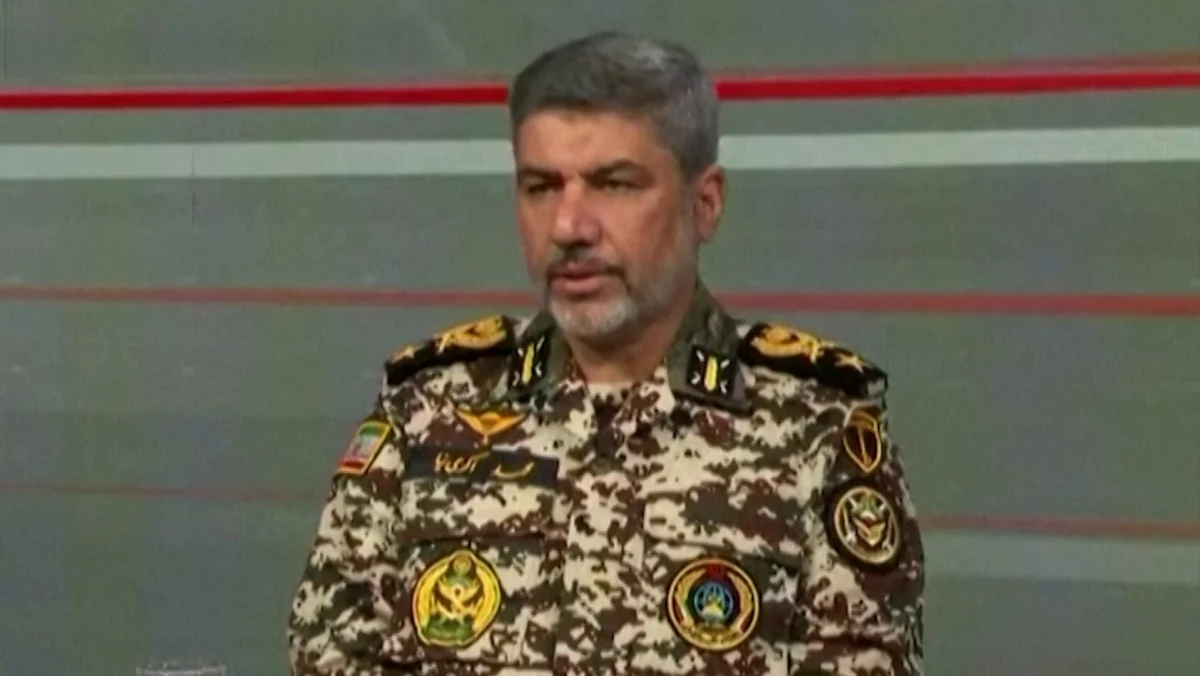
Iran has declared a cessation of what it terms "retaliatory operations" in the Persian Gulf, a move announced by Army spokesman Mohammad Akraminia on July 26, 2026. However, this purported de-escalation was immediately accompanied by a stern warning that any continued "attacks" by the United States would inevitably lead to a broader conflict engulfing the entire region. Akraminia’s carefully timed statement, delivered just hours before Israeli Prime Minister Benjamin Netanyahu’s scheduled arrival in Washington D.C., underscores the intricate and volatile geopolitical landscape of the Middle East, highlighting Iran’s strategic posturing in anticipation of high-level US-Israeli discussions on regional security, with particular emphasis on Tehran’s nuclear program and its expanding influence.
Escalating Tensions and the Context of Retaliation
The announcement from Tehran comes against a backdrop of persistently high tensions in the Persian Gulf, a critical global waterway vital for international oil trade. For months, the region has witnessed a series of naval confrontations, drone incidents, and cyber exchanges between Iranian forces and those of the United States and its allies. These incidents have been characterized by both sides as defensive or retaliatory actions, creating a dangerous cycle of escalation. The exact nature of the "retaliatory operations" Iran claims to have halted remains unspecified by Tehran, but observers suggest they likely refer to a recent surge in Revolutionary Guard Corps (IRGC) naval maneuvers, intermittent harassment of commercial shipping near the Strait of Hormuz, and increased drone surveillance activities targeting US naval assets and regional bases. Similarly, the "US attacks" mentioned by Akraminia likely encompass enhanced American military presence, surveillance flights, and ongoing economic sanctions that continue to cripple the Iranian economy.
The historical animosity between Iran and the United States, deeply rooted in the 1979 Islamic Revolution, has been exacerbated in recent years following the US withdrawal from the Joint Comprehensive Plan of Action (JCPOA), commonly known as the Iran nuclear deal, in 2018. This withdrawal and the subsequent re-imposition of stringent sanctions have severely impacted Iran’s oil exports and financial sector, pushing Tehran to gradually reduce its commitments under the nuclear agreement. This has led to an accelerated uranium enrichment program, raising alarm bells in Washington, Tel Aviv, and European capitals. The current climate of mistrust and open confrontation reflects a complex interplay of ideological differences, geopolitical ambitions, and economic pressures, with both sides frequently accusing the other of destabilizing the region.
A Chronology of Recent Flashpoints (June-July 2026)
The period leading up to Iran’s July 26 announcement has been particularly fraught with incidents, illustrating the delicate balance of power and the constant risk of miscalculation in the Gulf.
- June 5, 2026: A US Navy patrol boat, the USS Chinook, reported a "dangerous and unprofessional" encounter with three IRGC fast-attack craft in international waters near the Strait of Hormuz. The Iranian vessels allegedly performed aggressive maneuvers, coming within 50 yards of the US ship, prompting the Chinook to issue multiple warnings.
- June 18, 2026: Iran’s state media announced the successful test-firing of a new generation of anti-ship cruise missiles during naval exercises in the Gulf, sending a clear message about its defensive capabilities. The exercises, dubbed "Great Prophet 17," were widely seen as a show of force directed at the US and its allies.
- June 29, 2026: The US Central Command (CENTCOM) confirmed that an Iranian drone had "harassed" a US Navy carrier strike group transiting through the Strait of Hormuz, flying unsafely close to US aircraft. CENTCOM labeled the action as provocative and inconsistent with international maritime safety standards.
- July 10, 2026: Reports emerged from regional shipping intelligence firms detailing multiple instances of GPS interference and "spoofing" affecting commercial vessels in the Gulf, which some analysts attributed to Iranian electronic warfare capabilities, intended to disrupt navigation and assert control.
- July 17, 2026: The Pentagon announced the deployment of an additional squadron of F-22 Raptor stealth fighters to the Al Dhafra Air Base in the UAE, citing "escalating threats from Iran" and a need to bolster regional deterrence. This move was immediately condemned by Tehran as a provocative military build-up.
- July 22, 2026: Iran’s Mehr News Agency reported that IRGC naval forces had successfully "intercepted" a foreign surveillance drone operating in Iranian airspace over the Gulf, claiming it was an act of "defensive retaliation" against foreign intrusions. The drone’s origin was not specified, but US officials later stated no American assets were lost.
These incidents, among others, paint a picture of a region teetering on the brink, where each action by one party is perceived as an "attack" or "retaliation" by the other, feeding a cycle that Akraminia now claims Iran has temporarily paused.
Iran’s Official Stance and the Warning to Washington
Army spokesman Mohammad Akraminia’s declaration that Iran has "halted retaliatory operations" carries multiple layers of interpretation. On one hand, it can be seen as a tactical de-escalation, an olive branch of sorts, signaling a temporary reduction in aggressive posturing in the Gulf. This could be aimed at preventing an accidental escalation that neither side genuinely desires, or perhaps to project an image of responsibility on the international stage.
However, the immediate follow-up warning – that "if the US continues its attacks, the conflict will expand across the region" – overshadows any perceived gesture of goodwill. This threat is explicit and far-reaching, implying that any further US military actions, economic pressures, or perceived provocations would trigger a broader Iranian response, potentially involving its extensive network of proxy militias across Iraq, Syria, Lebanon, and Yemen. Such an expansion could plunge the entire Middle East into a multi-front conflict, disrupting global energy supplies, displacing millions, and drawing in other regional and international powers.
The timing of Akraminia’s message, delivered specifically "ahead of Israeli Prime Minister Benjamin Netanyahu’s visit to Washington," is strategically significant. Iran likely aims to pre-empt any joint US-Israeli strategy that might emerge from the high-stakes discussions. Tehran’s message serves as a direct warning to both Washington and Tel Aviv: any plans for increased pressure or military action against Iran will be met with severe consequences, and such actions would not be confined to the Gulf alone. It also subtly attempts to drive a wedge between the US and Israel, suggesting that a unified hardline approach could backfire dramatically.
Reactions from Key Players
United States: Initial reactions from Washington were cautious but firm. A spokesperson for the US State Department, speaking on background, stated, "We take all statements regarding regional stability seriously. Our posture in the Gulf remains defensive, aimed at protecting our interests, allies, and freedom of navigation. We call on all parties to exercise restraint and de-escalate tensions." The Pentagon reiterated its commitment to ensuring regional security and denied any "attacks" on Iran, characterizing its actions as necessary defensive measures in international waters. The White House, while acknowledging Akraminia’s statement, focused its immediate public remarks on the upcoming visit of Prime Minister Netanyahu, emphasizing the enduring strength of the US-Israel alliance and shared concerns about regional security and Iran’s nuclear ambitions.
Israel: Prime Minister Benjamin Netanyahu, en route to Washington, made no direct comment on Akraminia’s statement. However, senior Israeli defense officials, speaking anonymously to Israeli media, expressed skepticism about Iran’s sincerity, suggesting the declaration was likely a propaganda tactic designed to sow discord or buy time. "Iran’s words are often at odds with its actions," one official stated. "Our focus remains on ensuring Israel’s security against the existential threat posed by the Iranian regime and its proxies, and we expect robust discussions with our American allies on this front." The Israeli government is widely expected to push for a tougher international stance against Iran during Netanyahu’s visit, advocating for stronger sanctions and a credible military threat to curb Tehran’s nuclear program and regional adventurism.
Regional Allies (e.g., Saudi Arabia, UAE): Gulf Arab states, particularly Saudi Arabia and the United Arab Emirates, expressed deep concern over the continued volatility. A joint statement from the Gulf Cooperation Council (GCC) called for all parties to respect international law and work towards peaceful resolutions. While generally supportive of the US presence in the region as a deterrent against Iran, these nations also bear the brunt of any escalation, making them wary of outright conflict. They typically advocate for de-escalation while simultaneously urging international action to curb Iran’s destabilizing activities.
International Bodies: The United Nations Secretary-General issued a statement urging "maximum restraint" from all actors in the Persian Gulf, emphasizing the imperative to avoid any actions that could further inflame an already volatile situation. The European Union, a signatory to the JCPOA, reiterated its commitment to diplomatic solutions and expressed hope that Iran’s statement could open a window for renewed dialogue, even as it voiced concerns over Iran’s nuclear enrichment activities.
Broader Impact and Implications
Akraminia’s statement, while seemingly offering a momentary pause, underscores the extreme fragility of peace in the Persian Gulf and the broader Middle East.
- Geopolitical Stability: The explicit warning of regional expansion transforms any future confrontation from a localized naval skirmish into a potential full-scale regional war. This has profound implications for global security, given the number of non-state actors and proxy forces operating in the region.
- Economic Repercussions: The Persian Gulf is the gateway for a significant portion of the world’s oil supply. Any major conflict or sustained disruption of shipping lanes, particularly the Strait of Hormuz, could trigger an unprecedented global energy crisis, sending oil prices skyrocketing and devastating global economies still recovering from recent shocks. The current geopolitical premium on oil prices reflects this underlying risk.
- Diplomatic Pathways: While the warning is stark, the declaration of halting operations could also be interpreted as Iran leaving a door ajar for diplomacy, albeit on its own terms. It challenges the US to reciprocate with a reduction in its "attacks," potentially setting the stage for indirect talks if both sides are willing to explore de-escalation. However, the timing with Netanyahu’s visit suggests Iran might be more interested in influencing the narrative and deterring aggressive policies rather than initiating immediate dialogue.
- US-Israel Dynamics: The statement puts pressure on the US-Israel talks. If Washington and Tel Aviv pursue a hardline stance, Iran’s warning suggests it would be at a heightened risk of regional blowback. This could lead to intense debate within the US administration regarding the optimal strategy: whether to double down on pressure or to seek off-ramps to de-escalation.
- Domestic Iranian Politics: The statement also serves domestic purposes within Iran, projecting an image of strength and defiance to a populace grappling with severe economic hardship under sanctions, while simultaneously signaling a measured approach to avoid an all-out war that few Iranians desire.
The coming days, particularly following the outcomes of Prime Minister Netanyahu’s meetings in Washington, will be critical in determining whether Iran’s announcement represents a genuine, albeit conditional, step back from the brink, or merely a strategic maneuver in an ongoing, high-stakes geopolitical chess match that could still spiral into wider conflict. The world watches with bated breath as the delicate balance of power in the Persian Gulf continues to evolve.
