

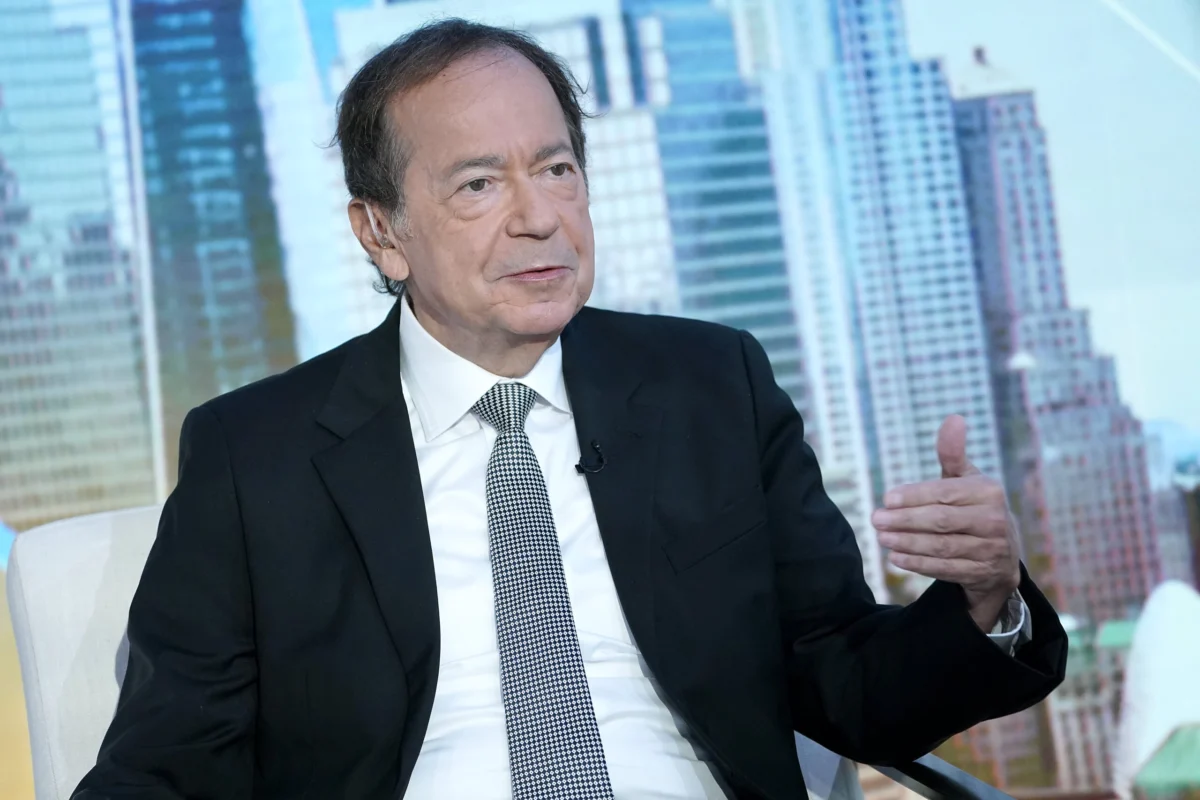
John Paulson, the renowned hedge fund manager celebrated for his prescient bet against the U.S. housing market, has reiterated his profound conviction that gold is merely at the nascent phase of an extended bull market. Speaking on CNBC’s "The Exchange" Wednesday, Paulson articulated a clear vision for the precious metal’s future, asserting, "I do think we’re in the beginnings or the early stages of a long-term bull market for gold." His thesis centers on a fundamental shift in global investor sentiment, where a growing distrust in traditional paper currencies is propelling gold to prominence as an indispensable alternative store of value. This pronouncement from an investor whose insights have historically reshaped financial landscapes carries significant weight, signaling potential enduring shifts in capital allocation strategies.
Paulson’s Investment Philosophy and Gold’s Resurgence
Paulson’s journey to becoming a prominent gold bull is rooted in a remarkable track record of identifying and capitalizing on macroeconomic dislocations. His firm, Paulson & Co., achieved legendary status during the 2007-2008 financial crisis by executing what has been dubbed "The Greatest Trade Ever" – a multi-billion dollar wager against the subprime mortgage market. This monumental success underscored his ability to foresee systemic risks and position his portfolio accordingly, often against prevailing market consensus.
Following the unprecedented financial turmoil, central banks globally unleashed a torrent of fiscal and monetary stimulus, including quantitative easing (QE) programs and near-zero interest rates, designed to avert a deeper economic collapse. It was in this environment, around 2009, that Paulson made another pivotal strategic shift. He began to significantly increase his exposure to gold, arguing that these aggressive stimulus measures would inevitably lead to a weakening of the U.S. dollar and, critically, fuel inflationary pressures. His view was that the massive expansion of the money supply would erode the purchasing power of fiat currencies, thereby enhancing gold’s appeal as a robust hedge against inflation and currency debasement.
Since Paulson’s initial pivot to gold in 2009, the precious metal has indeed experienced a substantial upward trajectory, validating much of his long-term outlook. While the specific claim of gold prices "topping the $5,000 threshold" in the past may reflect a misattribution or a specific portfolio performance rather than the spot price of gold itself, the overall trend has been unequivocally positive. Gold prices have seen significant appreciation, breaking previous all-time highs and demonstrating resilience amidst various economic cycles and geopolitical tensions. For instance, from its levels in late 2009, gold embarked on a multi-year rally, reaching an initial peak above $1,900 per ounce in 2011, and more recently surging past $2,400 per ounce in 2024, marking a substantial increase that has certainly rewarded long-term investors.
Drivers of Gold Demand and Price Appreciation
Paulson’s current bullish stance is underpinned by several powerful and interlocking drivers of demand that he believes are set to intensify. Foremost among these is the escalating activity of central banks, which have emerged as major net buyers of gold in recent years. Data from the World Gold Council consistently illustrates this trend. In 2022, central banks purchased a staggering 1,081.2 tonnes of gold, the highest level recorded in 55 years, and this robust buying spree continued into 2023 and early 2024. Nations like China, India, Turkey, and Poland have been particularly active, viewing gold as a crucial component of their reserve diversification strategies. This diversification is often motivated by a desire to reduce reliance on the U.S. dollar, mitigate geopolitical risks, and bolster financial stability in an increasingly uncertain global landscape. As Paulson highlighted, "Gold is becoming the most apt reserve currency in the world, replacing fiat currencies," reflecting a growing international consensus on its intrinsic value.
Beyond official sector purchases, private sector interest in gold is also broadening significantly. Retail investors, high-net-worth individuals, and institutional funds are increasingly allocating capital to gold-backed exchange-traded funds (ETFs), physical bullion, and gold mining stocks. This surge in private demand is fueled by persistent concerns over inflation, which has seen a resurgence globally following post-pandemic stimulus measures and supply chain disruptions. Gold’s historical role as an inflation hedge makes it particularly attractive in periods where the purchasing power of traditional currencies is under threat. Moreover, escalating geopolitical tensions, ranging from regional conflicts to trade disputes, consistently elevate gold’s appeal as a safe-haven asset, prompting investors to seek refuge from market volatility and economic uncertainty.
The broader macroeconomic environment further supports Paulson’s outlook. Global debt levels, both sovereign and corporate, remain at historically high levels. Coupled with the continued expansion of central bank balance sheets, there is an underlying apprehension about the long-term sustainability of current fiscal policies. These factors contribute to a pervasive sense of distrust in the stability and long-term value of unbacked fiat currencies. In such an environment, gold, with its finite supply, tangible nature, and millennia-long history as a store of value, naturally gains favor as a reliable alternative.
Paulson’s Preferred Investment Vehicle: Gold Miners

While Paulson is bullish on gold itself, his investment strategy favors a specific avenue for capitalizing on its appreciation: gold mining companies, particularly those in early stages with substantial undeveloped reserves. He articulated this preference unequivocally, stating, "I think the greatest way to invest is to invest in early-stage gold stocks." This approach is rooted in the concept of operational leverage. For a mining company, many costs, such as exploration, infrastructure development, and permitting, are relatively fixed. As the price of gold rises, the incremental revenue generated from each ounce produced flows disproportionately to the bottom line, leading to a magnified increase in profitability and, consequently, share price appreciation.
Investing in early-stage gold companies with large undeveloped reserves offers an even greater degree of leverage. These companies often trade at a discount relative to their proven resources because of the inherent risks and costs associated with bringing a mine into production. These risks include geological uncertainties, regulatory hurdles, environmental compliance, and the massive capital expenditure required for development. However, for investors willing to undertake this risk, successful project development and rising gold prices can unlock significant value, leading to substantial returns that far outpace the percentage gain in physical gold itself. Paulson’s strategy targets these undervalued assets, anticipating that rising gold prices will not only enhance the value of their existing reserves but also make the economics of developing new mines more attractive, thus narrowing the valuation gap.
NovaGold Resources and the Donlin Gold Project
A key illustration of Paulson’s investment philosophy is his long-standing involvement with NovaGold Resources. His firm, Paulson Advisers, has been a significant shareholder, and Paulson himself serves as co-chairman of NovaGold. The company’s flagship asset, the Donlin Gold project in Alaska, is central to Paulson’s investment thesis. NovaGold recently announced its intention to acquire Paulson Advisers’ 40% stake in the Donlin Gold project, moving towards full ownership. This strategic consolidation underscores the confidence in the project’s future.
The Donlin Gold project is widely recognized as one of the largest undeveloped gold deposits in the world. It boasts an immense resource base, with Paulson noting that "NovaGold has 40 million ounces of gold indicated and measured resources and reserves." To put this in perspective, many major gold mining companies have market capitalizations significantly higher than NovaGold’s stated $4.2 billion, yet possess smaller or less concentrated reserves. This discrepancy highlights the potential for substantial value creation as Donlin Gold progresses towards production. The project is located in a favorable mining jurisdiction in Alaska, which, despite its remote location, offers relative political stability and established regulatory frameworks compared to some other global mining regions.
While Donlin Gold is still in the permitting and development phase, its sheer scale offers investors significant leveraged exposure to rising gold prices. The project’s economics become increasingly compelling with each upward tick in gold’s spot price, potentially transforming it from a long-term development play into a highly profitable future producer. Paulson’s direct endorsement and significant financial commitment to NovaGold reinforce his belief in the company’s potential. He explicitly stated, "I think the best way to play gold is through stocks like NovaGold, if not NovaGold itself," positioning the company as a prime vehicle for investors seeking to capitalize on the anticipated bull market in gold.
Implications for Investors and the Global Financial System
Paulson’s renewed and emphatic bullish call on gold carries significant implications for both individual and institutional investors, as well as for the broader global financial system. Coming from an investor of his stature, it serves as a powerful validation for those who have long advocated for gold as an essential portfolio component. His analysis suggests that the forces driving gold’s appeal – namely, diminishing faith in fiat currencies and escalating geopolitical and economic uncertainties – are not transient but rather fundamental, structural shifts that will continue to unfold over the long term.
For investors, Paulson’s insights underscore the critical role of diversification. In an era marked by persistent inflation, unprecedented national debt levels, and a volatile geopolitical landscape, gold offers a tangible hedge against these systemic risks. While gold does not yield income like bonds or dividends like stocks, its value tends to preserve purchasing power during periods when other asset classes struggle. His specific focus on gold miners, particularly those with substantial undeveloped reserves, offers a higher-risk, higher-reward strategy for those seeking leveraged exposure to the gold price. However, investors must conduct thorough due diligence, understanding the specific risks associated with mining operations, project development, and commodity price volatility.
From a macroeconomic perspective, the increasing demand for gold from central banks, as noted by Paulson, signals a potential recalibration of the global monetary order. A move away from heavy reliance on the U.S. dollar as the primary reserve currency could have profound long-term consequences for currency markets, international trade, and global financial stability. This shift reflects a broader trend towards a more multipolar world, where nations seek to diversify their financial holdings and reduce their vulnerability to external economic or political pressures.
While Paulson’s bullish outlook is compelling, it is also important to acknowledge that market opinions on gold can vary. Factors such as rising real interest rates, a strengthening U.S. dollar, or significant new gold discoveries could present headwinds to gold prices. However, Paulson’s track record and the detailed rationale behind his current conviction provide a robust framework for understanding why gold continues to command such significant attention from the world’s most astute investors. His latest pronouncements serve as a powerful reminder that in times of economic transformation, gold remains a timeless and increasingly relevant asset.
