

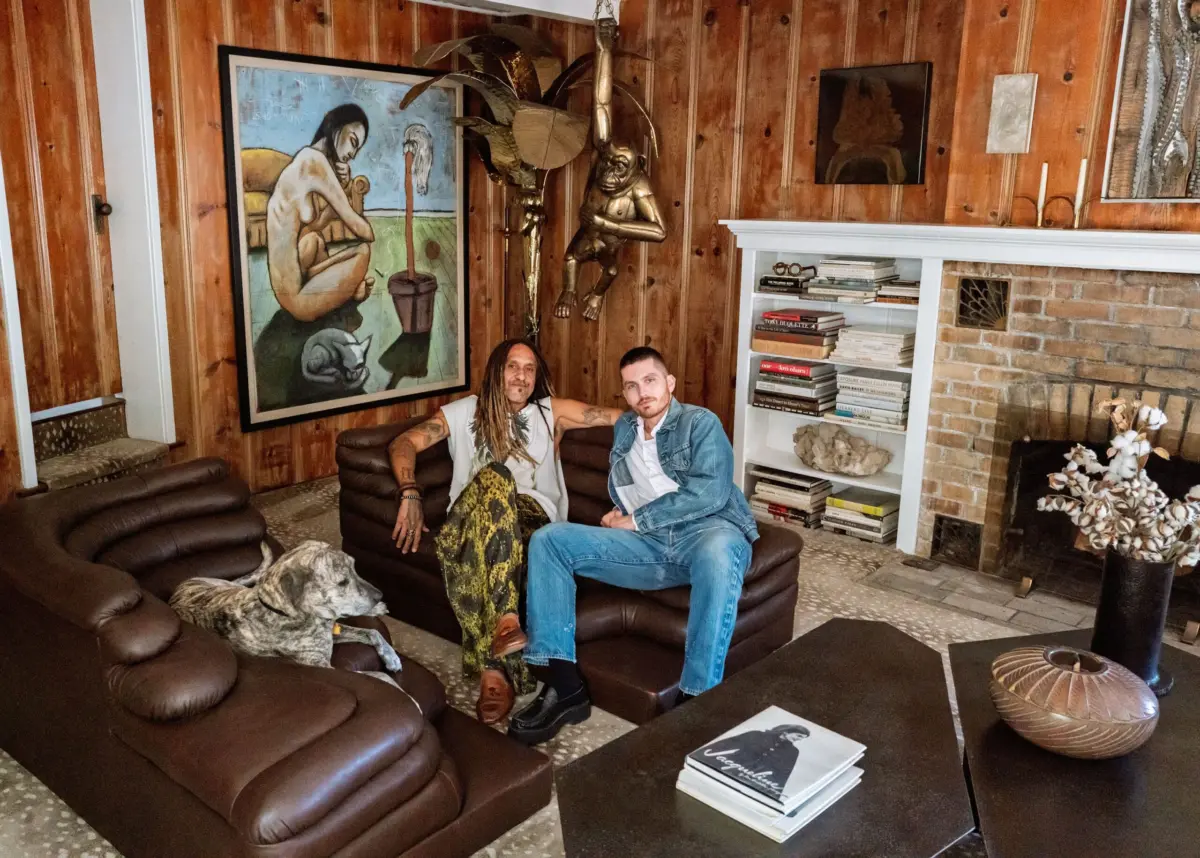
The transformation of a 1925 Craftsman house in Los Angeles’s historic Laurel Canyon serves as a testament to the unpredictable nature of creative partnership and the evolution of domestic design. Five years ago, interior designer Harrison Soll had no intention of altering his professional trajectory or his personal life, maintaining a strict focus on his career to avoid external distractions. However, a chance meeting in the autumn with Rodney Burns—a prominent stylist and the proprietor of the renowned West Hollywood vintage gallery, Church Boutique—realigned both their lives. By the following New Year, the two had formed a partnership rooted in a shared "throughline with design," a connection that has since manifested in a 1,400-square-foot residence that challenges traditional boundaries between minimalism and maximalism.

A Convergence of Distinct Creative Philosophies
The residence, a nearly century-old structure, serves as the physical intersection of two distinct, and often opposing, aesthetic ideologies. Harrison Soll, whose professional background is steeped in a bold, minimalist modern approach, found himself integrating his vision with that of Rodney Burns, who describes himself as a "maximalist to the umpteenth power." Burns’s influence is heavily informed by his 15-year tenure as a stylist and creative collaborator for rock icon Lenny Kravitz. This professional background has instilled in Burns a visual vocabulary that embraces ethnic expression and early-to-midcentury styles, often favoring a "more is more" philosophy.
The result of this collaboration is what the couple describes as an "Afrocentric Ralph Lauren" aesthetic. This hybrid style has garnered praise from their professional circle, most notably from Kravitz himself. In a statement regarding the couple’s home, Kravitz noted that the seamless blend of Burns’s ethnic expression and Soll’s modern minimalism creates a unique dialogue between eras and genres. According to Kravitz, Burns’s ability to "mix a vast stew of eras" while paying tribute to ancestral influences and uplifting new innovators is a hallmark of the couple’s joint project.

Chronology of a Curated Home
The development of the Laurel Canyon home was not a singular event but a multi-year process of negotiation and curation. The timeline of their residence reflects a gradual merging of two extensive collections of art and furniture.
- Initial Meeting (Fall, Five Years Ago): Soll and Burns meet, initially bonding over design theory and vintage acquisitions.
- Formation of the Household: The couple moves into the 1925 Craftsman, beginning the process of combining Soll’s minimalist furniture with Burns’s expansive archive from Church Boutique.
- The Negotiation Phase: Key design decisions, such as the installation of wall-to-wall carpeting and the placement of large-scale sculptures, were debated over several months.
- The Refinement Phase: The couple continues to adjust the décor, with Soll encouraging Burns to "take a pause" on acquisitions while Burns introduces Soll to more soulful, expressive textures.
The process of decorating a rental property presented its own set of chronological challenges. Unlike a ground-up renovation, the couple had to work within the confines of the existing architecture while securing permissions for semi-permanent changes, such as retiling the bathroom and installing a new vanity.

Significant Acquisitions and Design Highlights
The interior of the home is defined by several high-profile design pieces that represent the pinnacle of 20th-century furniture and art. These pieces serve as the anchors for the various rooms, bridging the gap between the structure’s 1920s bones and modern sensibilities.
The Living Area: A Study in Texture
The living room is perhaps the most vivid example of the couple’s "maximalist-minimalist" compromise. It features a Joseph D’Urso for Knoll sofa, which Soll insisted be upholstered in a mix of leopard-print Scalamandré fabric and a block of leather to prevent the piece from becoming "too maximalist." This is paired with a leather De Sede Terrazza sofa, a modular classic designed in the 1970s known for its sinuous, terrace-like form.

The flooring consists of an Antilocarpa (doe-patterned) carpet from Stark. Soll describes the decision to install this wall-to-wall carpeting as an "ask for forgiveness" move regarding the landladies, though the gamble ultimately succeeded as the owners approved of the aesthetic shift.
The Foyer and the "Giraffe Conflict"
One of the most discussed items in the home is a giant Sergio Bustamante giraffe bust located in the foyer. Bustamante, a Mexican artist known for his surrealist sculptures in papier-mâché and bronze, is a recurring favorite in the home. The placement of the giraffe was a point of significant contention. Burns was determined to showcase the rarity and scale of the piece, while Soll expressed concerns regarding the practicalities of the front door swinging into the sculpture’s path.

The foyer also serves as a gallery for a collection of masks and vintage paintings. Initially, Burns suggested placing the masks in storage to maintain a cleaner look, but Soll insisted on integrating them throughout the house, signaling a shift where the minimalist partner began to embrace the maximalist’s collection.
The Dining Room and Artistry
In the dining room, a Sergio Bustamante table is positioned on a diagonal—a strategic move by Soll to accommodate the couple’s large dog while navigating the room’s geometry. The space is further defined by:

- Paul Evans Chairs: Midcentury pieces that provide a structural, industrial contrast to the organic shapes of the table.
- Chinese Art Deco Rug: Sourced from Ariana Rugs, providing a historical anchor to the room.
- Tom Greene Chandelier: A brutalist lighting fixture sourced directly from Burns’s Church Boutique.
Professional Context: The Influence of Church Boutique
Rodney Burns’s aesthetic is inextricably linked to Church Boutique, a Los Angeles institution that has long served as a source for high-fashion and rare vintage finds. The boutique’s influence is visible in the home’s "bricolage" approach, where high-end European design sits alongside African mud cloth and folk art.
Burns views the curation of a home through the same lens as fashion styling. "Building an outfit, building a room: same thing in my opinion," he stated. This philosophy allows for a high degree of experimentation with textures and "limitless concepts," a trait that has defined his professional work with musicians and artists for over a decade.

Architectural Integrity and Limitations
The 1925 Craftsman architecture provides a "bohemian" framework that complements the couple’s eclectic style. The home’s layout includes an angular main bedroom that deviates from standard square dimensions. To address this, the couple installed a stainless steel bed from TTMM, which follows the funky, geometric lines of the room rather than fighting against them.
The backyard continues the theme of inherited history mixed with personal curation, featuring "funky" stonework and a collection of vintage pottery. Notably, a shed in the backyard has been repurposed to function as Burns’s closet, a practical solution to the limited storage space typical of 1920s California bungalows.

Broader Implications and Design Analysis
The collaboration between Soll and Burns reflects a broader trend in the interior design industry: the move away from rigid, "catalogue-ready" minimalism toward "curated maximalism" or "cluttercore," albeit a highly sophisticated version. By integrating rare midcentury pieces with ethnic artifacts and bold patterns, the couple has created a space that prioritizes narrative and history over strict adherence to a single era.
This approach also highlights the challenges and rewards of decorating as a couple with opposing tastes. The "negotiation" mentioned by Soll regarding the carpet and the giraffe underscores the reality of domestic design—that a home is often a compromise of space and ego. Burns noted that Soll’s influence has allowed him to "take a pause" and show "a little more restraint," while Soll has clearly moved toward a more textured, layered environment.

The fact that the property is a rental further emphasizes a growing trend among creative professionals in high-cost markets like Los Angeles: the "luxury renter" who invests significantly in the aesthetics of a space they do not own. By upgrading fixtures and flooring, Soll and Burns have treated the 1,400-square-foot house with the same reverence as a permanent estate, suggesting that the "feeling of home" is derived from the objects within it rather than the deed to the land.
Conclusion
As Harrison Soll and Rodney Burns continue to refine their Laurel Canyon residence, the home remains a work in progress. Despite the extensive collection of world-class furniture and art, the couple admits to one remaining gap in their décor: a blanket basket. In a final nod to their differing styles, Soll noted that they have yet to find one they can both agree upon. This small detail serves as a reminder that even in a home praised by global icons like Lenny Kravitz, the process of shared curation is a perpetual journey of discovery, debate, and design.
