

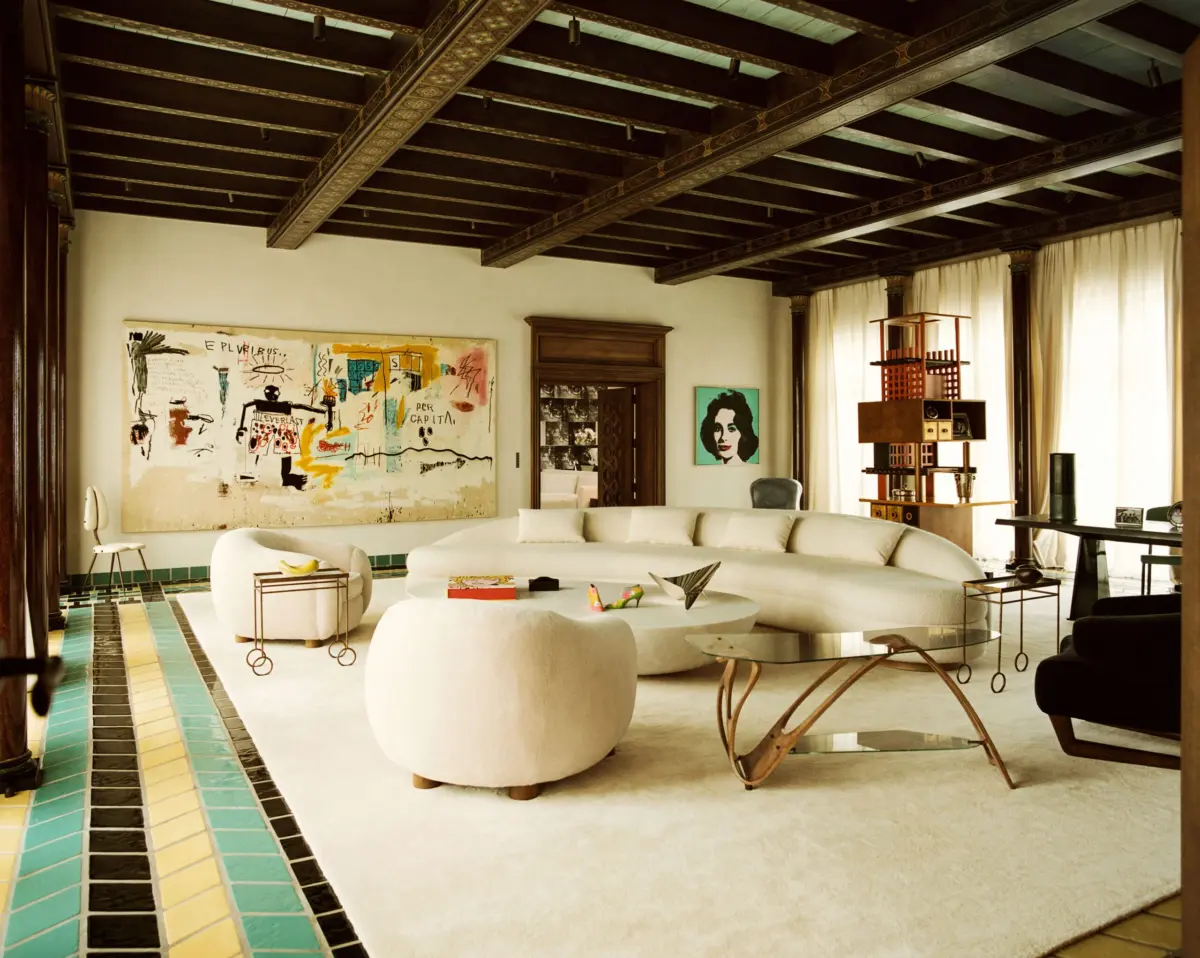
The convergence of historical preservation, contemporary art, and high-fashion couture has reached a new pinnacle in Palm Beach with the completion of the four-year reconstruction of Collado Hueco. This landmark residence, originally designed in 1924 by the architect Addison Mizner, has been reimagined by the Paris-based architect Joseph Dirand for the industrialist and art collector Peter Brant and his wife, the supermodel and couture archivist Stephanie Seymour Brant. The project represents more than a standard renovation; it is a meticulous "reconstruction saving the historical," designed specifically to house one of the world’s most significant private collections of postwar art and mid-century design.

The Genesis of a Collaboration
The partnership between the Brants and Joseph Dirand began with a serendipitous encounter in New York City. Dirand, known for his "minimalist ornamental" style and his ability to blend stark modernity with classical French sensibilities, was introduced to Peter Brant via the prominent art dealer Tico Mugrabi. At the time of their first meeting, the Brants had recently acquired Collado Hueco, a property that Peter Brant—a long-time resident of Palm Beach and a former polo player—viewed as an essential piece of architectural history.

Dirand’s appointment was rooted in a shared aesthetic language. The architect had spent years studying photographs of Brant’s previous residences, particularly noting Brant’s pioneering habit of pairing industrial Jean Prouvé furniture with the raw, neo-expressionist works of Jean-Michel Basquiat. This specific juxtaposition, which has since become a staple of high-end interior design, was a radical departure when Brant first began practicing it in the late 20th century.

Historical Context: The Mizner Legacy in Palm Beach
To understand the significance of Collado Hueco, one must look at the impact of Addison Mizner on the Florida landscape. In the 1920s, Mizner single-handedly defined the "Palm Beach Style," a Mediterranean Revival aesthetic that combined Spanish, Moorish, and Venetian influences. His designs were characterized by asymmetrical floor plans, heavy barrel-tile roofs, and the use of "coquina" stone and intricate plasterwork.

Collado Hueco was originally commissioned in 1924 by Paul Moore, a prominent American businessman. It stands as one of Mizner’s most complex designs, featuring multiple wings that range from one to three stories. By the time the Brants acquired the property in 2020, the house required extensive structural intervention to survive the increasingly volatile Florida climate while maintaining its landmark status.

A Technical Reconstruction Underpinned by Art
Dirand faced a dual challenge: the house was historically significant but structurally vulnerable, and it needed to serve as a gallery for a collection that includes massive canvases by Andy Warhol and Jean-Michel Basquiat. The architect’s approach was to treat the collection as the primary architectural driver. Rather than designing rooms and then placing art, the floor plans were developed around specific pieces identified in two thick binders provided by Peter Brant at the start of the project.

The technical execution was rigorous. To ensure the safety of the artworks, the team performed a comprehensive structural overhaul:

- Foundation Deepening: The team excavated beneath the existing structure to deepen and reinforce the foundations.
- Concrete Reinforcement: Every historical wall was kept standing but reinforced with modern materials to meet current seismic and wind-load requirements.
- Hurricane-Proofing: New hurricane-proof windows were custom-set into reinforced concrete frames, designed to mimic the original 1920s profiles.
- Preservation of Patina: Original tiles and the aged patina of the plaster fireplaces were carefully salvaged and reincorporated to ensure the house did not lose its century-old soul.
The Great Room and the Loggia: Hubs of Postwar Masterpieces
The heart of the residence is the Great Room, dominated by a monumental fireplace and a rare, three-meter-high carved-stone console by Alberto Giacometti. This console was originally part of a 1938 commission by Jean-Michel Frank for the Born family in Argentina. Its counterpart remains missing, making this piece a singular artifact of design history.

Flanking the fireplace is Andy Warhol’s White Disaster (White Car Crash 19 Times) (1963). This acquisition represents a full-circle moment for Peter Brant, who bought his first Warhol in 1966 and maintained a close friendship with the artist until his death in 1987. The room is further furnished with Jean Prouvé pieces sourced from Brazzaville, Congo, which bear the weathered texture of their original colonial climate—a detail that appeals to Brant’s preference for "madness" and character in a collection over sterile perfection.

The Loggia serves as a lighter, more playful counterpoint to the Great Room. It retains Mizner’s original black, yellow, and turquoise tiled floors and Egyptian-style column capitals. Here, the walls are anchored by Jean-Michel Basquiat’s Per Capita (1981) and Warhol’s Liz #5 (Early Colored Liz) (1963). The furniture includes a pair of Jean Royère Ours Polaire (Polar Bear) chairs and a central Tower Cabinet by Ettore Sottsass, a piece from the early 1960s that bridges the gap between mid-century functionalism and the Memphis Group’s later radicalism.

The Integration of Couture and Private Sanctuaries
While Peter Brant’s focus has traditionally been on the "Titans" of the 20th-century art world, Stephanie Seymour Brant has curated a parallel collection of equal historical weight: high fashion. As a muse and close friend to the late Azzedine Alaïa, Seymour Brant possesses one of the most significant private archives of his work, along with rare pieces of historic couture.

Dirand designed the upper levels to reflect this intersection. The primary suite spans the entire width of the house, allowing for a 360-degree light cycle from the Atlantic sunrise to the garden sunset.

- Stephanie’s Dressing Room: Designed as an intimate boudoir, it houses her archive and is overlooked by John Currin’s portrait Constance Towers (2009).
- The Bathrooms: Stephanie’s bathroom features Estremoz marble carved to resemble soft fabric curtains, while Peter’s bathroom is a study in "minimalist ornamentation," utilizing a marquetry of white and gray marble to frame works by Glenn Ligon.
Broader Implications and the Brant Foundation
The completion of this Palm Beach residence is a significant event for the global art community. Peter Brant’s influence extends far beyond his private walls through the Brant Foundation, established in 1996. With locations in Greenwich, Connecticut, and New York’s East Village, the foundation has been instrumental in the critical re-evaluation of artists like Basquiat and Cady Noland.

The Palm Beach house acts as a living laboratory for the foundation’s mission. It demonstrates a philosophy of collecting that Brant describes as avoiding the "adviser-led" sterility of many modern collections. By incorporating "madness"—the inclusion of pieces that may be out of style or structurally daring—the Brants have created a space that is a portrait of their personal history rather than a mere investment vehicle.

Chronology of the Project
- 1924: Collado Hueco is completed by Addison Mizner.
- 1966: Peter Brant purchases his first Andy Warhol painting.
- 1995: Peter Brant and Stephanie Seymour marry.
- 2020: The Brants acquire Collado Hueco; Joseph Dirand is commissioned for the reconstruction.
- 2020–2024: The four-year reconstruction period, involving deep-foundation work and structural reinforcement.
- 2024: Project completion and move-in.
Conclusion: A Legacy in Stone and Canvas
The relationship between the architect and the clients evolved throughout the four-year process into a profound friendship. This is perhaps best illustrated by Peter Brant’s recent naming of a thoroughbred horse in his stable. Brant, a major figure in international horse racing, named a winning son of his champion horse Sottsass after the architect: Dirand.

The reconstruction of Collado Hueco stands as a testament to the idea that a house can be both a fortress and a gallery. In an era where many historic Palm Beach estates are being razed to make way for speculative glass boxes, the Brants and Joseph Dirand have provided a blueprint for how to honor the past while creating a sophisticated environment for the future of contemporary art. The residence is not merely a home; it is a meticulously curated archive of 20th and 21st-century creative achievement, protected within the reinforced walls of a 1920s masterpiece.
