

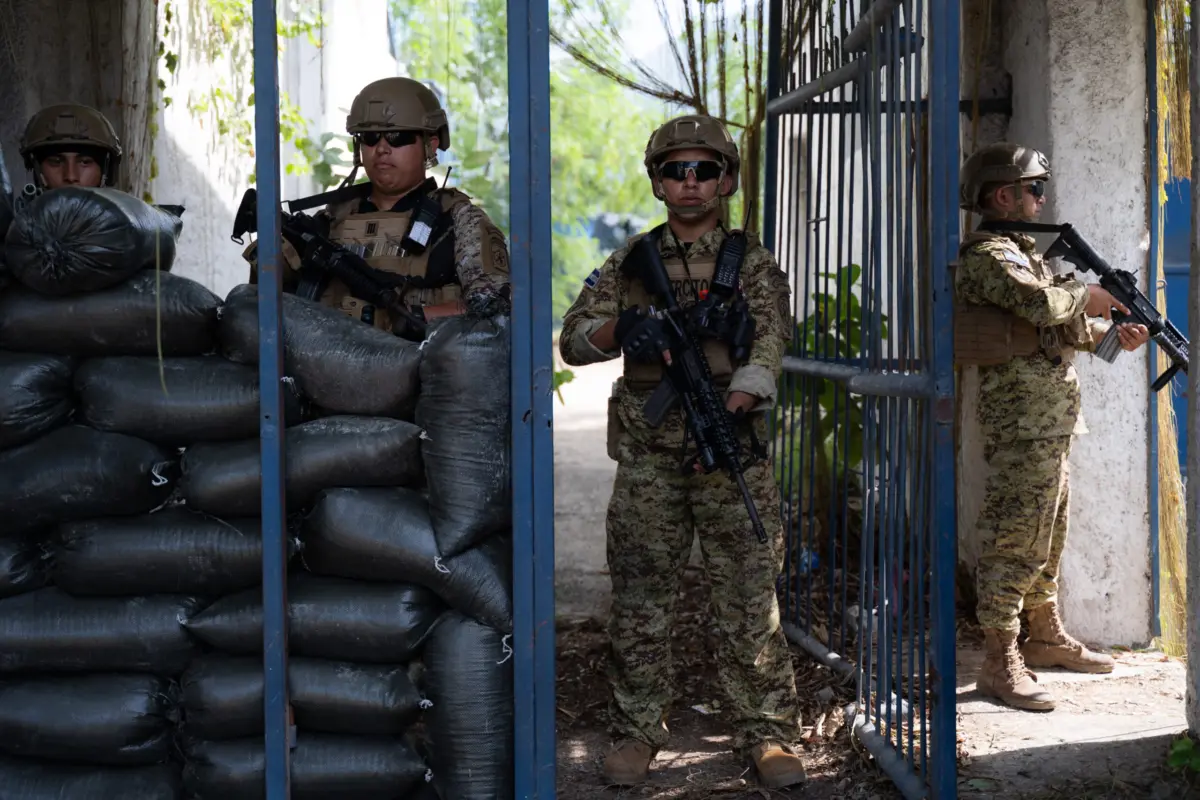
Demonstrators have marched in several Haitian cities to show support for a deployment of troops from El Salvador, despite mounting concerns from international observers and human rights advocates that the outside intervention may inadvertently worsen instability and lead to potential human rights abuses in the deeply troubled Caribbean nation. The visible public backing for the Salvadoran presence highlights the desperation among many Haitians for any action to counter the pervasive grip of armed gangs that have paralyzed the country.
On Tuesday, hundreds of protesters rallied in the streets of cities like the capital, Port-au-Prince, bearing signs with slogans like “Down with the gangs” and expressing a yearning for the "mano dura" (strong hand) approach popularized by Salvadoran President Nayib Bukele. This grassroots support underscores a profound public frustration with the Haitian government’s inability to quell the escalating violence and restore order, prompting many to look to unconventional external solutions.
Haiti’s Descent into Anarchy: A Deepening Crisis
Haiti has long struggled with chronic political instability, natural disasters, and widespread gang violence. However, the crisis dramatically worsened around July 2021, following the assassination of President Jovenel Moïse at his private residence. Moïse’s death plunged the nation into an even deeper political vacuum, exacerbating an already fragile security situation. His assassination further weakened Haiti’s central government, which had already been struggling with legitimacy and capacity, and experts universally agree that powerful criminal gangs took advantage of the eroding public confidence and the resultant power vacuum to expand their territorial control and influence.
Before Moïse’s assassination, Haiti was already grappling with a severe lack of governmental oversight, pervasive corruption, and a dysfunctional judicial system. The vacuum created by his death meant that vital state functions either ceased or became severely impaired. Gangs, already sophisticated and well-armed, swiftly moved to fill this void, consolidating control over critical infrastructure, supply routes, and entire neighborhoods. Today, it is estimated that gangs control more than 80 percent of the capital region of Port-au-Prince, effectively holding the city hostage and disrupting daily life, commerce, and humanitarian aid efforts.
The human toll of this escalating conflict is staggering. Since 2022 alone, more than 22,000 people have been killed as a direct result of gang-related violence. The United Nations reports that over half of the deaths in the first nine months of the current year are attributable to security operations, including the tragic deaths of approximately 300 civilians. The pervasive violence has also triggered a severe humanitarian crisis, with hundreds of thousands displaced from their homes, facing acute food insecurity, and lacking access to basic services. The UN estimates that nearly 2,000 people have been newly displaced since the recent arrival of Salvadoran troops, indicating the volatile nature of the ongoing security operations.
The Catalyst for El Salvador’s Intervention
The immediate trigger for El Salvador’s military deployment was the October 18 kidnapping of four Salvadoran aviation technicians near Port-au-Prince. This incident prompted El Salvador’s President Nayib Bukele to announce a swift military operation to Haiti, initially framed as a rescue mission for the abducted personnel. The rapid deployment, though initially ambiguous in its scope and duration, quickly gained international attention, partly due to Bukele’s assertive and often controversial foreign policy.
However, the initial mission parameters soon shifted. On Monday, El Salvador confirmed it would end its deployment of approximately 2,500 troops once the missing Salvadoran airmen were found. Salvadoran Security Minister Gustavo Villatoro stated, “If they reappear tomorrow, as President Bukele said, we will leave.” This announcement, however, was immediately followed by public gestures of support and diplomatic engagements from Haitian officials, with some top officials in Haiti actively encouraging the Salvadoran deployment to stay beyond its initial mandate.
Haitian Justice Minister Patrick Pelissier traveled to San Salvador on Monday, expressing profound gratitude for the troop surge and appealing for their continued presence. “The Haitian people applaud the decision of Nayib Bukele to send troops,” Pelissier said on Monday, reflecting the desperation of a populace yearning for security. He further added that Haitian security forces, working in conjunction with their international counterparts, had recently managed to regain control of Haiti’s national football stadium, which had been held by gangs for years, symbolizing a small but significant victory against the entrenched criminal elements. President Bukele, in a social media post last week, claimed that during the operation to reclaim the stadium, "we discovered several human skulls inside the stadium," underscoring the horrific nature of the gangs’ control.
The ‘Mano Dura’ Approach: A Controversial Export
President Bukele has proactively championed his country’s role in confronting Haiti’s gangs, leveraging social media to promote the offensive and sharing videos of military operations. This approach is a direct reflection of his "mano dura" or "strong hand" doctrine, a security philosophy he has popularized and implemented with dramatic, albeit controversial, results in El Salvador.
Bukele, who once famously referred to himself as the “world’s coolest dictator,” rose to prominence by promising to tackle El Salvador’s pervasive gang problem. Faced with one of the highest homicide rates in the world, he launched a hardline security crackdown on gangs in El Salvador in March 2022, declaring a state of emergency that has been repeatedly extended. This crackdown involved mass arrests, with tens of thousands of suspected gang members and affiliates detained, and mass trials.
His heavy-handed approach has undeniably led to a sharp decline in crime and homicide rates in El Salvador, earning him immense popularity domestically. However, this success has come at a steep cost and has been widely condemned by international human rights organizations and governments for severe human rights abuses. These criticisms include widespread arbitrary detentions, lack of due process, torture, deaths in state custody, and the systematic erosion of civil liberties. Human rights groups estimate that over 100,000 people have been detained under the state of emergency, often based on vague accusations and with little evidence.
Critics have vociferously warned that transplanting such tactics to Haiti, a country with a vastly different political, social, and economic landscape, could spark a severe backlash. They fear it could lead to even greater instability, exacerbate violence, and pose significant risks to civilians, potentially creating a new cycle of repression and resistance. The fundamental differences in state capacity, judicial independence, and societal structures between El Salvador and Haiti make a direct application of the "mano dura" model fraught with peril.
Furthermore, critics have raised concerns about the apparent lack of long-term planning for El Salvador’s troop deployment. A sudden or poorly managed withdrawal, for instance, could leave Haiti’s already overwhelmed and under-resourced security forces in an even more precarious position, potentially allowing gangs to regain lost ground and further destabilize the nation. Analysts also speculate that Bukele’s actions in Haiti could be strategically used as a campaign tool to drum up support for his controversial bid for a third term in El Salvador’s upcoming February presidential election, adding another layer of political complexity to the intervention.
A Series of International Actions: A Complex Legacy
The Salvadoran deployment is the latest in a long and often controversial series of international interventions in Haiti. Historically, foreign involvement in Haiti has been a double-edged sword, frequently failing to achieve lasting stability and sometimes leading to unintended negative consequences, including perceived infringements on national sovereignty.
The United States, for instance, has sent troops to Haiti on multiple occasions in the 20th century, notably occupying the country for decades from 1915 to 1934 and seizing control of its central bank, a period that still resonates in Haitian collective memory as a symbol of external domination. More recently, the United Nations has maintained various peacekeeping and political missions in Haiti. The largest was the United Nations Stabilization Mission in Haiti (MINUSTAH), which was deployed from 2004 to 2017. While MINUSTAH did provide some level of security, its legacy is marred by controversies, including allegations of sexual abuse by peacekeepers and the introduction of cholera, which killed thousands.
Currently, a United Nations-backed Multinational Security Support (MSS) mission, approved by the UN Security Council in October, is awaiting deployment. This Kenyan-led force is intended to help address the widespread gang violence and support the Haitian National Police. However, its deployment has faced significant delays, including legal challenges in Kenya, highlighting the complexities and challenges of coordinating international efforts in Haiti. The Salvadoran deployment, while distinct from the UN-mandated MSS, adds another layer to the international response landscape.
Humanitarian Concerns and the Path Forward
Amidst these security operations, the humanitarian situation remains dire. The UN estimates that nearly half of Haiti’s population, approximately 5.5 million people, require humanitarian assistance. The ongoing conflict disrupts food supply chains, impedes access to healthcare, and displaces thousands, creating a vicious cycle of poverty and vulnerability. While Justice Minister Pelissier stated that Haiti’s government had not reported any civilian casualties in the latest operations, which he described as professional, the UN’s own casualty figures indicate that civilian deaths are an unfortunate reality of the security crackdown. “The best to do is to avoid, as much as possible, human rights violations, and that’s what we are doing together,” the minister affirmed, emphasizing the importance of adherence to international norms.
The timeline for the Salvadoran troop withdrawal remains uncertain, complicated by the conflicting reports regarding the fate of the kidnapped airmen. Wilson Joseph, the leader of Haiti’s notorious 400 Mawozo gang, told The Associated Press that the four technicians are already dead, though he provided no evidence to back his assertions and claimed the abduction took place in territory controlled by Chen Mechan, a rival gang. This lack of verifiable information further clouds the prospects for a swift resolution to the crisis.
For Haiti to achieve long-term stability, a multifaceted approach is required. Beyond immediate security interventions, the international community and Haitian authorities must focus on strengthening state institutions, reforming the justice system, combating corruption, and fostering inclusive economic development. Without addressing these foundational issues, any security gains, whether achieved by domestic forces or international partners, risk being temporary and ultimately unsustainable. The delicate balance between restoring order and upholding human rights will be crucial in determining the ultimate impact of El Salvador’s intervention and the broader international efforts to stabilize Haiti.
