

Fifty years ago, Alain Peyrefitte, then a spokesperson for French President Charles de Gaulle, penned his seminal work, Le Mal français (The French Malaise). In this influential book, Peyrefitte meticulously argued that the progress and dynamism of the French nation were fundamentally undermined by a pervasive lack of trust – both within society itself and between its citizens and state institutions. This deep-seated distrust, he posited, led to an overcompensating state, which sought to exert excessive control through an intricate web of rules, pervasive bureaucracy, and relentless centralization, ultimately fostering stagnation rather than innovation and growth. Today, five decades later, the "French malaise" endures, yet its manifestations have evolved dramatically, presenting a complex challenge to the very fabric of the Republic.
The Enduring Shadow of Distrust: Peyrefitte’s Legacy
Peyrefitte’s observations in 1976 captured the anxieties of a nation grappling with its post-war identity and the legacies of Gaullism. The book resonated deeply in a France that, while having undergone significant modernization, still bore the hallmarks of a historically centralized and hierarchical state. De Gaulle’s vision of a strong, sovereign France, while inspiring, also inadvertently reinforced the state’s paternalistic role, often at the expense of individual initiative and local autonomy. Peyrefitte’s critique highlighted how this top-down approach, while perhaps intended to forge national unity, instead created a chasm of mistrust. Citizens felt distant from an opaque administrative apparatus, and the state, in turn, viewed societal initiatives with suspicion, leading to a vicious cycle of control and resentment. This foundational analysis of trust deficit and over-centralization remains eerily relevant, providing a historical lens through which to view contemporary French discontents.
Contemporary Manifestations: A Nation in Tumult
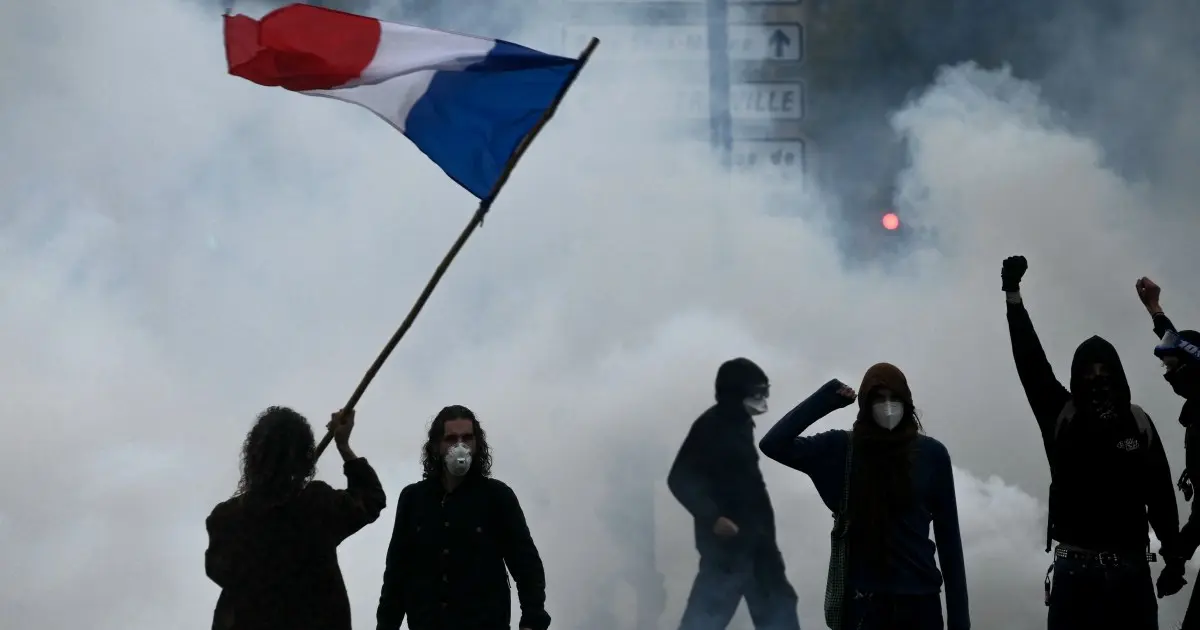
The symptoms of today’s malaise are starkly different from those described by Peyrefitte, characterized by dramatic and often violent protests that periodically engulf French cities. Recent years have seen widespread unrest, from the "Yellow Vest" movement challenging fuel taxes and economic inequality in 2018-2019, to the massive demonstrations against pension reforms in 2023, and the furious urban riots following the police killing of teenager Nahel Merzouk in Nanterre. These protests, involving students, workers, and a broad spectrum of disaffected groups, are not mere isolated incidents but rather the visible tip of a much deeper societal iceberg, signaling profound systemic issues.
The intensity of these demonstrations reached a critical point in October, where symbols of state authority were explicitly targeted. Town halls in Limoges and Marseille, along with an official building in Lyon, suffered attacks, and businesses faced widespread looting. In response, President Emmanuel Macron issued a stern condemnation, declaring these acts sought "to tear down our institutions." Such powerful rhetoric inevitably draws parallels to the discourse employed by the French government during the seismic events of May 1968, when student-led protests challenging the established order were similarly denounced as an "attack on the Republic."
Echoes of Unrest: Comparing ’68 and 2005
While a superficial comparison between the current wave of demonstrations and May 1968 might be tempting, a closer examination reveals fundamental differences. The 1968 protests, largely spearheaded by a privileged student youth, primarily articulated demands for greater freedom, challenging traditional social norms, academic structures, and the perceived authoritarianism of the Gaullist state. Their grievances were rooted in a desire for cultural liberation and individual expression within a relatively affluent society.
In contrast, today’s protests are driven by a different impetus and demographic. The current demonstrators are largely demanding equality, dignity, and social justice, often stemming from experiences of economic marginalization, systemic discrimination, and a sense of being "left behind" by the state and the economic system. They represent segments of society that feel excluded from the Republic’s promise of universalism.
Perhaps a more pertinent historical parallel to understand the current dynamics is the widespread upheaval of 2005. For three weeks in October and November of that year, the impoverished suburbs (banlieues) of Paris and other major cities erupted in anger following the deaths of two teenagers, Bouna Traoré and Zyed Benna, who were electrocuted while hiding from police in an electrical substation in Clichy-sous-Bois. This incident ignited an unprecedented wave of urban unrest, with residents of geographically and socially marginalized neighborhoods expressing deep-seated fury over police violence, racial profiling, and their chronic marginalization. The riots involved thousands of vehicles being torched, public buildings attacked, and a national state of emergency declared, illustrating a profound rupture between the state and a significant segment of its youth.
The Fault Lines: Policing, Marginalization, and the State
The 2005 unrest illuminated two critical elements of the enduring French malaise that persist today. First, it underscored the deep and widening divide between two distinct segments of French society: the prosperous, often predominantly white, urban populations residing in city centers, and the marginalized, often racialized, poor living in the underdeveloped and underserviced outskirts. This geographical and socio-economic segregation has only intensified, with disparities in access to education, employment, and public services creating a fertile ground for resentment. Unemployment rates, for instance, in some banlieues can be two to three times the national average, particularly among youth.
The second critical element brought to the fore was the nature of the French police force itself. In many democratic nations, a citizen-oriented police force aims to build trust and foster community bonds, acting as guardians of public safety for all. However, in France, the police have historically been tasked primarily with defending the authority of the state (gardien de la paix), rather than consistently protecting and serving all citizens equally. This institutional mandate often translates into a policing approach that does not contribute to national cohesion. Reports from human rights organizations, including Amnesty International, have consistently highlighted concerns about disproportionate use of force, lack of de-escalation tactics, and systemic racial bias in French policing, particularly targeting communities of color and residents of impoverished areas.
This discriminatory approach, which differentiates between affluent neighborhoods and underprivileged areas, and between the white majority and communities of color, has profoundly eroded trust. The perception, often backed by data, that law enforcement operates with impunity and without adequate accountability, further exacerbates tensions. It is perhaps no surprise, then, that polls have indicated upwards of 60 percent of French police and military personnel vote for far-right parties, reflecting a particular worldview and potentially an "us vs. them" mentality that views certain segments of the population as inherently threatening. This trend, coupled with the state’s robust defense of police actions even in controversial cases, deepens the chasm between the police and the communities they are meant to serve.
A Fractured Society: The ‘French Archipelago’ Thesis
In 2019, French political scientist Jérôme Fourquet offered a compelling framework for understanding contemporary France in his book, The French Archipelago: The birth of a diverse and divided nation. Fourquet argues that France has undergone a profound societal transformation, leading to a fundamental alteration in people’s relationship with themselves and with the "other." The traditional notion of a unified, homogenous French identity has fragmented, resulting in a society composed of numerous small, increasingly isolated "islands" or communities, each with its own values, customs, and perceptions, often disconnected from the others.
This societal fragmentation, Fourquet contends, cannot be attributed solely to immigration, though demographic shifts certainly play a role. More fundamentally, it is the result of what he terms the "secession of the elite." This refers to a growing detachment and indifference of the nation’s political, economic, and cultural elite from the fate and concerns of the majority of the population. This includes segments of the political left, now colloquially referred to as the gauche caviar (the "caviar left"), implying a disconnect from working-class realities. The elite’s abandonment and self-isolation, manifested through economic policies that exacerbate inequality, a perceived disdain for traditional values, and a failure to address the daily struggles of ordinary citizens, have, in Fourquet’s view, precipitated a "revolt of the masses" – a bottom-up reaction to top-down neglect.
Historically, institutions such as public schools, youth summer camps, and compulsory military service played a crucial role in fostering socialisation across diverse groups, instilling a sense of shared national identity and belonging. However, many of these traditional unifying forces are either no longer functioning effectively, have been significantly curtailed, or have lost their universal appeal and reach. For example, the abolition of compulsory military service in 1996 removed a significant mechanism for mixing youth from different social and regional backgrounds. Budget cuts to public education and youth programs further weaken the state’s capacity to build social cohesion, leaving a void that contributes to the archipelago effect.
The Scapegoat Narrative: Islamophobia and Identity Politics
In this increasingly fragmented society, a dangerous trend has emerged: the selection of one segment of the population as a scapegoat for all societal problems. This diversionary tactic deflects attention from the deeper, systemic roots of the malaise. Islamophobia has become alarmingly prevalent in France, often intertwined with the propagation of the "Great Replacement" conspiracy theory, a racist ideology asserting that white European populations are being systematically replaced by non-European immigrants, particularly from Muslim-majority countries. This narrative, once confined to the fringes, has seeped into mainstream political discourse.
Indeed, Islamophobia has become institutionalized through specific legislation and a political culture that, in the name of secularism (laïcité), has arguably transformed blasphemy into something resembling a civic duty for some, and criticism of Islam into a litmus test for "integration." Examples include the 2004 ban on religious symbols (including headscarves) in public schools, and more recently, the 2021 "separatism law," officially titled "Law reinforcing republican principles." While ostensibly aimed at combating radicalization and protecting secularism, critics argue this law disproportionately targets Muslim communities, placing them under increased surveillance and scrutiny, and further stigmatizing Islamic practices.
The paradox of the French situation is striking: compared to many of its European neighbors like Germany or the United Kingdom, France actually has a proportionally smaller immigrant population (around 10-13% foreign-born, depending on the definition, compared to 15-18% in Germany and the UK). Yet, it espouses a significantly louder and more insistent rhetoric about "integration." Moreover, there exists a considerable gap between this rhetoric and the reality on the ground. While those in power frequently demand that people of immigrant background "integrate" into French society and its republican values, very little concrete action or investment is undertaken by the state to genuinely facilitate this process. Lack of targeted support for integration, persistent discrimination in housing and employment, and insufficient investment in marginalized neighborhoods contradict the stated goal.
The Unfulfilled Promise of Citizenship
As a result of these systemic failures, many French citizens, particularly those from immigrant backgrounds or marginalized communities, feel they are French only on paper. They understand that citizenship cannot be reduced to a mere political discourse or a legal status devoid of practical implications. Without genuine, equitable access to fundamental rights – which necessarily entails social justice, economic opportunity, and human dignity – there can be no meaningful or felt sense of citizenship. These citizens often face a daily reality of discrimination in education, employment, housing, and interactions with public services, leading to a profound sense of alienation.
This deep disillusionment led a group of activists in 2005 to declare themselves the "Natives of the Republic" (Indigènes de la République), explicitly calling for the "decolonization" of France from within. Their movement argued that the Republic, despite its universalist ideals, had reproduced a colonial order internally, maintaining systems of racial and social hierarchy that echoed France’s historical imperial past. Indeed, anyone familiar with French society can recognize the enduring patterns of discrimination and marginalization that disproportionately affect communities with roots in former French colonies.
France, the nation that gave birth to the Declaration of the Rights of Man and of the Citizen in 1789 – a foundational document proclaiming universal liberty, equality, and fraternity – has demonstrably struggled to treat some of its own people as full and equal citizens. This failure, manifested in persistent inequality, institutionalized discrimination, a divisive approach to secularism, and a deepening chasm of mistrust between the state and segments of its population, stands at the core of the new, multifaceted French malaise. Addressing this crisis will require not just policy adjustments, but a fundamental rethinking of the Republic’s social contract, its understanding of citizenship, and its commitment to universal values for all its inhabitants.
