

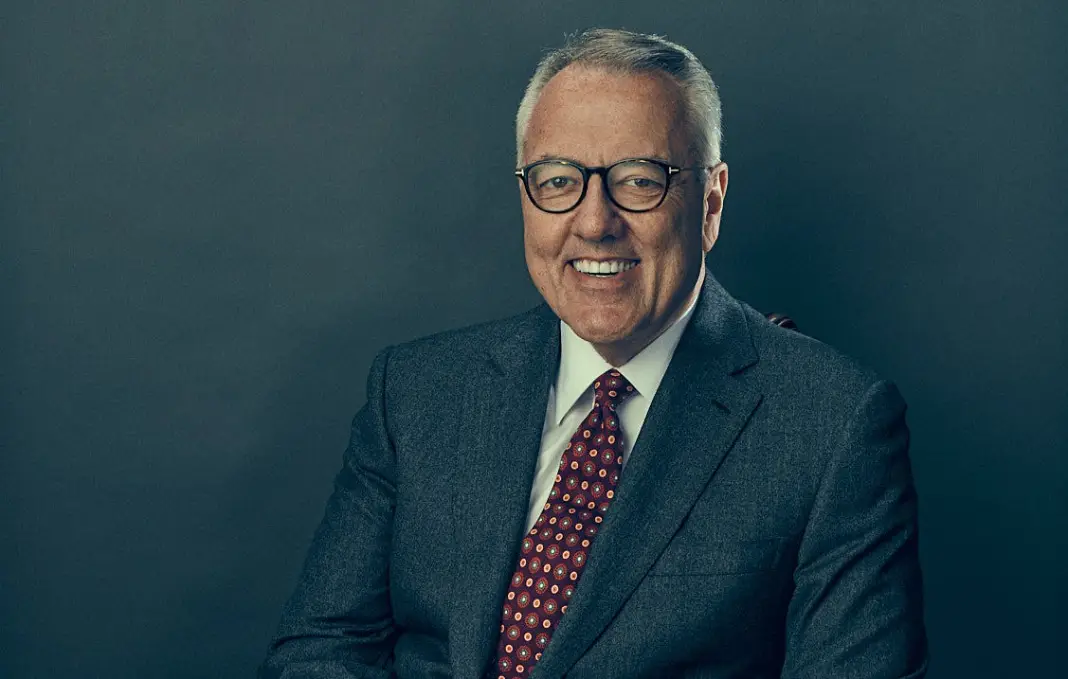
Nineteen years ago, Greg Brown inherited a sprawling, beleaguered Motorola empire valued at over $40 billion, teetering on the brink of collapse. His subsequent, often painful, dismantling of the conglomerate to salvage the company has since yielded returns far exceeding initial expectations, marking one of modern business’s most remarkable transformations. This strategic pivot, driven by a blend of brutal honesty, decisive action, and unwavering focus, has not only saved Motorola but has repositioned it as a global leader in mission-critical communications and public safety technology. For this extraordinary achievement and the depth of leadership foresight it represents, Greg Brown has been named Chief Executive’s 2026 CEO of the Year.
The Crucible of Crisis: A CEO’s Darkest Hour
The weight of leadership pressed heavily on Greg Brown in the early hours of a sleepless night in 2008. Around 3 a.m., his wife, Anna, found him pacing their home outside Chicago, a physical manifestation of the immense pressure he was under. The CEO role at Motorola had already taken a toll; Brown had shed 40 pounds, a stark indicator of the relentless challenges. His tenure had been marked by drastic measures: slashing over 15,000 jobs, freezing pension plans, and executing a reverse stock split. The once-iconic handset division, responsible for introducing the commercial cell phone in 1973 and creating the celebrated Razr, was hemorrhaging more than $1 billion annually. This flagship business, a symbol of Motorola’s past glory, had become a critical liability, unsellable despite its historical significance.
Adding to the turmoil, activist investor Carl Icahn had amassed a substantial stake at market highs and was vocal in his dissatisfaction, placing Brown squarely in his crosshairs. The board, sensing the company’s precarious position, grew increasingly restless. In this crucible of uncertainty, Brown confessed to his wife, "You have no idea how bad this is."
Anna Brown’s response, however, provided a crucial anchor. "You’re right," she acknowledged, "And I don’t care. But while you’re walking around the house with your shoulders slumped, consumed in self-doubt and self-pity, there are 75,000 people working for you waiting for you to lead. So, Greg, you gotta get your shit together. Eat the elephant one bite at a time and get going." This pivotal moment, a stark reminder of his responsibility, became a turning point.
Strategic Surgery: Decisive Action in the Face of Adversity
Brown did not miraculously transform Motorola overnight. Instead, he embraced a pragmatic, step-by-step approach. He returned to the core tenets of effective leadership: unvarnished honesty about the company’s predicament, the identification of critical decisions, and the courage to act decisively, even without unanimous board approval.
A key move was the strategic decision to bring in outside expertise for the ailing handset business. He hired Sanjay Jha, a Qualcomm executive, as co-CEO. Jha was at the forefront of a nascent technology called Android, which would soon revolutionize the mobile landscape. Simultaneously, Brown navigated a contentious settlement with Carl Icahn, a move that, despite initial board objections, ultimately accelerated decision-making and is now cited as a landmark in corporate governance. The activist’s presence, paradoxically, galvanized the company’s leadership.
The most consequential decision, however, was the aggressive push to spin off the consumer mobile business – the very heart of Motorola’s brand recognition but also its deepest financial drain. This strategic divestiture allowed Brown to focus Motorola’s resources and future on its then-underappreciated but critically important mission-critical communications business. This sector served the indispensable needs of first responders, military personnel, and government agencies worldwide, a market characterized by high switching costs and deep customer loyalty.
The Birth of Motorola Solutions: A New Trajectory
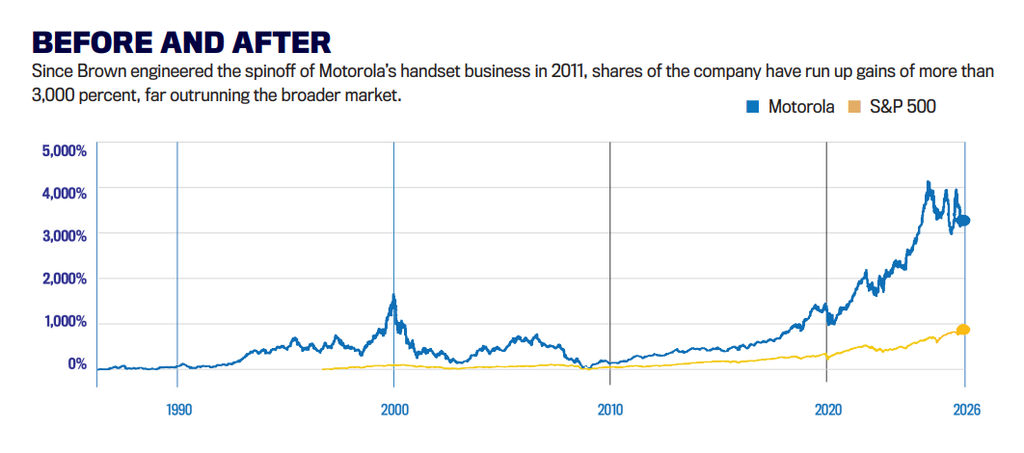
In January 2011, Motorola Mobility was officially spun out. Eight months later, Google acquired it for $12.5 billion, a testament to the residual value of the handset business. The entity that remained, under Greg Brown’s steadfast leadership, was Motorola Solutions, trading on the NYSE as MSI. What followed was a period of extraordinary, albeit quiet, success that has reshaped its standing in the corporate world.
Today, Motorola Solutions stands as a powerhouse in public safety and enterprise security, generating $11.7 billion in annual revenue. Its focus is laser-sharp: powering the essential infrastructure that underpins societal safety. This includes the networks that keep 911 call centers operational, the body cameras worn by law enforcement officers, and the sophisticated communication systems relied upon by first responders in every major U.S. city and in over 100 countries.
Under Brown’s stewardship, Motorola Solutions has executed more than 60 strategic acquisitions, each meticulously aligned with its core mission. These acquisitions have bolstered its capabilities and extended its market reach. The result has been a staggering total shareholder return exceeding 1,500% since the spin-off, dramatically outperforming the S&P 500’s approximately 400% return over the same period. With a market capitalization of $66.5 billion, Motorola Solutions has firmly established itself as one of the past decade and a half’s most significant compounders, a fact that often surprises those who still associate the Motorola name solely with mobile phones.
Recognition of Visionary Leadership
The selection committee for Chief Executive’s CEO of the Year recognized the profound impact of Brown’s leadership. Marillyn Hewson, former chair and CEO of Lockheed Martin and a member of the committee, lauded Brown as "an exceptional leader who has navigated a challenging and complex environment to transform Motorola into a highly valued technology partner for public safety entities around the world."
Tamara Lundgren, former chair and CEO of Radius Recycling and a veteran committee member, echoed this sentiment, stating, "His courageous transformation of an iconic company toward mission-critical communications, software growth, and rigorous operational excellence has redefined its trajectory and built a powerful launchpad for Motorola’s next century."
Dave Ricks, chair and CEO of Eli Lilly and a committee member, underscored the strategic acumen and execution prowess behind Motorola Solutions’ success: "Greg Brown has led his company from challenged to winning with his willingness to make a bold strategic bet and a relentless focus on execution. The fact that Motorola now sits at the core of public safety communications—protecting communities across the U.S. and around the world—is a testament to his vision and discipline. As a long-serving CEO, Greg has earned the respect of investors, his customers, and fellow CEOs alike. He is an outstanding choice for CEO of the Year."
A Humble Beginning, A Remarkable Ascent
Greg Brown’s journey to the helm of a corporate titan was not paved with preordained destiny. Born in 1960 in Highland Park, New Jersey, he was the youngest of five children. His academic path led him to Rutgers University, where he earned a bachelor’s degree in economics in 1982. Far from the typical profile of a future tech leader, Brown’s early career saw him join AT&T in Detroit, guided by his older brother, Dick, who would himself become a prominent CEO.
Brown’s aptitude for leadership quickly became apparent. By 29, he was president of Ameritech’s equipment business. His ascent within Ameritech was rapid, culminating in his leadership of Ameritech New Media, where he built a significant cable TV operation from the ground up, a business eventually sold for approximately $1 billion.
In 1999, seeking a greater challenge, Brown moved to Micromuse, a San Francisco-based software company. As chair and CEO, he spearheaded its growth from $28 million to over $200 million in annual revenue before Motorola came calling in 2003. He joined the conglomerate to lead its Commercial, Government and Industrial Solutions Sector (CGISS)—a division then largely overlooked but which Brown recognized as the company’s most promising asset.
This success, Brown emphasizes, was not a matter of chance but of instilled values. He attributes his resilience and pragmatic approach to his father, Harris Brown, whose philosophy was simple: "When you’re in a tough spot, don’t be an excuse guy. Look in the mirror, and mow your own lawn." His mother, Winifred Brown, provided the complementary perspective of unwavering optimism, instilling in him the belief that he could achieve anything he set his mind to. Brown describes himself as a blend of these two guiding influences.
The competitive drive was further fueled by his brother Dick’s distinguished career. "I remember my father saying, ‘Look at your brother, he’s a CEO,’" Brown recalls. This familial benchmark, while high, also served as proof of attainability. On the eve of his first job in Detroit, Brown confidently told his father, "By the way, Dad, I really appreciate you driving me out, and I just want to tell you one thing—you ain’t seen nothin’ yet. I’m gonna surprise you." This was not an assertion of arrogance, but a deeply felt conviction.
The "Blessing of the Obvious": Identifying the Core Strength
The Motorola that Greg Brown inherited as CEO in January 2008 was a company with a storied legacy of innovation, akin to Bell Labs combined with the federal government’s deep technical expertise. Its history was punctuated by groundbreaking inventions: the portable TV, the pager, the portable cellular telephone, and the transponders used in the Apollo moon landing. At its peak in 2006, Motorola had achieved an impressive $42.9 billion in revenue.
However, a persistent weakness had plagued Motorola throughout its history: an inability to sustain market leadership once competitors emerged. The company would innovate, dominate for a period, and then cede ground to faster-scaling, lower-cost manufacturers. The mobile phone, once a symbol of Motorola’s prowess, became emblematic of this pattern. By the time the Razr craze waned and the iPhone debuted in 2007, the handset division was losing over $300 million per quarter, having missed the crucial transition to 3G technology.
Brown’s stark assessment was unequivocal: "If we didn’t get out of the cell phone business, there would be no interview today. We wouldn’t be here." His conviction, particularly notable given the handset business’s prominent role in Motorola’s identity, lay in recognizing that the company’s most valuable asset was not its most visible. It was CGISS, the public safety and government communications division, which represented a mere 10% of revenue during the Razr era.
This sector operated on a foundation of mission-critical networks, custom-engineered for individual clients like the NYPD, LAPD, and the Pentagon. The high switching costs and the inherent complexity of these systems created formidable barriers to entry. "These networks were built and curated and customized around each customer," Brown explained. "Very high switching costs. Significant barriers to entry." In essence, he identified deep, defensible competitive moats.
Navigating the Storm: A Tumultuous Transformation
Brown’s tenure as CEO began with immediate, seismic shifts. In his first board meeting in January 2008, he advocated for a statement acknowledging the company’s evaluation of strategic alternatives. By March 2008, the discussion had sharpened to the potential spin-off of the handset business. Within four months of taking office, and against the board’s explicit objection, he settled with Carl Icahn. His pragmatic approach was simple: "I want him inside the tent pissing out, not outside pissing in."
The decision to hire Sanjay Jha, offering him a salary five times Brown’s own, was a bold move to stabilize the handset portfolio, an area where Brown lacked direct expertise. Cost-cutting measures and pension freezes were implemented, all aimed at preserving value and making the struggling handset division an attractive asset for a potential acquirer. Brown admitted, "I thought the strategy was right. I just wasn’t sure we could pull it off. I wasn’t sure there was enough tarmac in the runway to get the plane in the air."
The "Commit or Quit" Mandate: Forging a New Culture
The years following the spin-off were not without internal resistance. In 2014, a critical leadership meeting highlighted deep-seated skepticism about the company’s new direction and Brown himself. The meeting opened with unflattering quotes from social media and press coverage, painting Brown as a mere cost-cutter who broke things up rather than building growth.
Brown responded with brutal honesty, projecting the company’s historical shareholder returns. "You sucked," he declared to the room. "You’re terrible. I don’t even think you should be here. So, I’m sure I’m part of the problem, but I ain’t the biggest one. You are." He then issued a stark ultimatum: "Commit or quit." Those unwilling to fully embrace the new vision were offered generous severance packages. Approximately 15% of attendees chose to leave, a decisive step in purging the organization of inertia and fostering a culture focused on total shareholder return.
This shift was monumental, as the company culture had historically prioritized tenure and full employment over shareholder accountability. Brown discovered an unwritten rule where long-serving employees could only be fired by the chair, a cultural artifact rather than formal policy. His "Commit or quit" mandate was designed to dismantle such impediments to progress.
The Power of Focus: Strategic Acquisitions and Disciplined Growth
Since that pivotal meeting, Motorola Solutions has achieved sustained growth. A series of strategic acquisitions, ranging from tuck-ins to transformative deals, have solidified its market position. Notable acquisitions include Avigilon, an AI-driven video security company; Airwave, which manages the UK’s national emergency network; and Silvus Technologies, a leader in mission-critical mobile ad-hoc networks. The pending acquisition of D-Fend, specializing in counter-drone systems, further illustrates this forward-looking strategy. These acquisitions have consistently served to deepen the company’s competitive moat and align with the evolving needs of its core customer base.
Brown’s philosophy of "less is more" guides this approach. "I’d much rather be a $15 billion firm that’s the leader in the markets it serves than a $50 billion firm, even if the $50 billion firm is growing faster," he stated. This focus on market leadership and profitability, rather than sheer scale, is a hallmark of elite compounders.
The Road Ahead: Innovation in Public Safety
The future opportunities for Motorola Solutions are vast and transformative. The company is at the forefront of integrating advanced technologies like unmanned drones as autonomous first responders, providing crucial real-time support before human personnel can arrive. Counter-drone detection systems are being deployed to secure high-profile events and critical infrastructure. Furthermore, AI is revolutionizing emergency response, enabling real-time translation of 911 calls from Spanish to English, flagging critical keywords like "weapon," and seamlessly bridging supervisors onto calls.
Brown emphasizes that these technological advancements are not theoretical but are actively saving lives. "Shave 60 seconds off every 911 response," he points out, "and you save 10,000 lives a year in the U.S." His optimism for the company’s future is palpable and deeply rooted in its mission.
Leveraging "Event Drivers" for Consistent Alignment
Brown’s leadership philosophy extends to his meticulous approach to communication and alignment. He views every corporate interaction—from board meetings and earnings calls to one-on-ones and town halls—as an "event driver," an opportunity to reinforce strategic priorities, key messages, and critical milestones. This systematic approach ensures clarity and alignment vertically and horizontally throughout the organization.
He actively seeks external perspectives, inviting investors and analysts to share their candid assessments. This commitment to transparency and continuous feedback loop allows for course correction and strategic refinement. "Every single interaction, every ‘event’ in this context is an event driver, a catalyst for galvanizing, clarifying, and having a crystal-clear call to action on what we’re doing and why we’re doing it," Brown explains.
A Legacy of Learning and Leadership
At 66 and with 19 years at the helm of Motorola, Greg Brown’s tenure is exceptionally long, surpassing all but the founder and his son, and nearly four times the average tenure of an S&P 500 CEO. Yet, his enthusiasm for the role remains undimmed. He maintains direct contact with employees, engaging in open dialogue and demonstrating a genuine curiosity for their work. He humbly admits to not being an expert in any single area, preferring to learn from his team, famously asking to be taught about AI "like I’m in second grade" without embarrassment. This blend of humility, relentless learning, and infectious joy underscores his leadership style.
"I love the mission. I love our team. I love what we focus on," Brown states. "I never work because it isn’t work for me. If you said, ‘Would you rather go to the Amalfi Coast or work at Motorola?’—Motorola every time." This profound dedication, coupled with his strategic vision and execution, has cemented his legacy as a transformative leader.
The Core of the Transformation: From Conglomerate to Critical Enabler
Brown’s assessment of Motorola upon taking the CEO role in January 2008 painted a picture of a disparate conglomerate, a company with a rich history of invention but an inconsistent track record of commercial success. His initial attraction to the public safety division stemmed from its perceived strength, its end-to-end system orientation, and its high switching costs, creating substantial barriers to entry. This sector, then an "afterthought" representing just 4.5% of Motorola’s $40 billion revenue in 2006, held the key to the company’s future.
"This sector is an afterthought in Motorola," he recalled telling board members. "There’s one really, really good business in Motorola. And it’s called CGISS." This insight became the bedrock of Motorola Solutions’ future.
The "bright shiny objects" that had historically distracted Motorola were a stark contrast to Brown’s "less is more" philosophy. He recognized that true value lay not in breadth but in depth and focus. The company’s history of inventing products like the portable TV and the car radio, only to exit those markets, underscored the danger of diversification without sustained competitive advantage.
The critical juncture arrived with the rise of the smartphone. Motorola’s core strength, Brown identified, was "custom complex communications," not consumer computing. The missed 3G opportunity and the advent of Apple’s iPhone with its superior iOS software and hardware design meant that the handset business was unsustainable. "If we didn’t get out of the cell phone business, there would be no interview today," he reiterated.
The house was indeed on fire. Losing $300 million a quarter, with nearly $3 billion in bloated inventory, demanded immediate action. Brown’s first board meeting saw him propose evaluating strategic alternatives, quickly followed by the explicit evaluation of exiting the cell phone business. His controversial decision to settle with Carl Icahn, against board opposition, was a pragmatic move to avert a potentially crippling proxy fight and leverage Icahn’s influence to accelerate necessary changes.
The Icahn Factor: A Catalyst for Change
Brown’s relationship with Carl Icahn, though initially fraught with tension, proved to be a crucial catalyst. He engaged with Icahn extensively, fostering a relationship built on transparency. "I never lied to Carl, ever, not one sentence," Brown stated. This open communication, including late-night calls and impromptu meetings, allowed Brown to implement his strategy, which aligned with Icahn’s desire for reform.
"What I learned quickly is that having Carl’s representatives inside the boardroom allowed me to move faster on decisions," Brown explained. "The Icahn brand was a catalyst for change and acceleration in a way I didn’t fully anticipate, and it made board governance better." This strategic alliance, born of necessity, was instrumental in saving the company. The immense pressure led to Brown losing 40 pounds, a testament to the "Icahn diet" he humorously coined.
Empowering Expertise: The Sanjay Jha Partnership
Recognizing his limitations, Brown sought specialized expertise for the handset division. He recruited Sanjay Jha, then No. 2 at Qualcomm, who was already working on the nascent Android operating system. The decision to offer Jha a salary five times Brown’s own was a clear indication of Brown’s commitment to pragmatism over ego. "Check your ego at the door," he advised. Jha’s stabilization of the handset portfolio and implementation of Android were crucial steps in making the division a viable asset for divestiture. Brown identified the spin-off, the settlement with Icahn, and the hiring of Jha as the three best decisions made during his tenure.
Mastering Acquisitions: A Customer-Centric Approach
Motorola Solutions’ success is also built on a robust M&A strategy, with over 60 acquisitions executed under Brown’s leadership. This success is attributed to a deep understanding of deal intricacies, spearheaded by his long-time colleague Michael Annes, and a customer-led approach. Acquisitions are driven by feedback from the field and a deep understanding of customer needs, rather than top-down directives.
Key acquisitions like Avigilon, Airwave, and Silvus Technologies were all customer-driven, reinforcing the company’s competitive moat and expanding its capabilities in areas where existing customers were already signaling demand. Brown emphasizes the importance of assembling and retaining top talent, noting the evolution of his leadership team through a mix of homegrown expertise and external hires, all united by a shared commitment to learning, accountability, and putting the company first.
The AI Revolution and the Future of Public Safety
The integration of Artificial Intelligence represents the next frontier for Motorola Solutions. Brown approaches AI with a "realistic optimist" perspective, focusing on its immediate applications and potential to enhance public safety. He has committed that AI will be additive, not a tool for job reduction, but stressed the importance of employees embracing AI to remain relevant.
Externally, AI is poised to transform Motorola’s products. Real-time translation and transcription in body cameras and 911 systems will significantly improve emergency response times, potentially saving thousands of lives annually. AI-powered anomaly detection in video security will enhance situational awareness without overwhelming human operators. Critically, Motorola Solutions is committed to transparency regarding AI usage, implementing AI labels on its products and establishing a Technical Advisory Council (MTAC) to rigorously assess privacy and ethical considerations.
The future for Motorola Solutions, as envisioned by Greg Brown, is one of boundless opportunity. The demand for enhanced public safety and national security solutions is ever-growing, fueled by evolving threats and technological advancements. Brown’s leadership has transformed a struggling conglomerate into a focused, resilient, and innovative company poised to play a pivotal role in shaping the future of public safety worldwide. His journey is a powerful testament to the enduring impact of visionary leadership, strategic clarity, and the courage to make difficult decisions in pursuit of a greater mission.
