

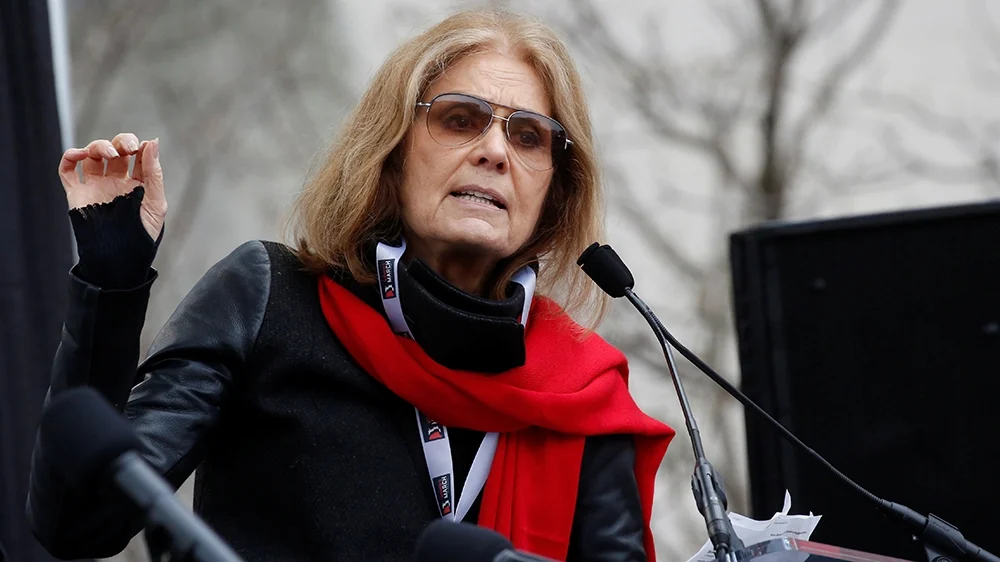
Gloria Steinem, the trailblazing journalist, author, and activist who served as the primary catalyst for the second-wave feminist movement in the United States, died on Wednesday at her home in New York City. She was 92 years old. Her passing was confirmed by her foundation via social media, marking the end of a career that spanned more than six decades and fundamentally reshaped the social, political, and legal landscape for women worldwide. Known for her signature style—long, streaked hair and oversized aviator glasses—Steinem was more than a fashion icon; she was a tireless organizer who spent the majority of her life traveling to the front lines of social justice movements.
According to statements released by her foundation, Steinem passed away peacefully, surrounded by the books and mementos of a life dedicated to the pursuit of equality. The foundation noted that her greatest gift was her ability to listen, fostering environments where people felt seen and heard. In her final years, she continued to host "talking circles" in her home, a practice she believed was essential for human empathy. She famously maintained that true connection required the presence of all five senses, arguing that the digital world could never fully replicate the solidarity found when people gather in the same room.
The Formative Years and Journalistic Beginnings
Born on March 25, 1934, in Toledo, Ohio, Gloria Marie Steinem’s early life was characterized by mobility and a lack of traditional stability. Her father was a traveling salesman, and much of her childhood was spent in a trailer. These early experiences with transience later informed her 2015 memoir, "My Life on the Road." However, it was her mother’s struggle with mental illness and the lack of social support for women in the mid-20th century that deeply influenced her later activism.
Steinem graduated from Smith College in 1956 and spent time in India on a Chester Bowles Fellowship, where she became acquainted with Gandhian activism. Upon returning to the United States, she pursued a career in journalism in New York City, a field that was overwhelmingly male-dominated at the time. Her early assignments often focused on "women’s topics," but she sought to bring a serious investigative lens to her work.
In 1963, Steinem gained national notoriety for her undercover exposé on the working conditions of "Bunnies" at the Playboy Club in New York. For the assignment, she donned the iconic ears and tail to document the low wages, sexual harassment, and demeaning physical requirements imposed on the workers. While the article, "A Bunny’s Tale," made her a household name, Steinem later expressed regret that it overshadowed her more serious political commentary. She noted that the assignment initially made it difficult for editors to take her seriously as a political journalist.
The Pivot to Activism: The 1969 Speak-Out
The trajectory of Steinem’s life changed permanently in 1969. While covering a speak-out on abortion organized by the radical feminist group Redstockings, she heard women publicly sharing their experiences with illegal and dangerous procedures. At the age of 22, Steinem herself had traveled to London to undergo a secret abortion, an experience she had kept private for years.
Hearing other women speak their truths provided Steinem with what she described as a "click" moment—a sudden realization that her personal struggles were part of a systemic political issue. This event transitioned her from a journalist observing the movement to an activist leading it. She began to argue that reproductive freedom was the bedrock of all other rights. In her view, if a person does not have control over their own body, they cannot be considered a full citizen in a democracy.
The Founding of Ms. Magazine and National Leadership
In 1972, Steinem co-founded Ms. magazine, the first national periodical to be owned and operated by women and to address feminist issues from a woman’s perspective. The magazine was a revolutionary concept in an era when "women’s magazines" focused almost exclusively on homemaking, fashion, and attracting male attention. The preview issue, published as a supplement to New York magazine, sold out its 300,000-copy run in just eight days.
Ms. magazine became a platform for groundbreaking journalism, covering topics such as domestic violence, workplace discrimination, and the wage gap—issues that were largely ignored by the mainstream press. Through the magazine, Steinem helped popularize the term "Ms." as an alternative to "Miss" or "Mrs.," arguing that a woman’s marital status should not define her identity in the same way a man’s status does not define his.
Chronology of Key Milestones in Steinem’s Career
To understand Steinem’s impact, it is necessary to look at the timeline of her contributions to the American social fabric:
- 1963: Publication of "A Bunny’s Tale" in Show magazine.
- 1969: Attends the Redstockings abortion speak-out, marking her entry into formal activism.
- 1971: Co-founds the National Women’s Political Caucus (NWPC) alongside Bella Abzug, Shirley Chisholm, and Betty Friedan.
- 1972: Launches Ms. magazine.
- 1977: Plays a lead role in the National Women’s Conference in Houston, Texas, which brought together 20,000 people to draft a National Plan of Action.
- 1983: Publishes "Outrageous Acts and Everyday Rebellions," a collection of essays that becomes a bestseller.
- 2013: Awarded the Presidential Medal of Freedom by President Barack Obama.
- 2015: Publishes "My Life on the Road," detailing her decades of traveling for the movement.
- 2020: Subject of the biographical film "The Glorias," which highlighted her intersectional approach to feminism.
Supporting Data: The Landscape of Gender Equality
During Steinem’s peak years of activism, the legal and economic status of women in the United States was starkly different from today. In 1970, women earned approximately 59 cents for every dollar earned by men. By the time of her death, that figure had risen to roughly 82 cents, though the gap remains wider for women of color—a disparity Steinem frequently highlighted in her later speeches.
Furthermore, when Steinem began her work, women could be legally fired for becoming pregnant, and in many states, they could not obtain a credit card in their own name without a male co-signer. Steinem’s advocacy was instrumental in the passage of the Pregnancy Discrimination Act of 1978 and the Equal Credit Opportunity Act of 1974.
Intersectional Advocacy and Global Outreach
Unlike some of her contemporaries, Steinem was a staunch advocate for intersectional feminism before the term was widely used. She frequently shared stages with Black feminist leaders like Dorothy Pitman Hughes and Florynce Kennedy, recognizing that race and class were inextricably linked to gender oppression.
In her later decades, Steinem expanded her focus to global issues. She campaigned against female genital mutilation (FGM) in Africa and the Middle East and worked on peace initiatives, including a 2015 crossing of the De-Militarized Zone (DMZ) between North and South Korea with a group of international female peace activists. Her activism was characterized by a refusal to slow down; even in her 80s, she was a regular presence at the Women’s March in Washington and various college campuses.
Official Responses and Tributes
The news of Steinem’s death has prompted a wave of tributes from political leaders, activists, and cultural figures.
The White House released a statement describing her as a "giant of justice" whose courage changed the American story. "Gloria Steinem did more than just lead a movement; she gave millions of women the tools to lead their own lives," the statement read.
Former President Barack Obama, who awarded her the Medal of Freedom, noted on social media: "Gloria Steinem’s life was a testament to the power of a single voice to spark a revolution. She was a friend, a mentor, and a relentless optimist who believed that the world could be made better through conversation and community."
Fellow activists emphasized her personal warmth. "Gloria didn’t just talk about sisterhood; she lived it," said a spokesperson for the National Organization for Women (NOW). "She was always the first to offer a hand to a new generation of leaders."
Broader Impact and Implications
The death of Gloria Steinem comes at a period of significant upheaval for the causes she championed. The 2022 reversal of Roe v. Wade by the Supreme Court was a development she viewed with grave concern. In her final interviews, she warned that the loss of reproductive rights was a harbinger of broader democratic erosion.
Her passing leaves a vacuum in the leadership of the American feminist movement, but her legacy is found in the infrastructure she helped build. Organizations like the Ms. Foundation for Women and the Women’s Media Center continue to operate based on the principles she established.
Analysts suggest that Steinem’s greatest impact may not be a single piece of legislation, but a fundamental shift in the American consciousness. She helped move feminism from the fringes of radical politics into the mainstream, making it possible for women to envision lives outside of traditional domestic roles.
As the nation reflects on her 92 years, Steinem’s own words serve as a fitting epitaph. She often told her audiences, "The story of women’s struggle for equality belongs to no single feminist nor to any one organization but to the collective efforts of all who care about human rights." While the "face of feminism" has passed, the movement she helped ignite continues to evolve, shaped by the curiosity, humor, and independent spirit she modeled for more than half a century.
