

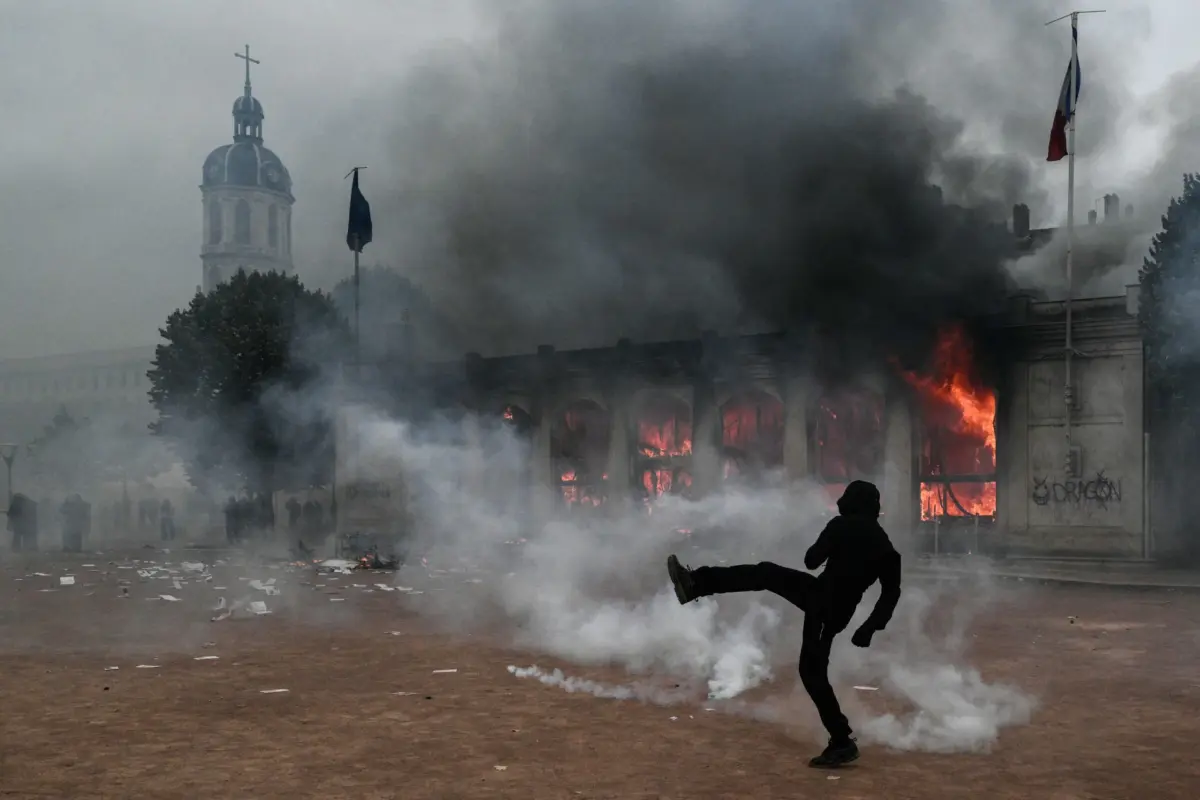
Thousands of demonstrators took to the streets across France on Saturday, engaging in widespread protests against the escalating cost of living, which quickly escalated into clashes with law enforcement in several major urban centers, including the capital, Paris. The day of nationwide action saw a diverse coalition of citizens, unions, and social movements voice their profound discontent over rising prices for essential goods such as fuel and food, putting immense pressure on household budgets already strained by economic uncertainties.
Anatomy of a Day of Disruption
The protests, which had been building in intensity over recent weeks, reached a flashpoint on Saturday, marked by significant disruption and sporadic violence. In Paris, the epicentre of much of the unrest, confrontations broke out between groups of protesters and police. Law enforcement deployed tear gas in the Place de la République, a prominent square northeast of the city centre, and its surrounding streets, in an effort to disperse individuals, many of whom were observed wearing hoods and masks, engaging in acts of vandalism or confrontation. Large contingents of riot police had been strategically deployed throughout the area from early morning, anticipating the potential for disorder. By midday, dozens of individuals had already been detained in the capital alone, as authorities sought to contain the escalating situation.
Beyond Paris, similar scenes unfolded across the country. In the southern port city of Marseille, local media outlets reported instances of protesters breaching the town hall, a symbolic act of defiance, and subsequently looting shops within the city’s commercial district, indicating a breakdown of order in specific areas. Further north, in Lyon, France’s third-largest city, reports emerged of the local tourism office being set ablaze, underscoring the destructive turn some demonstrations took. The scale of the unrest prompted a rapid response from the Interior Ministry, which, by midday, had recorded 140 separate protest actions nationwide, involving an estimated 32,800 participants. The ministry also confirmed 166 arrests had been made across the country by that point, signalling a coordinated law enforcement effort to manage the widespread demonstrations.
Despite the outbreaks of violence and property damage, a significant portion of Saturday’s events comprised peaceful demonstrations. Unions, teachers, and ordinary citizens marched through towns and cities, their presence underscoring the broad-based nature of the grievances. These peaceful assemblies highlighted the fundamental right to protest, even as authorities grappled with managing the more volatile elements within the larger movement.
The Economic Undercurrent: A Crisis of Affordability
The immediate catalyst for Saturday’s widespread demonstrations was the relentless rise in the cost of living, a phenomenon that has gripped France and much of Europe over the past year. France, like its neighbours, has been battling persistent inflation, driven by a confluence of global factors including supply chain disruptions exacerbated by the COVID-19 pandemic, the war in Ukraine, and soaring energy prices.
Official statistics from France’s National Institute of Statistics and Economic Studies (INSEE) have consistently shown inflation rates hovering at multi-decade highs. While the precise figures fluctuate, annual inflation has seen significant increases, particularly impacting staple goods. For instance, food prices have witnessed sharp increases, with common household items experiencing double-digit percentage hikes. Energy costs, particularly for fuel and heating, have been a major pain point, with petrol and diesel prices at the pump reaching unprecedented levels, directly impacting commuters, transport businesses, and agricultural sectors. The average French household has seen a noticeable erosion of its purchasing power, with wages struggling to keep pace with the upward trajectory of prices.
This economic strain is not merely an abstract statistical point; it translates directly into daily struggles for millions of French citizens. Families are forced to make difficult choices between heating their homes and affording nutritious food. Small businesses face increased operational costs, leading to potential closures or price increases that further burden consumers. The protests are a direct manifestation of this growing economic anxiety and a cry for governmental intervention and relief.
A Chronology of Mounting Discontent
Saturday’s large-scale protests did not emerge in a vacuum but were the culmination of weeks, if not months, of simmering discontent and smaller-scale actions.
- Weeks Preceding Saturday: French high school students had been actively protesting against deteriorating conditions in their schools, raising concerns about inadequate resources, overcrowded classrooms, and the general state of public education. These student rallies, while initially distinct in their focus, quickly became a precursor to the broader cost-of-living protests, as many young people and their families are directly impacted by economic hardship. Disturbingly, some of these high school protests had already seen instances of police brutality, including reports of serious injuries to students, with one harrowing case detailing a 15-year-old girl losing a hand during a demonstration. These incidents further fuelled public anger and distrust towards authorities.
- The "Yellow Vest" Echo: A significant factor in the current unrest is the resurgence of the "yellow vest" (gilets jaunes) movement. This movement, which first erupted in late 2018, also began as a protest against rising fuel prices and quickly broadened into a wider rejection of economic inequality and perceived government indifference to the struggles of ordinary citizens. The "yellow vests" became synonymous with sustained, often volatile, weekend demonstrations that profoundly challenged President Macron’s first term. Their signalled participation in Saturday’s protests was a clear indication that the grievances from half a decade ago remained unresolved and that a potent, experienced protest force was re-mobilising. Their distinct methodology, often characterised by decentralised organisation and direct action, adds a layer of unpredictability to the current wave of protests.
- Union Mobilisation: In the days leading up to Saturday, major French trade unions had issued calls for nationwide action, aiming to coalesce various grievances into a unified front. Unions representing workers across multiple sectors, including transport, education, and public services, have consistently highlighted the need for higher wages to combat inflation and for greater social protections. Their organised presence ensured a broader, more structured participation in the protests, lending them legitimacy and a significant numerical boost.
Official Reactions and Appeals for Calm
In anticipation of the potentially volatile protests, French President Emmanuel Macron issued an appeal for calm on Friday, the eve of the demonstrations. Speaking from Brussels, where he was attending official engagements, Macron acknowledged the constitutional right to protest while simultaneously stressing the imperative for respect and order. "There is a constitutional right to protest and to express oneself," he stated, "But this right comes with the need to respect. Respect for people, respect for property, and therefore a commitment not to insult or destroy." His statement reflected the government’s delicate balancing act: upholding democratic freedoms while attempting to prevent the escalation of violence and damage that had marred previous protest movements.
The Interior Ministry, led by Gérald Darmanin, played a central role in managing the security response. The deployment of large numbers of riot police, the pre-emptive arrests, and the monitoring of protest actions were all part of a strategy to maintain public order and prevent widespread anarchy. The ministry’s real-time updates on participant numbers and arrests served to frame the narrative, attempting to quantify and control the perception of the events. However, the use of tear gas and reports of injuries, particularly among students in earlier protests, also raised questions about the proportionality of the police response in certain instances, fueling criticisms from civil liberties groups and opposition parties.
Broader Impact and Political Implications
The renewed wave of protests presents a significant challenge to President Macron’s government and his reform agenda. Having just secured a second term, Macron has been pushing for ambitious reforms, including controversial pension adjustments, which have themselves been met with substantial public opposition. The current cost-of-living crisis adds another layer of complexity, diverting attention and resources, and potentially eroding public trust further.
- Political Pressure: The protests amplify the political pressure on Macron and his cabinet to deliver tangible solutions to the economic crisis. Failure to adequately address the public’s grievances could lead to sustained social unrest, making governance exceedingly difficult and potentially jeopardising the government’s ability to enact its legislative programme. Opposition parties, from the far-left to the far-right, are likely to capitalise on the public anger, using it to bolster their own political narratives and challenge the ruling majority.
- Social Cohesion: Prolonged periods of intense social unrest can strain the fabric of national unity. The divisions between those struggling economically and those perceived to be insulated, coupled with the recurring clashes between citizens and the state, can foster deep societal rifts. The government’s challenge is not just to manage the economy, but to rebuild trust and foster a sense of shared national purpose.
- Economic Implications: While the protests themselves are a symptom of economic woes, their continuation can also have direct economic consequences. Disruption to public transport, damage to commercial property, and reduced consumer confidence can further impede economic recovery. Businesses, particularly in affected urban centres, can suffer significant losses, potentially leading to job cuts or closures.
- European Context: France’s situation is not isolated. Many European nations are grappling with similar cost-of-living crises, driven by shared global economic pressures. The French protests could serve as a bellwether, potentially inspiring similar movements in other countries or highlighting the broader socio-economic challenges facing the European Union. How France manages this crisis could offer lessons, or warnings, for its neighbours.
Looking Ahead: An Uncertain Future
The immediate aftermath of Saturday’s protests will likely see continued debate over the extent of the damage, the appropriateness of the police response, and the efficacy of government policies. While the intensity of the demonstrations might fluctuate, the underlying grievances related to the cost of living are unlikely to dissipate quickly. The government faces the formidable task of implementing measures that genuinely alleviate economic hardship, while also upholding public order and preserving democratic freedoms.
Potential future scenarios include:
- Continued Weekly Protests: Much like the "yellow vest" movement, the current protests could evolve into regular weekend actions, maintaining pressure on the government.
- Government Concessions: Macron’s administration might be forced to consider further economic relief packages, such as targeted subsidies, wage increases, or tax adjustments, to appease public anger.
- Escalation of Tactics: Should grievances remain unaddressed, there is a risk of more radical elements gaining prominence, potentially leading to increased violence and more organised acts of civil disobedience.
- Political Realignment: The crisis could precipitate shifts in France’s political landscape, strengthening populist movements or leading to new alliances as traditional parties grapple with the public mood.
The widespread unrest on Saturday serves as a stark reminder of the deep-seated economic anxieties permeating French society. As the nation navigates this challenging period, the ability of its leaders to respond effectively to the legitimate concerns of its citizens will be crucial in determining the path forward for France.
