

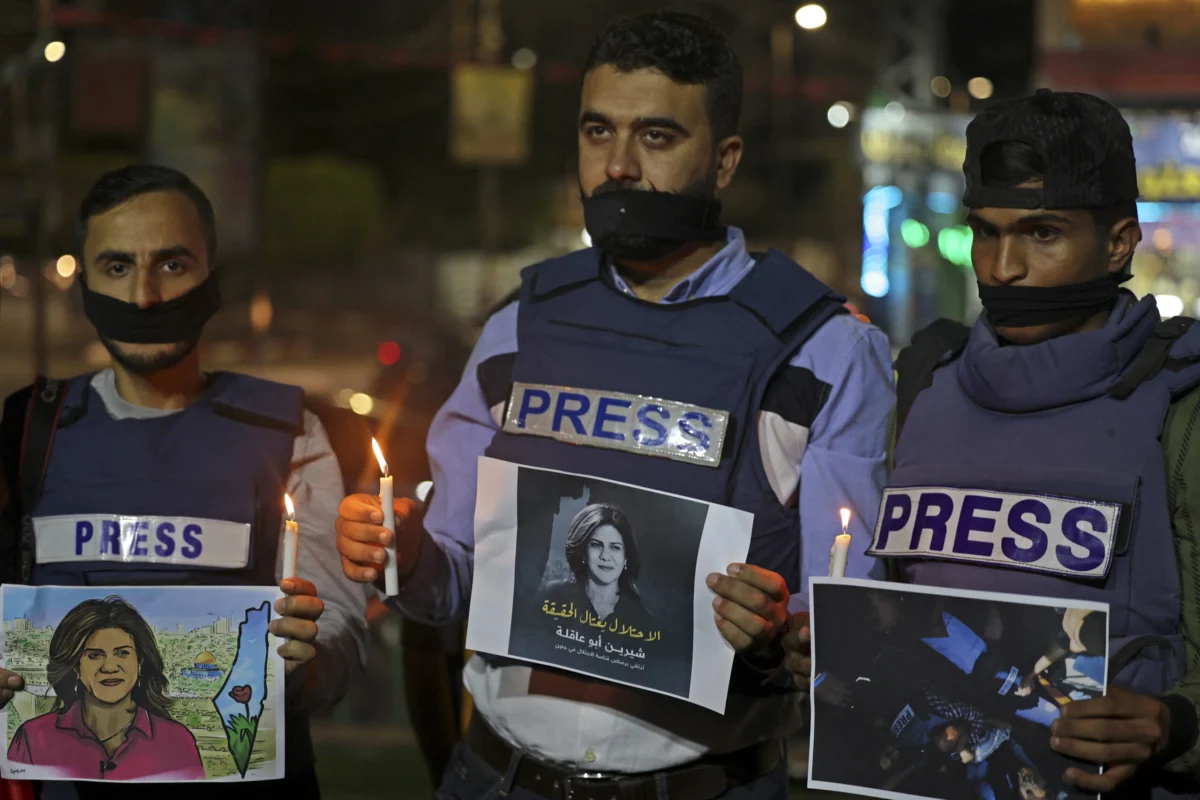
Four years have passed since the killing of veteran Palestinian-American journalist Shireen Abu Akleh, a tragedy that continues to reverberate across the globe and underscore persistent demands for accountability. On May 11, 2022, Abu Akleh, a revered correspondent for Al Jazeera, was fatally shot while covering an Israeli military raid in the Jenin refugee camp in the occupied West Bank. Her colleague, Ali al-Samoudi, also an Al Jazeera journalist, was shot in the back moments before her death, surviving to recount the harrowing events of that day. His experience in the immediate aftermath — medics restraining him as his critically wounded colleague’s body arrived at Ibn Sina hospital — painted a stark picture of the chaos and profound loss. "I managed to look and see Shireen lying next to me. I couldn’t believe the situation. I started screaming, and I tried to get to her. They didn’t let me," al-Samoudi recounted to Al Jazeera, adding with a grim certainty born of experience, "But I knew from my experience in field work that it was clear that she had been killed."
The killing of Abu Akleh, a US citizen renowned throughout the Arab world for her unflinching coverage of the Israeli-Palestinian conflict, sparked international outrage and an immediate call for an independent investigation. Yet, despite widespread condemnation and multiple probes by international bodies and media organizations pointing towards Israeli military culpability, no arrests have been made, and no charges have been filed. This persistent lack of accountability, critics argue, has emboldened Israel, contributing to a broader pattern of abuses against journalists and civilians, particularly evident in the current conflict in Gaza.
A Pillar of Palestinian Journalism: Shireen Abu Akleh’s Enduring Legacy
Shireen Abu Akleh was more than just a journalist; she was an icon. Born in Jerusalem in 1971, she held both Palestinian and US citizenship. Her career, spanning over two decades with Al Jazeera, made her a household name across the Middle East and North Africa. Known for her calm demeanor, articulate reporting, and deep understanding of the Israeli-Palestinian conflict, Abu Akleh became a trusted voice, often reporting from the front lines of significant events. Her distinctive voice and presence brought the realities of life under occupation into millions of homes, making her a symbol of journalistic integrity and resilience for a generation of Palestinians and Arabs.

Her work was particularly impactful in documenting the second Intifada (2000-2005) and subsequent conflicts, providing crucial context and human stories that often went unreported by mainstream Western media. She covered pivotal moments such as the siege of Bethlehem’s Church of the Nativity in 2002 and numerous Israeli incursions into Palestinian cities. Colleagues remember her as meticulous, brave, and deeply committed to her profession and the truth. Ali al-Samoudi, reflecting on her legacy, described her as embodying "a comprehensive school in journalism, in humanity, in morality, in superior ideals." He emphasized her professionalism, her unique ability to "analyse, describe and report on any situation with sophistication," earning her universal respect. Her death was not just the loss of a journalist, but of a vital chronicler of history and a voice for the voiceless. Her image, often seen wearing her iconic blue press vest and helmet, became synonymous with courage in reporting from one of the world’s most challenging conflict zones.
The Tragic Events of May 11, 2022: A Detailed Chronology
The morning of May 11, 2022, found Shireen Abu Akleh and Ali al-Samoudi, along with other journalists, in the Jenin refugee camp, a persistent flashpoint in the northern West Bank, to cover an ongoing Israeli military raid. Jenin had been experiencing heightened tensions and frequent Israeli incursions as part of what Israel termed "Operation Breakwater," launched in response to a series of attacks inside Israel. These raids frequently led to clashes between Israeli forces and Palestinian residents, often resulting in casualties.
- Early Morning: Abu Akleh, al-Samoudi, and other journalists, including producer Majdi al-Haddad and reporter Shatha Hanaysha, arrived at the western edge of the camp around 6:00 AM local time. They were clearly identifiable as members of the press, wearing blue protective vests emblazoned with "PRESS" and helmets, in accordance with international journalistic safety protocols for conflict zones.
- Positioning and Lack of Clashes: According to al-Samoudi and other eyewitnesses, the journalists positioned themselves on a side street where Israeli military vehicles were parked. Crucially, al-Samoudi stressed that there were "no [Palestinian] fighters. There were no clashes of any kind near us. There weren’t even any stone throwers. We were also far from Palestinian civilians who were behind us." Their intent was to find a safe vantage point for coverage, as is standard journalistic practice. This absence of active combat in their immediate vicinity is a critical detail confirmed by multiple independent investigations.
- The First Shot: As they advanced cautiously, the first shot rang out. Al-Samoudi, who was slightly ahead, turned to warn Abu Akleh. "I was telling her, ‘Let’s go back; it looks like they’re shooting towards us.’ As soon as I finished my sentence, I felt like something struck me. I put my hand on my back and found blood," he recalled. He believes turning away likely saved his life, as the bullet might have otherwise hit his chest.
- The Second, Fatal Shot: Abu Akleh’s final words were, "Ali got injured." As al-Samoudi ran for cover, bleeding heavily, Abu Akleh retreated and sought shelter by a wall. A second bullet, fired with precision, struck her in the head, in the small, unprotected area between her helmet and protective vest. This detail, al-Samoudi emphasized, pointed to a deliberate act: "This was not an accident or a coincidence." Forensic analysis later indicated the bullet was a 5.56mm round, commonly used by Israeli military rifles.
- Aftermath: Al-Samoudi was rushed to Ibn Sina hospital, approximately 500 meters away. Soon after, Abu Akleh’s body arrived, brought by distraught colleagues and local residents. The scene at the hospital, with al-Samoudi grappling with his own injuries while witnessing his colleague’s lifeless form, underscored the brutality of the event and the profound loss felt by the journalistic community.
The journalists were visible and posed no threat to Israeli forces, and no warning was issued before the shooting began, according to al-Samoudi and other eyewitnesses. This account was corroborated by multiple independent investigations, which found no evidence of Palestinian militant activity in the immediate vicinity of the journalists at the time of the shooting, directly contradicting initial Israeli claims.
Contradictory Narratives and Failed Investigations
The immediate aftermath of Abu Akleh’s killing was marked by conflicting accounts and international calls for a thorough, transparent investigation.

- Israeli Response and Investigations: Initially, then-Prime Minister Naftali Bennett falsely claimed that Palestinian fighters were responsible for Abu Akleh’s death, sharing a video of clashes that occurred far from the scene. This narrative quickly collapsed under scrutiny from eyewitnesses and geolocated video evidence. Subsequently, the Israeli military launched its own investigation. In September 2022, it concluded there was a "high possibility" that Abu Akleh was "accidentally hit" by Israeli fire from a soldier targeting suspected militants. However, it ruled out a criminal investigation and denied deliberate targeting. This conclusion drew widespread criticism for its lack of transparency, its failure to align with eyewitness testimonies, and its dismissal of criminal intent. Human rights groups and legal experts argued that even if unintentional, a lack of clear rules of engagement or failure to identify targets properly could constitute a war crime.
- Palestinian Authority Investigation: The Palestinian Authority conducted its own investigation, which concluded that Abu Akleh was intentionally targeted by Israeli forces. They handed the bullet that killed her to US investigators for forensic analysis, though the US ultimately stated the bullet was too damaged for a definitive conclusion on its origin, while acknowledging "likely" Israeli fire.
- Independent Media and UN Probes: Several prominent media organizations, including CNN, The New York Times, The Washington Post, and the investigative collective Bellingcat, conducted their own forensic analyses and witness interviews. These investigations consistently pointed to Israeli military fire as the cause of death. For instance, a CNN investigation published in May 2022 concluded that the evidence suggested Abu Akleh was shot in a "targeted attack by Israeli forces." The United Nations Human Rights Office (OHCHR) also concluded in June 2022 that the shots that killed Abu Akleh and injured al-Samoudi came from Israeli forces and that it was "deeply disturbing" that Israel had not launched a criminal investigation.
- US Investigation and Silence: Given Abu Akleh’s US citizenship, calls for a US-led investigation were immediate and persistent. In late 2022, Israeli officials confirmed that the US Federal Bureau of Investigation (FBI) had opened a probe into the shooting. However, four years later, this investigation has yielded no public reports or criminal charges. Ali al-Samoudi stated he was interviewed by US officials only once, with no follow-up. The US Department of Justice has remained silent on the progress of the probe. Critics, including the administration of President Joe Biden, have been accused of adopting the Israeli narrative that the killing was accidental, despite the weight of evidence suggesting otherwise. This lack of transparency and action from Washington has been a significant point of contention for Abu Akleh’s family and advocacy groups.
The Climate of Impunity: Broader Implications for Press Freedom
Advocates and human rights organizations argue that the failure to ensure accountability for Shireen Abu Akleh’s killing has set a dangerous precedent, fostering a climate of impunity that has had devastating consequences for journalists covering the Israeli-Palestinian conflict.
James Zogby, president of the Arab American Institute, told Al Jazeera that "the US is the only power that could play a role here. It has levers it chooses not to use." He criticized Israel’s strategy of "denying, lying and obfuscating," a "tried-and-true practice for all sorts of crimes," which, when coupled with US inaction, "creates a sense of impunity." He added that the US was "adopting the Israeli game plan" in dealing with the killing, using delay as a means of shielding Israel from accountability.
The numbers paint a grim picture. The period since Abu Akleh’s death has seen an alarming escalation in journalist fatalities. While specific numbers for the entire period since May 2022 across Gaza, Lebanon, and the West Bank are complex to aggregate
