

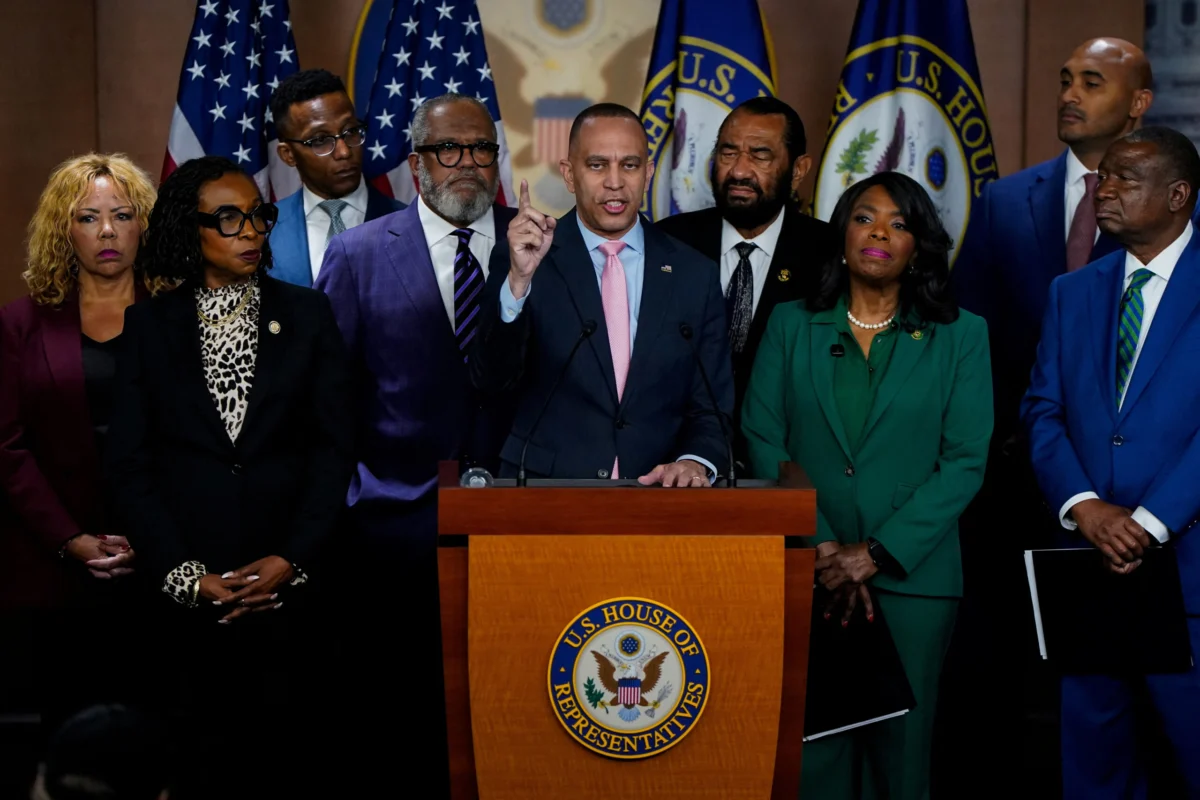
The office of Hakeem Jeffries, the highest-ranking Democrat in the United States House of Representatives, has issued a searing condemnation of a fellow lawmaker, U.S. Representative Jen Kiggans (R-VA), who publicly endorsed a comment widely perceived as racist during a discussion about congressional redistricting. The incident has ignited a firestorm across the political spectrum, drawing accusations of racial insensitivity and calls for Kiggans’ resignation, further highlighting the deep ideological and racial fissures within American politics.
The Genesis of the Controversy: A Radio Interview and a Racially Charged Phrase
The contentious remarks surfaced during a conservative radio talk show appearance by Representative Kiggans on Monday, May 5, 2026. The program, hosted by Rich Herrera, focused primarily on the ongoing and often acrimonious battle over the redrawing of Virginia’s congressional map. During the segment, Herrera directed pointed criticism at Jeffries, who represents a district in New York, for his involvement in efforts to influence Virginia’s redistricting process.
Herrera’s commentary escalated quickly, culminating in a demand that Jeffries either "relocate to Virginia and run for public office, or get your cotton-picking hands off of Virginia." The phrase "cotton-picking hands" carries a profound and painful historical weight in the United States, deeply rooted in the era of chattel slavery where millions of enslaved Black people were brutally forced to labor in the cotton fields of the American South until the mid-19th century. Its usage today is widely recognized as a derogatory and racist slur, conjuring images of exploitation and racial subjugation.
In response to Herrera’s incendiary remark, Representative Kiggans, a Republican representing Virginia’s 2nd congressional district, unequivocally stated, "That’s right. Ditto. Yes. Yes to that." Her affirmative response, broadcast publicly, immediately sparked outrage and drew widespread condemnation from civil rights advocates, Democratic leaders, and a segment of the public.
Kiggans’ Defense and Jeffries’ Vehement Rebuttal
Following the swift backlash, Representative Kiggans attempted to clarify and defend her comments. She subsequently issued a statement denying that she approved of Herrera’s specific choice of words. Instead, Kiggans argued, her agreement was directed solely at the broader sentiment that Democrats should not interfere with Virginia’s state redistricting processes. "The radio host should not have used that language and I do not — and did not — condone it," Kiggans stated, adding, "It was obvious to anyone listening that I was agreeing Hakeem Jeffries should stay out of Virginia."
However, this explanation failed to quell the mounting criticism. Christie Stephenson, a spokesperson for Representative Jeffries, swiftly and vehemently condemned Kiggans’ remarks on Tuesday, May 6, 2026. Stephenson’s statement pulled no punches, declaring, "Extremists who endorse disgusting, vile and racist language are pathetic." The spokesperson went further, asserting, "Jen Kiggans has no interest in our nation’s progress toward a multiracial democracy and apparently craves a return to the days of Jim Crow racial oppression in the South." This accusation directly links Kiggans’ perceived endorsement of the racist phrase to a historical period of systemic racial segregation and discrimination that spanned from the late 19th century to the mid-20th century, underscoring the gravity of the controversy.
Historical Context: The Enduring Stain of "Cotton-Picking"
The term "cotton-picking" is not merely an antiquated phrase; it is a linguistic artifact of a brutal chapter in American history. For centuries, the Southern economy was built upon the forced labor of enslaved Africans and their descendants, particularly in the cultivation of cotton. The phrase became a common pejorative, often used to dismiss or demean Black individuals, and its echoes persist in contemporary language, serving as a painful reminder of racial oppression.
Scholars and civil rights organizations consistently highlight how such language, even when claimed to be used innocently or metaphorically, perpetuates systemic racism by invoking historical traumas and reinforcing stereotypes. Its deployment in public discourse, especially by elected officials, is often seen as a dangerous normalization of prejudiced language, which can embolden extremist elements and further marginalize communities of color.
Wider Political Reactions and Calls for Resignation
The incident quickly garnered national attention, prompting a wave of condemnations from prominent Democratic figures. U.S. Minority Whip Katherine Clark and California Governor Gavin Newsom were among the first to publicly call for Representative Kiggans to resign from her position. Their demands underscore the perceived severity of Kiggans’ actions and the low tolerance for racially insensitive language within the Democratic Party.
The Congressional Black Caucus (CBC), a powerful legislative body dedicated to advocating for the interests of Black Americans, also weighed in forcefully. The CBC utilized the social media platform X (formerly Twitter) to amplify its condemnation, posting a clip of the radio exchange with a stark message: "Did she agree with him? Yes. Is this racist? Yes. Should she resign? Yes to that, too." The CBC’s statement reflects the collective outrage within the Black legislative community and their commitment to challenging instances of racial prejudice in politics. This unified front from Democratic leadership signals a clear intent to hold Kiggans accountable and to draw a firm line against the use of racially charged rhetoric.
A Pattern of Racially Charged Incidents in US Politics
The controversy surrounding Representative Kiggans is not an isolated event but rather part of a disturbing pattern of racially charged incidents that have increasingly permeated American political discourse in recent years. This trend raises serious concerns about the erosion of civility and the normalization of offensive language.
Just months prior to this incident, in February 2026, former U.S. President Donald Trump posted a deeply offensive video on his social media account. The video depicted former President Barack Obama and former First Lady Michelle Obama, both prominent Black figures, as primates. The imagery, historically used to dehumanize Black individuals, was widely denounced. Even within his own party, the video drew sharp criticism. Senator Tim Scott of South Carolina, the only Black Republican senator, condemned the video as "the most racist thing I’ve ever seen." The video was subsequently removed, with the White House attributing its posting to a staffer. This incident, along with others, illustrates a troubling willingness among some political figures to engage with or tolerate racially inflammatory content, often under the guise of political critique.
These repeated occurrences highlight a volatile political climate where racial sensitivities are frequently tested and, at times, overtly disregarded. The increasing polarization and reliance on sensationalist rhetoric have created an environment where such language can proliferate, often with significant political and social repercussions.
The Broader Battle: Redistricting and the Future of Voting Rights
The immediate controversy, while centered on Kiggans’ remarks, is inextricably linked to the broader, high-stakes national battle over congressional redistricting. This process, which involves redrawing electoral maps, is typically conducted once a decade following the U.S. Census to reflect population shifts. However, it has become a fiercely partisan arena where political parties strategically manipulate district boundaries – a practice known as gerrymandering – to maximize their electoral advantage.
While partisan gerrymandering is not explicitly illegal under U.S. law, it is widely criticized by democracy advocates as undermining fair representation and democratic principles. Critics argue that it allows politicians to choose their voters rather than the other way around, leading to less competitive elections and more extreme political outcomes.
The situation in Virginia, which prompted the radio discussion, exemplifies this national struggle. In April 2025, Virginia voters approved a redrawn map that was expected to increase the number of Democrat-leaning districts. However, the state’s Supreme Court subsequently invalidated this map, injecting further uncertainty into the electoral landscape. Democrats have since appealed to the U.S. Supreme Court to intervene, underscoring the national importance of these state-level battles. Hakeem Jeffries’ involvement, despite being a New Yorker, likely stems from his role as a national party leader and head of the Democratic Congressional Campaign Committee (DCCC) in previous cycles, which strategically supports redistricting efforts beneficial to the party nationwide.
The Shadow of the Weakened Voting Rights Act
Adding another layer of complexity and concern to the redistricting debate is the perceived weakening of the Voting Rights Act (VRA) of 1965. This landmark legislation was enacted to overcome legal barriers at the state and local levels that prevented African Americans from exercising their right to vote. While the original article references a "Voting Rights Act of 1973," the foundational legislation is the VRA of 1965, which has been reauthorized and amended multiple times. The critical point is a recent Supreme Court decision in late April 2026 that has significantly altered the landscape of its enforcement.
This particular ruling, interpreted by many civil rights groups, has made it considerably more challenging to successfully challenge congressional districts on the grounds of racial discrimination. Specifically, it has made it easier for states to break up predominantly Black congressional districts unless "explicitly racist motivations" can be proven. Civil rights organizations contend that proving such explicit intent is an almost insurmountable legal hurdle, effectively gutting a key mechanism for ensuring fair representation for minority voters. They argue that this ruling could be leveraged to dilute the voting power of Black Americans, who have historically skewed Democratic, thereby impacting electoral outcomes for years to come.
In the wake of this Supreme Court decision, Republican lawmakers in several states, including Tennessee, Florida, Alabama, and South Carolina, have reportedly intensified their efforts to redraw their congressional maps. These actions are viewed by critics as attempts to solidify Republican control and further diminish the political influence of minority communities, potentially reversing decades of progress made under the VRA.
Implications for American Democracy and Political Discourse
The incident involving Representative Kiggans and the subsequent outcry highlight several critical implications for American democracy. First, it underscores the persistent and often unaddressed issue of racial prejudice in political discourse. When elected officials use or endorse language with deep racist roots, it legitimizes prejudice and can deepen societal divisions, making it harder to address pressing national issues constructively.
Second, the controversy further exacerbates the already heightened political polarization in the United States. In an environment where every statement is scrutinized through a partisan lens, apologies are often seen as insufficient, and calls for accountability become rallying cries for opposing factions. This makes genuine dialogue and compromise increasingly difficult.
Finally, the intertwined issues of racist language, gerrymandering, and the weakening of the Voting Rights Act paint a concerning picture for the future of fair representation and democratic participation. The ability to draw electoral maps in a way that disadvantages specific racial or political groups, coupled with a reduced legal capacity to challenge such practices, poses a fundamental threat to the principle of "one person, one vote" and the promise of an inclusive, multiracial democracy. The events of early May 2026 serve as a stark reminder of the ongoing struggle to uphold these ideals in the face of contentious political battles and the enduring legacy of racial inequality.
