

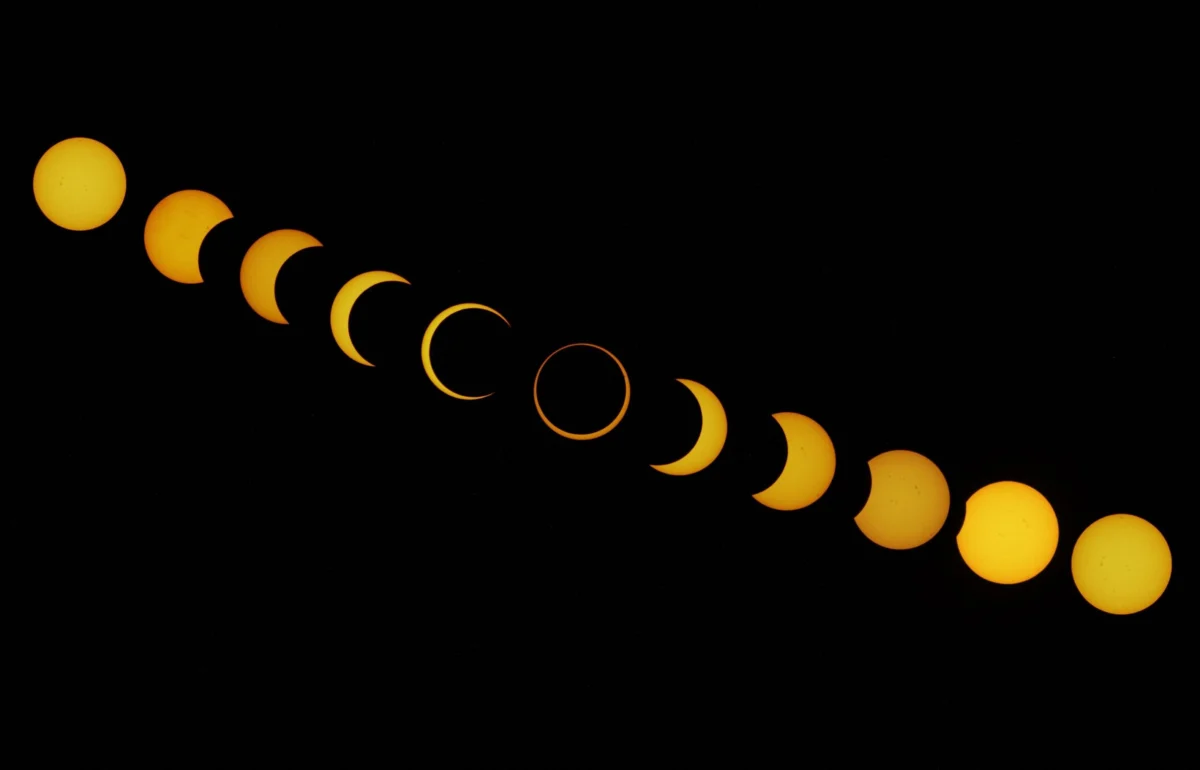
The year 2026 is poised to be a landmark period for the global astronomical community, defined by a series of rare celestial alignments that will capture the imagination of millions. While the 2026 calendar features only four eclipses in total, the month of August represents a unique "bounty of riches," hosting the final two events of the year: a highly anticipated total solar eclipse and a dramatic partial lunar eclipse. These events follow the earlier occurrences of an annular solar eclipse in February and a penumbral lunar eclipse in March, making the August window the definitive climax of the year’s astronomical narrative.
The Grand Spectacle: The Total Solar Eclipse of August 12, 2026
The centerpiece of the 2026 astronomical calendar is undoubtedly the total solar eclipse occurring on August 12. This phenomenon, which occurs when the moon passes directly between the Earth and the sun, completely obscuring the solar disk, is often described by observers as one of the most profound natural experiences available to humanity. The August 12 event is particularly significant as it marks the first total solar eclipse visible in continental Europe since 1999 and the first for the Iberian Peninsula in over a century.
The Path of Totality and Global Visibility
The "path of totality"—the narrow corridor where the moon’s shadow completely blocks the sun—will begin its journey in the remote reaches of the Arctic. Starting near the North Pole, the shadow will sweep southward and eastward, crossing over the eastern coast of Greenland. While these areas are sparsely populated, they offer some of the longest durations of totality for dedicated "eclipse chasers" willing to brave the rugged terrain.
As the shadow moves across the North Atlantic, it will graze the westernmost fringes of Iceland. The capital city, Reykjavík, is positioned just outside the path of totality, but those traveling to the western peninsulas will witness the sun’s corona in its full glory. Following its transit across the ocean, the path of totality will make its final landfall in northern and central Spain.
In Spain, the eclipse will reach its peak during the late afternoon and early evening, providing a dramatic visual display as the sun sits low on the horizon. Major cities including Gijón, Bilbao, Zaragoza, and parts of Valencia and Madrid will be either within or very near the path of totality. The timing is particularly noteworthy for the Mediterranean region, as the eclipse will coincide with the "golden hour," potentially creating unprecedented photographic opportunities as the solar corona appears against a sunset-hued sky.
Scientific Significance and Observation
For scientists, the 2026 total solar eclipse offers a rare opportunity to study the solar corona—the sun’s outer atmosphere—which is usually invisible to the naked eye due to the sun’s overwhelming brightness. During the roughly two minutes of totality expected in Spain, researchers will deploy instruments to measure solar winds and the magnetic structure of the corona.
For the general public, safety remains the paramount concern. Experts from the International Astronomical Union (IAU) emphasize that at no point, except during the brief period of total obscuration, should the sun be viewed with the naked eye. Observers in partial view zones—such as the eastern United States, Canada, and most of Europe—must use ISO 12312-2 certified solar viewing glasses. Failure to do so can result in permanent retinal damage, commonly known as solar retinopathy.
The Lunar Finale: The Partial Lunar Eclipse of August 27–28, 2026
Only two weeks after the solar spectacle, the Earth will once again align with its celestial neighbors to produce a partial lunar eclipse. This event occurs when the Earth moves between the sun and the moon, casting its shadow—the umbra—across the lunar surface. While not a "total" lunar eclipse, the August 27–28 event is of high magnitude, with up to 96 percent of the moon’s disk expected to be submerged in the Earth’s shadow.
Regional Visibility and the "Blood Moon" Effect
Unlike solar eclipses, which are visible only along a narrow track, lunar eclipses can be seen from any location on Earth where the moon is above the horizon. The August 28 event will be most favorable for observers across the Americas. Residents of the United States, Canada, Mexico, and South America will have a front-row seat to the event as it unfolds during the late-night and early-morning hours.

A unique feature of this partial eclipse is its high magnitude. Because 96 percent of the moon will be covered, the lunar surface is likely to take on a deep reddish or coppery hue. This phenomenon is caused by Rayleigh scattering—the same process that makes the sky blue and sunsets red. As Earth’s atmosphere filters out shorter wavelengths of light, it bends the longer red wavelengths into the shadow, illuminating the moon in a ghostly glow. To the casual observer, the event may appear nearly indistinguishable from a total lunar eclipse.
Chronology of the Lunar Event
The eclipse is expected to begin its penumbral phase (a subtle darkening) late on the night of August 27 for Western Hemisphere observers, transitioning into the partial (umbral) phase in the early hours of August 28. The peak of the eclipse—the moment of maximum coverage—will offer a stark contrast between the sliver of bright lunar surface and the deep red of the shadowed portion.
Historical Context and Comparative Analysis
The 2026 August eclipses follow a period of intense global interest in syzygy (the alignment of three celestial bodies). The 2024 "Great North American Eclipse" set records for tourism and scientific engagement, and the 2026 events are expected to continue this trend, albeit with a focus on the European and Atlantic sectors.
Historically, the return of a total solar eclipse to Spain is a generational event. The last total solar eclipse to cross the Spanish mainland occurred in 1905. For Iceland, the 2026 event is equally significant, as it provides the first opportunity for totality on the island since 1954. These long intervals between events often trigger significant "astro-tourism" booms, with hotels in the path of totality often booking out years in advance.
Economic and Social Implications
The economic impact of the August 2026 eclipses is expected to be substantial. In Spain, the timing of the eclipse coincides with the peak of the summer tourism season. Regional governments in Castile and León, Aragon, and Galicia have already begun preliminary discussions regarding crowd management and the promotion of "dark sky" tourism.
"An eclipse of this magnitude is not just a scientific event; it is an economic engine," notes Dr. Elena Rodriguez, a researcher in astronomical tourism. "We expect hundreds of thousands of international visitors to converge on the Iberian Peninsula. This requires infrastructure readiness, from transportation to public safety measures."
Furthermore, the dual nature of the August events—a solar eclipse followed by a lunar eclipse—provides a unique educational window. Schools and universities across Europe and the Americas are expected to integrate these events into their science curricula, using the "eclipse season" to foster interest in STEM (science, technology, engineering, and mathematics) fields.
Final Preparations and Technical Specifications
As the countdown to August 2026 continues, astronomical societies are refining the precise timings for cities within the path. For the solar eclipse on August 12, totality is expected to occur around 8:30 PM Central European Time (CET) in Spain. Because the sun will be very low (approximately 10 degrees above the horizon), observers are advised to find locations with an unobstructed view of the west-northwest horizon.
For the lunar eclipse on August 28, no special equipment is required. Unlike solar viewing, looking at a lunar eclipse is perfectly safe for the eyes. Binoculars or a small telescope can enhance the view of the "terminator" line—the boundary between the shadowed and unshadowed parts of the moon—where the rugged lunar topography becomes most visible.
Conclusion
The August 2026 eclipses represent a rare double-header of celestial mechanics that will bridge the gap between the Arctic and the Americas, and between scientific inquiry and public wonder. Whether it is the brief, chilling darkness of the solar totality in the Spanish evening or the crimson transformation of the moon over the American midnight, these events serve as a reminder of the clockwork precision of our solar system. For those wishing to witness the final eclipses of 2026, the message from the scientific community is clear: plan early, prioritize safety, and prepare for a month of unparalleled astronomical beauty.
