

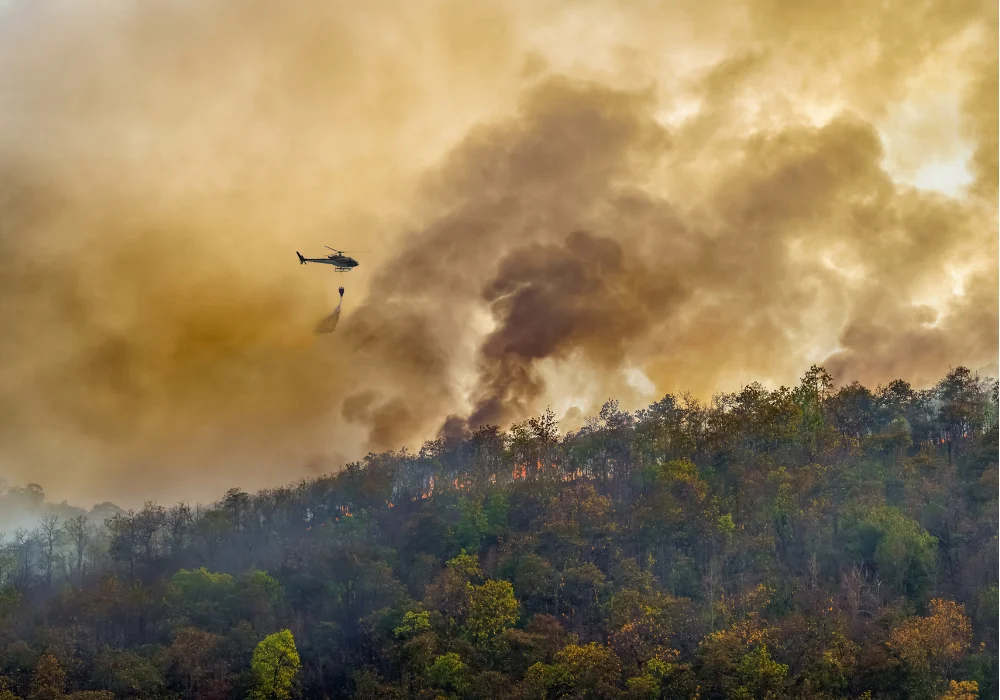
The vast boreal landscapes of Canada, long considered a vital global bastion against climate change, have undergone a fundamental ecological shift, transitioning from a reliable carbon sink into a net source of atmospheric carbon dioxide. According to a landmark study published in the journal Global Change Biology, this transformation is being driven primarily by an escalating cycle of wildfire disturbances that now outpace the regenerative capacity of the nation’s forests. The research, which utilizes advanced "wall-to-wall" modeling of Canadian landscapes, suggests that the immediate impacts of these disturbances began to overwhelm recovery-driven carbon sequestration as early as 2009, with the definitive crossing of the source-sink threshold occurring around 2021.
A New Framework for Carbon Accounting: The CLASSIC Model
For decades, scientists have grappled with the complexities of measuring the carbon balance across Canada’s 362 million hectares of forest. Previous estimates often relied on generalized global models or fragmentary data that struggled to capture the specific geophysical nuances of the Canadian North. The recent study addresses these gaps through the implementation of the Canadian Land Surface Scheme Including Biogeochemical Cycles (CLASSIC) model.
Unlike earlier iterations, CLASSIC is a process-based model. It does not merely extrapolate future conditions from current observations; instead, it utilizes a framework of equations rooted in historical data and fundamental scientific laws, such as the conservation of energy and mass. By integrating specific plant functional types and geophysical data for every hectare of Canada’s forested and unforested land, the model provides a "physically coherent" estimate of carbon pools—including biomass and soil—and the fluxes between them.
The study’s methodology involved simulating carbon cycling from 1750 to 2023. This 273-year reconstruction allowed researchers to account for long-term trends in forest regrowth, cellular respiration, and "CO2 fertilization"—a phenomenon where elevated atmospheric carbon levels initially stimulate faster plant growth. However, the data reveals that these natural growth-enhancing factors are no longer sufficient to counteract the carbon released during massive combustion events and subsequent decomposition.
The Chronology of a Shifting Landscape
The historical data provided by the CLASSIC model illustrates a relatively stable period for Canadian forests lasting over two centuries. From the mid-18th century through the late 20th century, Canada’s forests acted as a net carbon sink. During this era, the carbon sequestered by growing trees and stored in forest soils exceeded the carbon lost to natural decay, harvesting, and periodic wildfires.
However, the dawn of the 21st century marked a period of rapid destabilization. The study identifies 2009 as a pivotal year when the frequency and intensity of disturbances began to systematically erode the forest’s ability to recover. While forests naturally regenerate after a fire, the "recovery-driven sink"—the period during which young trees aggressively pull carbon from the air—requires time and stability. As the interval between fires shortens and the "burn area" expands, the forests are trapped in a state of permanent carbon deficit.
By 2021, the models indicate that the transition was complete. The cumulative impact of wildfire and, to a lesser extent, industrial harvesting, pushed the entire Canadian forest estate into "source" territory. This means that, on an annual basis, the landscape now contributes more CO2 to the atmosphere than it removes, creating a dangerous feedback loop that exacerbates global warming.
The Central Canadian Crisis and Vegetation Recovery
A critical finding of the research is that the shift is not uniform across the country. The trend is most pronounced in the forests of central Canada. In these regions, environmental conditions are often harsher, and the growing season is shorter than in coastal or southern regions. The researchers noted that lower Net Primary Production (NPP)—a measure of how much carbon plants take in—slows the rate of vegetation recovery significantly.
When a high-intensity fire sweeps through a central Canadian forest, it does more than just kill trees; it often consumes the organic layer of the soil, which can take decades or even centuries to rebuild. Because the vegetation in these regions recovers so slowly, the carbon lost during the fire is not "recaptured" quickly enough to balance the scales before the next disturbance event occurs. The study concludes that this specific regional dynamic is the primary engine behind the unprecedented national trend observed over the last century.
Wildfire as a Primary Driver: Data and Context
The study’s conclusions are bolstered by the harrowing reality of recent Canadian wildfire seasons. While the research covers the timeline up to 2023, the data from that specific year underscores the study’s urgency. In 2023, Canada experienced its most devastating wildfire season on record, with over 18 million hectares burned—an area roughly the size of North Dakota.
Preliminary data from the Copernicus Atmosphere Monitoring Service estimated that the 2023 fires emitted nearly 480 megatonnes of carbon. To put this in perspective, this is nearly three times the annual carbon emissions of Canada’s entire industrial and transportation sectors combined. When forests burn at this scale, they do not just stop being sinks; they become "carbon bombs" that release centuries of stored carbon in a matter of weeks.
The CLASSIC model emphasizes that while harvesting remains a factor in carbon loss, the sheer scale of wildfire disturbance has become the dominant force. Unlike managed harvesting, which often involves reforestation efforts and long-term carbon storage in wood products, wildfires represent an unmanaged and catastrophic release of carbon directly into the atmosphere, often accompanied by methane and nitrous oxide, which have even higher global warming potentials.
Implications for Climate Policy and Net-Zero Targets
The revelation that Canadian forests have become a carbon source poses a significant challenge to federal and international climate strategies. Many nations, including Canada, have relied on "nature-based solutions" as a cornerstone of their plans to reach net-zero emissions by 2050. These plans often assume that forests will continue to act as a "free" carbon offset, absorbing a portion of the emissions generated by fossil fuel combustion.
If the forest estate is no longer a sink, the math of net-zero changes fundamentally. Government officials and land managers may be forced to reckon with the fact that the "land use, land-use change, and forestry" (LULUCF) sector is now a liability rather than an asset in the carbon ledger. This shift could necessitate much more aggressive emission cuts in other sectors, such as oil and gas or heavy industry, to compensate for the forest’s transition to a carbon source.
Furthermore, the study suggests that rising wildfire activity will lead to escalating management costs. Fire suppression efforts, which already cost Canadian provinces billions of dollars annually, may become increasingly futile as "mega-fires" become the norm. The researchers warn that this environment "imperils efforts to manage the carbon sink through sustainable land management practices."
Expert Reactions and the Path Forward
While the study authors maintain an objective, data-driven tone, the broader scientific community has reacted with concern. Climate analysts suggest that these findings confirm a long-feared "tipping point" in the boreal ecosystem. Many experts argue that the traditional approach to forest management—focused on timber yield and reactive fire suppression—is no longer viable in a rapidly warming world.
There is an increasing call for "proactive" management, which includes controlled burns to reduce fuel loads and the protection of old-growth forests that hold the highest densities of soil carbon. However, the study’s authors note a significant limitation in current modeling: the role of peatlands. Canada’s peatlands are massive carbon reservoirs, and while they were not explicitly modeled in this study, their vulnerability to fire is a growing concern. When peat burns, it can smolder underground for months, releasing ancient carbon that has been sequestered for millennia.
Conclusion: A Century of Change
The findings published in Global Change Biology represent a somber milestone in environmental science. The transition of Canadian forests from a carbon sink to a source is a trend the authors describe as "unprecedented over the last ~100 years." It serves as a stark reminder that the natural systems humanity relies upon to buffer the effects of climate change are themselves susceptible to the very warming they help mitigate.
As future fire seasons are projected to worsen in duration and intensity, the pressure on Canada’s landscapes will only grow. The shift observed in 2021 may not be a temporary fluctuation but the beginning of a new ecological era. For policymakers, the message is clear: the assumption that nature will indefinitely absorb the excesses of industrial civilization is no longer supported by the data. The focus must now shift toward both mitigating the drivers of wildfire and fundamentally rethinking how a carbon-emitting forest fits into a warming world.
