

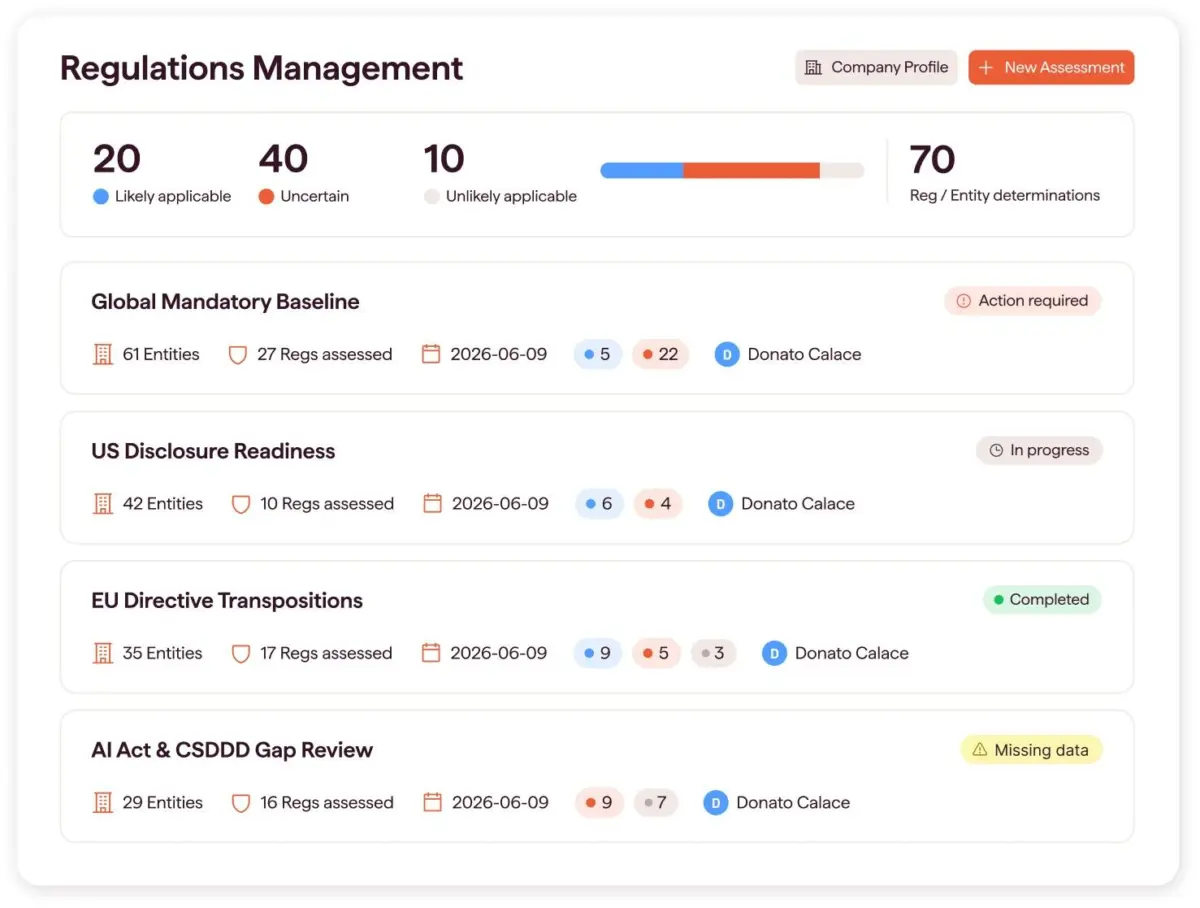
The landscape of corporate sustainability has undergone a radical transformation, shifting from a voluntary framework of "best practices" to a rigid, legally mandated environment where compliance is no longer optional. Recognizing the immense logistical burden this shift places on global enterprises, Datamaran, a leading provider of ESG-focused software analytics, announced on October 26, 2026, the launch of its "Applicability Assessment" tool. This new feature is designed to automate and streamline the process by which companies identify their specific regulatory obligations across a fragmented global landscape of jurisdictions, sectors, and entity structures.
The Applicability Assessment tool serves as a significant enhancement to Datamaran’s Regulatory Monitoring Platform, which was originally introduced in March 2026. As the regulatory tide continues to rise—driven by the implementation of the European Union’s Corporate Sustainability Reporting Directive (CSRD), the U.S. Securities and Exchange Commission’s climate disclosure rules, and various emerging standards in Asia-Pacific—the tool aims to replace the manual, spreadsheet-heavy processes that have traditionally plagued compliance and legal departments.
Addressing the Complexity of Global Regulatory Fragmentation
In the current global economy, a single multinational corporation may operate hundreds of legal entities across dozens of countries. Each of these entities may be subject to different reporting requirements based on localized thresholds for revenue, employee headcount, or industry classification. Historically, determining which laws apply to which subsidiary has been a Herculean task, often requiring thousands of billable hours from external legal counsel and internal compliance teams.
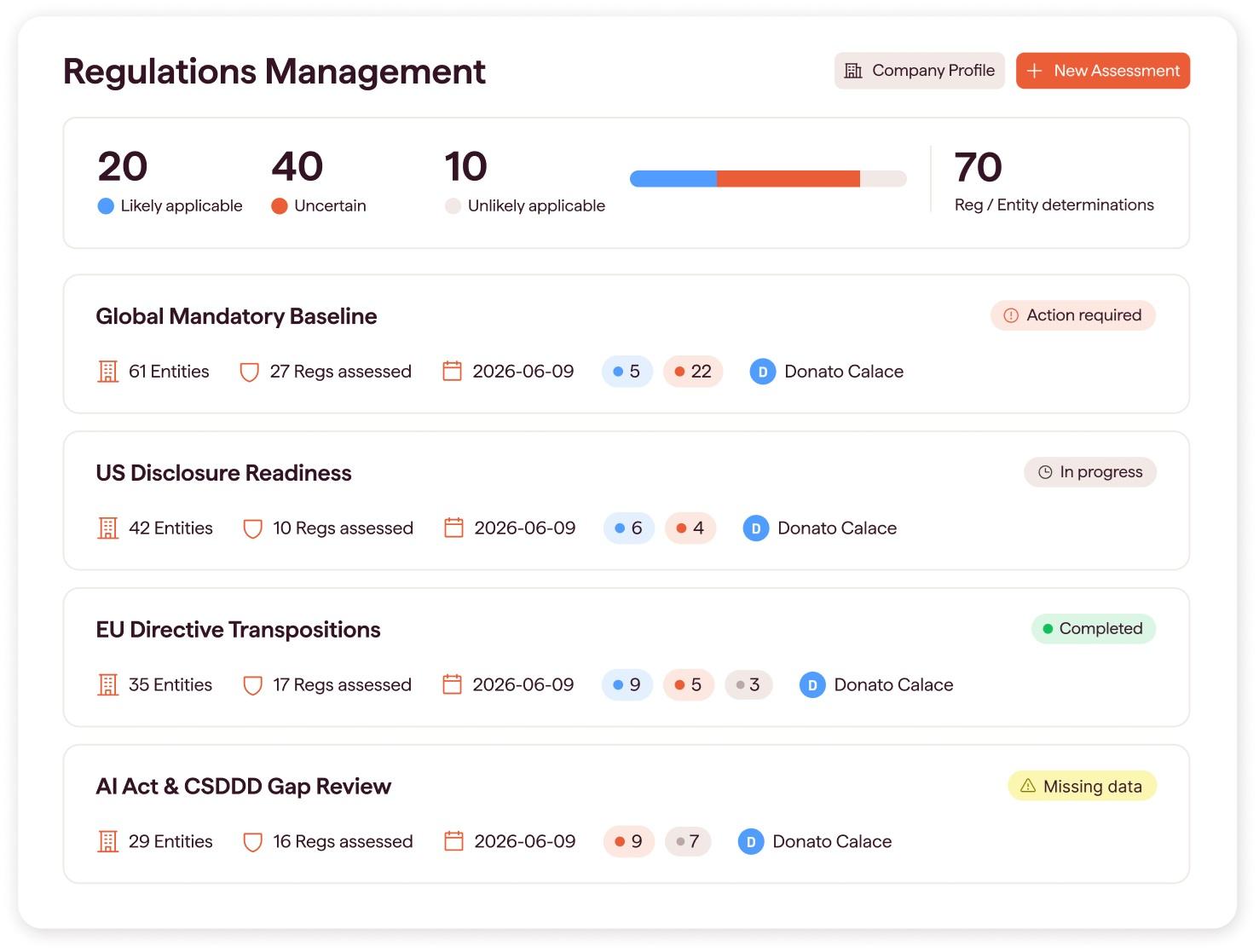
Datamaran’s new feature addresses this "discovery" phase of compliance by enabling businesses to assess multiple entities simultaneously. The platform evaluates these entities against both existing and proposed mandatory regulations. Each assessment is categorized into three distinct statuses: Likely, Unlikely, or Uncertain. Crucially, the tool does not merely provide a status update; it offers a detailed explanation of the logic and criteria used to reach each determination, providing a transparent audit trail that can be used for internal governance or external assurance.
By centralizing this data, Datamaran allows companies to move away from reactive compliance. Instead of waiting for a regulatory deadline to approach, firms can use the platform to forecast future obligations based on proposed legislation, allowing for better resource allocation and strategic planning.
Technical Capabilities and Automated Profiling
One of the standout features of the Applicability Assessment tool is its ability to automatically populate entity profiles. Leveraging Datamaran’s proprietary data engine, the tool pulls essential information such as headquarters locations, operational footprints, specific industry sectors, annual revenue, and employee counts. This automation minimizes the risk of human error during data entry, which is a frequent point of failure in manual compliance tracking.
Furthermore, the tool provides advanced organizational mapping. Users can group entities by geographical region, specific business units, or even by supplier tiers. This level of granularity is particularly relevant as modern regulations, such as the German Supply Chain Due Diligence Act (LkSG) and the EU’s Corporate Sustainability Due Diligence Directive (CSDDD), increasingly hold parent companies responsible for the actions and disclosures of their subsidiaries and supply chain partners.
The platform’s dashboard functionality provides a high-level overview of a company’s total regulatory exposure. These dashboards allow executives to identify information gaps—areas where data may be missing to confirm applicability—and track changes in real-time as regulations move from the proposal stage to active enforcement. To further bolster the reliability of these assessments, Datamaran has announced that an "expert review" feature is in development, which will allow for a secondary layer of validation by legal professionals within the platform.
A Chronology of Datamaran’s Strategic Expansion
The launch of the Applicability Assessment tool is the latest milestone in Datamaran’s decade-long evolution. Founded in 2014, the company initially focused on helping organizations conduct "materiality assessments"—identifying which ESG issues were most relevant to their business and stakeholders. However, as the market matured, Datamaran recognized that the primary challenge for C-suite executives was shifting from "what is important" to "what is required by law."
- 2014–2020: Datamaran establishes itself as a pioneer in AI-driven materiality, moving ESG analysis from a subjective exercise to a data-driven science.
- 2021–2025: As the CSRD and other global mandates take shape, the company begins integrating regulatory tracking into its core offering, responding to a 300% increase in global ESG-related regulations during this period.
- March 2026: The Regulatory Monitoring Platform is launched, providing a comprehensive database of global ESG laws.
- October 2026: The Applicability Assessment tool is introduced to help companies operationalize the data within the Monitoring Platform at the entity level.
This timeline reflects a broader trend in the "RegTech" (Regulatory Technology) space, where the focus has moved from simple data collection to sophisticated, automated analysis and risk mitigation.
The Economic Burden of Compliance and the Value of Automation
The demand for tools like Datamaran’s is driven by the soaring costs of ESG compliance. According to industry data from 2025, the average large-cap firm spends upwards of $1.5 million annually on ESG reporting and data collection. Much of this expenditure is directed toward external consultants and law firms tasked with interpreting complex legal texts across different languages and jurisdictions.

Manual assessments are not only expensive but also prone to obsolescence. A determination made in January may be invalidated by a legislative amendment in June. Datamaran’s platform solves this by providing continuous monitoring. When a regulation changes, the platform automatically updates the applicability status for all affected entities, notifying the relevant teams immediately.
Marjella Lecourt-Alma, CEO and co-founder of Datamaran, emphasized the practical necessity of the tool during the launch. "‘We just need to know what applies to us’ is something we hear often from legal, compliance, and sustainability teams," Lecourt-Alma stated. "Applicability Assessment provides that information quickly and reliably at the entity level at scale."
Broader Implications for Corporate Governance and Legal Teams
The launch of this tool signals a shift in the "ownership" of ESG within the corporate structure. While sustainability was once the domain of marketing or specialized CSR departments, it has now become a core function of the General Counsel and the Chief Compliance Officer.
By providing a tool that categorizes obligations as "Likely" or "Uncertain," Datamaran is speaking the language of risk management. For legal teams, the "Uncertain" category is perhaps the most valuable, as it highlights areas where legal nuance is required, allowing them to focus their expensive internal resources on complex interpretations rather than rote data gathering.
Furthermore, this tool enhances "investor-grade" reporting. As institutional investors demand more rigorous ESG disclosures, they are looking for evidence that companies have a robust process for identifying their legal risks. Using a standardized, AI-driven platform for applicability assessments provides a level of rigor that manual spreadsheets simply cannot match.
Market Context: The Shift Toward Mandatory Disclosure
The context of this launch is a global regulatory environment that is becoming increasingly punitive. In the European Union, non-compliance with CSRD can lead to significant fines and reputational damage. In the United States, despite political debates surrounding ESG, the reality of California’s climate laws means that most large companies operating in the U.S. must now prepare for mandatory carbon accounting.

Furthermore, the International Sustainability Standards Board (ISSB) has seen rapid adoption of its standards (IFRS S1 and S2) across jurisdictions including Australia, Singapore, and Brazil. This convergence of standards means that while the content of what must be reported is becoming more standardized, the legal triggers for when a company must report remain highly localized and complex.
Datamaran’s Applicability Assessment tool arrives at a critical juncture where the "cost of ignorance" has never been higher. By bridging the gap between vast regulatory databases and specific corporate structures, the tool provides a foundation for the next era of corporate transparency.
Looking Ahead: The Future of ESG Analytics
As Datamaran continues to refine its platform, the integration of "expert review" features suggests a future where technology and human expertise work in a hybrid model. While AI can handle the heavy lifting of scanning thousands of pages of legislative text and matching them against entity profiles, the final "stamp of approval" will likely remain a human-led process for the foreseeable future.
The success of the Applicability Assessment tool will likely be measured by its ability to reduce the time-to-compliance for its users. In a world where regulatory changes are the only constant, the ability to achieve "compliance at scale" is becoming a competitive advantage. Companies that can navigate these obligations efficiently will be better positioned to focus on their core business, while those stuck in manual processes risk being left behind in a sea of red tape.
With this latest release, Datamaran solidifies its position not just as a software provider, but as a critical infrastructure component for the modern, compliant enterprise. As the October 2026 launch demonstrates, the future of ESG is not just about doing good—it is about knowing exactly what the law requires and having the data to prove it.
