

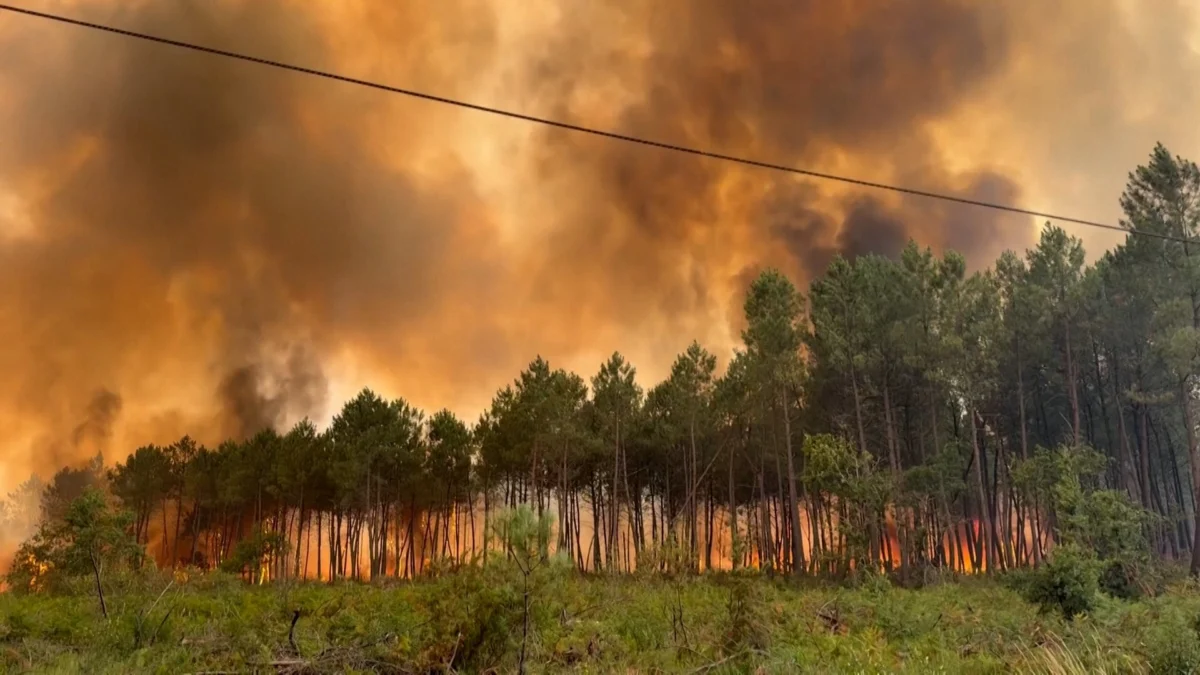
A devastating wildfire near Bordeaux, France, has consumed an estimated 3,100 hectares (approximately 7,660 acres) of dense forest, triggering the urgent evacuation of more than 20,000 residents and tourists from affected areas. The inferno, which has ravaged parts of the Gironde department in southwestern France, represents a significant challenge for emergency services, with around 700 firefighters currently deployed to combat the blaze. Their efforts are severely complicated by highly unpredictable wind patterns, which continuously shift the fire’s direction, threatening homes and vital infrastructure. The incident underscores the escalating vulnerability of the region to climate-induced environmental disasters.
The Unfolding Crisis: Main Facts and Immediate Impact
The conflagration, reported to have intensified rapidly over the past several days, has primarily affected forested areas known for their susceptibility to wildfires, particularly during periods of high temperatures and drought. The scale of the destruction has necessitated a comprehensive emergency response, mobilizing substantial resources from across the nation. The 20,000 individuals evacuated represent a mix of permanent residents from villages and hamlets within the fire’s path, as well as holidaymakers enjoying the summer season in a popular tourist destination. Authorities have established temporary shelters in nearby unaffected communities, providing essential services and support to those displaced. The immediate priority for firefighting crews remains the protection of human life and property, as the volatile winds pose a constant threat of embers igniting new fires ahead of the main front. Aerial support, including water-bombing aircraft, has been crucial in attempting to suppress the most aggressive sections of the blaze, yet the sheer size and intensity of the fire continue to test the limits of these capabilities.
A Chronology of Escalation and Response
The exact cause of the wildfire remains under investigation, though initial reports suggest multiple ignition points or rapid spread from a single source exacerbated by tinder-dry conditions. The initial reports of smoke and small fires emerged approximately two days prior to the large-scale evacuations, around July 21, 2026. Within hours, fueled by strong, gusty winds and exceptionally dry vegetation, what began as a localized incident quickly morphed into a rapidly expanding wildfire.
Day 1 (Circa July 21, 2026): Initial Detection and Rapid Spread
Local fire services initially responded to reports of smoke in a forested area. Despite prompt action, the prevailing meteorological conditions – high temperatures exceeding 35°C (95°F), low humidity, and moderate winds – facilitated an exponential spread. Initial containment efforts proved challenging as the fire front advanced several kilometers in a matter of hours.
Day 2 (Circa July 22, 2026): Escalation and First Evacuations
By the morning of the second day, the fire had already consumed hundreds of hectares. The escalating threat prompted local authorities to issue initial evacuation orders for the most directly endangered communities. The number of deployed firefighters increased significantly, and the first aerial assets, including Canadair water bombers, were scrambled to the scene. Despite these reinforcements, the fire’s erratic behavior, driven by unpredictable wind shifts, made strategic containment difficult, leading to a decision to expand the evacuation perimeter as the evening approached.
Day 3 (July 23, 2026): Mass Evacuation and Battle Intensifies
The morning of July 23 saw the fire’s footprint swell to 3,100 hectares. The expanded scale of the blaze directly threatened a larger population, leading to the dramatic increase in evacuation orders, displacing over 20,000 individuals. This day marked the peak of the immediate crisis, with 700 firefighters from various departments and civil protection units converging on the site. Their primary focus shifted to creating firebreaks and protecting residential areas, especially as the shifting winds constantly threatened to push flames towards populated zones. The national government was by this point fully engaged, coordinating resources and offering assistance to the affected Gironde department.
Emergency Response and Operational Challenges
The deployment of 700 firefighters represents a substantial commitment of resources, comprising both local brigades and reinforcements from other regions of France. These ground crews are employing a range of tactics, from direct flame suppression using hoses and specialized equipment to the creation of defensive lines and backburning operations. However, the dense, resinous pine forests characteristic of the Gironde department, particularly in the Landes de Gascogne regional natural park area, provide ample fuel for such intense fires. The dry undergrowth, accumulated over weeks of heatwave conditions, ignites easily and burns fiercely, creating towering flames and thick smoke plumes visible for many kilometers.
A critical challenge is the deployment and coordination of aerial assets. Multiple water-bombing aircraft, including the iconic yellow Canadairs and other specialized helicopters, are continuously ferrying water from nearby lakes or the Atlantic coast to douse hot spots and slow the fire’s advance. Each pass delivers thousands of liters of water, but these efforts are often likened to "a drop in the ocean" against such a massive inferno. The effectiveness of aerial operations is also highly dependent on visibility, which can be severely hampered by dense smoke, and wind conditions, which can make precise drops difficult and dangerous for pilots. The unpredictable wind shifts, a recurring theme in this crisis, force firefighters to constantly re-evaluate their strategies, moving resources quickly to new danger zones, making overall containment a prolonged and arduous battle.
Evacuation Efforts and Humanitarian Impact
The evacuation of 20,000 people from the path of an active wildfire is a complex logistical undertaking that requires precise coordination and swift action. Local gendarmerie and municipal police forces, alongside civil protection volunteers, were instrumental in going door-to-door in some areas, ensuring residents and tourists understood the urgency of the situation and had access to transport if needed. Designated safe zones and temporary accommodation centers, often in municipal sports halls or community centers in neighboring towns, were quickly established. These centers provide not only shelter but also food, medical assistance, and psychological support for those who have been forced to leave their homes with little warning.
The human toll extends beyond immediate displacement. Many evacuees experience significant stress, anxiety, and uncertainty about the fate of their homes and livelihoods. Farmers worry about their livestock and crops, particularly the region’s renowned vineyards, while tourism operators face immediate revenue losses and long-term reputational damage. The psychological impact on children, witnessing the smoke-filled skies and the hurried departure from their familiar surroundings, is also a serious concern. Local authorities are working to ensure that basic needs are met and that communication channels remain open to keep evacuees informed about the evolving situation and when it might be safe to return, even if only to assess damage.
Official Statements and Government Response
The crisis has elicited strong reactions from various levels of government. The Prefect of the Gironde department, as the chief state representative, has been at the forefront of the response, holding daily press briefings to update the public on the fire’s progress, containment efforts, and safety instructions. Statements from the Prefect have emphasized the "unprecedented intensity" of the blaze and commended the "heroic efforts" of the firefighters and emergency personnel. Calls have been made for public vigilance and strict adherence to fire prevention regulations.
At the national level, the Minister of Interior and other relevant government officials have expressed solidarity with the affected communities and pledged full national support. This includes the deployment of additional military personnel for logistical support, if needed, and the activation of national disaster relief funds. President Emmanuel Macron’s office has been closely monitoring the situation, signaling the government’s readiness to provide further assistance, including potential requests for European Union aid if the situation escalates beyond national capacity. Environmental agencies and agricultural ministries have also begun to assess the long-term ecological and economic damage, preparing for post-fire rehabilitation efforts.
Broader Context: Wildfires in France and Europe
The current Bordeaux wildfire is not an isolated incident but rather a stark reminder of a worrying trend across France and Southern Europe. The summer of 2022 saw record-breaking wildfires in the same Gironde department, with tens of thousands of hectares burned and similar mass evacuations, particularly around La Teste-de-Buch and Landiras. These events, occurring with increasing frequency and intensity, are widely attributed to the impacts of climate change.
France, like other Mediterranean countries, has experienced a significant increase in the number and severity of wildfires over the past two decades. Prolonged heatwaves, reduced rainfall leading to severe drought conditions, and strong winds create a "fire season" that is starting earlier, lasting longer, and impacting larger areas. The Landes de Gascogne forest, one of Europe’s largest man-made forests, composed primarily of maritime pine, is particularly vulnerable due to its flammable nature. European climate models predict that these conditions will only worsen in the coming decades, necessitating a radical overhaul of forest management and civil protection strategies. This broader context emphasizes that the Bordeaux fires are not merely a local catastrophe but a manifestation of a continental and global environmental challenge.
Economic and Environmental Implications
The implications of such a large-scale wildfire are profound and far-reaching. Economically, the immediate impact is felt by the tourism sector, a vital component of the regional economy. Holidaymakers are forced to cut short their stays, and reservations plummet, affecting hotels, campsites, restaurants, and local businesses. The long-term impact on the region’s reputation as a serene summer destination could also be significant. Furthermore, the forestry industry, a key employer in the Gironde, faces devastating losses, with years, if not decades, required for reforestation and recovery. While Bordeaux’s famous vineyards are generally located closer to the city and often benefit from protective measures, the smoke and ash can still affect grape quality, and the psychological impact on workers and investors is undeniable. Agricultural businesses in the surrounding areas also suffer from direct damage to crops, loss of irrigation infrastructure, and the stress on livestock.
Environmentally, the destruction of 3,100 hectares of forest represents a significant blow to biodiversity. Countless species of flora and fauna, many endemic to the region, are lost or displaced. The burning of vegetation releases vast quantities of carbon dioxide and other greenhouse gases into the atmosphere, contributing to climate change and creating a feedback loop. The intense heat sterilizes the soil, making it vulnerable to erosion, especially during subsequent heavy rainfall events, which can lead to landslides and affect water quality in rivers and aquifers. The long-term ecological recovery process is arduous, requiring concerted efforts in reforestation, habitat restoration, and monitoring of ecosystem health.
Preventative Measures and Future Outlook
The recurring nature of these catastrophic wildfires compels a re-evaluation of current preventative measures and long-term strategies. French authorities have been investing in improved early detection systems, including drone surveillance and satellite monitoring, and enhancing the capabilities of firefighting units. However, the sheer scale of the threat demands more. This includes a renewed focus on proactive forest management, such as controlled burns in winter months to reduce fuel load, diversifying tree species to create more fire-resistant landscapes, and maintaining wider firebreaks around vulnerable communities.
Public awareness campaigns are also critical, educating residents and visitors about fire risks and responsible behavior, particularly regarding discarded cigarettes and campfires. Urban planning regulations might need to be reviewed to ensure new constructions in high-risk areas incorporate fire-resistant materials and adequate defensible space. Furthermore, international cooperation, sharing best practices, and pooling resources for aerial firefighting assets across Europe, are increasingly seen as essential given the transnational nature of climate change impacts.
As firefighters continue their relentless battle against the Bordeaux wildfire, the incident serves as a stark reminder of the urgent need for comprehensive, adaptive strategies to mitigate the escalating threat of climate-driven natural disasters. The immediate focus remains on containment and protecting lives, but the long-term imperative is to build more resilient landscapes and communities capable of withstanding a future increasingly defined by such environmental challenges.
