

The decentralized social network Bluesky, once hailed as the primary refuge for users fleeing Elon Musk’s X, is facing a significant cooling period nearly two years after its most explosive growth phase. According to new data from digital intelligence provider Similarweb, the platform is struggling to maintain the engagement levels it achieved during the high-profile exodus of late 2024. While the service continues to register new accounts, the actual usage of its mobile application has seen a double-digit decline, raising questions about the long-term viability of decentralized platforms as direct competitors to established social media giants.
By June 2026, Bluesky’s mobile app recorded 10.4 million monthly active users (MAU) globally. While this figure represents a substantial community, it reflects a 27.2% decrease compared to the same period in 2025. The downward trend appears to be accelerating in the short term as well; daily active users (DAU) on mobile fell by 25.6% year-over-year in July 2026, settling at approximately 3 million. These figures suggest that the initial novelty of the platform, coupled with the political and social catalysts of 2024, has not translated into the permanent habit-forming behavior required to sustain a major social network.
A Chronology of Momentum: From Surge to Stagnation
To understand Bluesky’s current predicament, it is necessary to look back at the timeline of its rise. In November 2024, following the U.S. presidential elections, X (formerly Twitter) experienced a wave of departures. Users cited concerns over content moderation, the political leanings of the platform’s ownership, and a general shift in the digital culture of the site. Bluesky, which was still relatively new and built on the open-source AT Protocol, became the "destination of choice" for journalists, academics, and activists.
During the fourth quarter of 2024, Bluesky reached a quarterly average of approximately 22.1 million monthly active users. This was the platform’s high-water mark, characterized by a vibrant, invite-only-turned-public atmosphere that many described as "the early days of Twitter." However, the data indicates that this peak was short-lived. By the second quarter of 2026, that monthly average had plummeted to 10.7 million, representing a 52% decline from its post-election high.

The retention struggle highlights a common challenge for "alternative" social media: the difficulty of maintaining a "network effect." While millions joined in a moment of frustration with X, the lack of a critical mass of mainstream users, celebrities, and brand accounts may have led many to eventually return to more populated platforms or simply reduce their social media consumption altogether.
Comparative Performance: The Shadow of X and the Rise of Threads
Despite Bluesky’s struggles, the data does not necessarily suggest a total victory for Elon Musk’s X. Similarweb’s reports indicate that X is also facing its own engagement headwinds. Worldwide monthly active users on X’s mobile app were down roughly 3% year-over-year in June 2026. More tellingly, X’s mobile daily active users dropped by 7% in July to 123.7 million.
However, the scale of the two platforms remains vastly different. Even with a slight decline, X maintains over 302 million monthly active users on its app. Furthermore, X has seen a resurgence in web-based traffic, with visits up 5.3% year-over-year in July, reaching 4.7 billion. This suggests that while mobile app usage might be fluctuating, X remains the dominant "global town square" for breaking news and real-time commentary.
The real beneficiary of the shifting social media landscape appears to be Meta’s Threads. Unlike Bluesky, which sought to build a new ecosystem from scratch, Threads leveraged Instagram’s massive existing user base to ensure a frictionless onboarding process. By July 2026, Threads saw its daily active users jump 21.3% year-over-year to 147 million. Perhaps even more impressive was the growth of the Threads website, which saw a 112% increase in visits, totaling 471.6 million.
The divergence between Bluesky and Threads suggests that convenience and integration often outweigh the philosophical benefits of decentralization for the average consumer. While Bluesky offered "user sovereignty" and "algorithmic choice," Threads offered a ready-made community and a stable, familiar interface backed by the world’s largest social media infrastructure.

The Strategic Pivot: Prioritizing the Protocol
For Bluesky’s leadership, these declining app metrics may not be viewed as a definitive failure. Under the guidance of CEO Toni Schneider, who transitioned from an interim to a permanent role in July 2026, the company has increasingly emphasized that the "Bluesky app" is merely one implementation of the underlying AT Protocol (Authenticated Transfer Protocol).
The long-term vision for the company is to create a federated environment where various social apps can interoperate. In this scenario, the success of the Bluesky ecosystem is measured not just by its own app’s users, but by the growth of third-party services built on its technology. Several niche projects have already begun to gain traction:
- BlackSky and Eurosky: These community-focused instances have seen steady growth, catering to specific demographics and geographic regions.
- Skylight: A video-centric platform built on the AT Protocol, Skylight reportedly surged to 380,000 users following the finalization of the TikTok U.S. divestiture deal in early 2026.
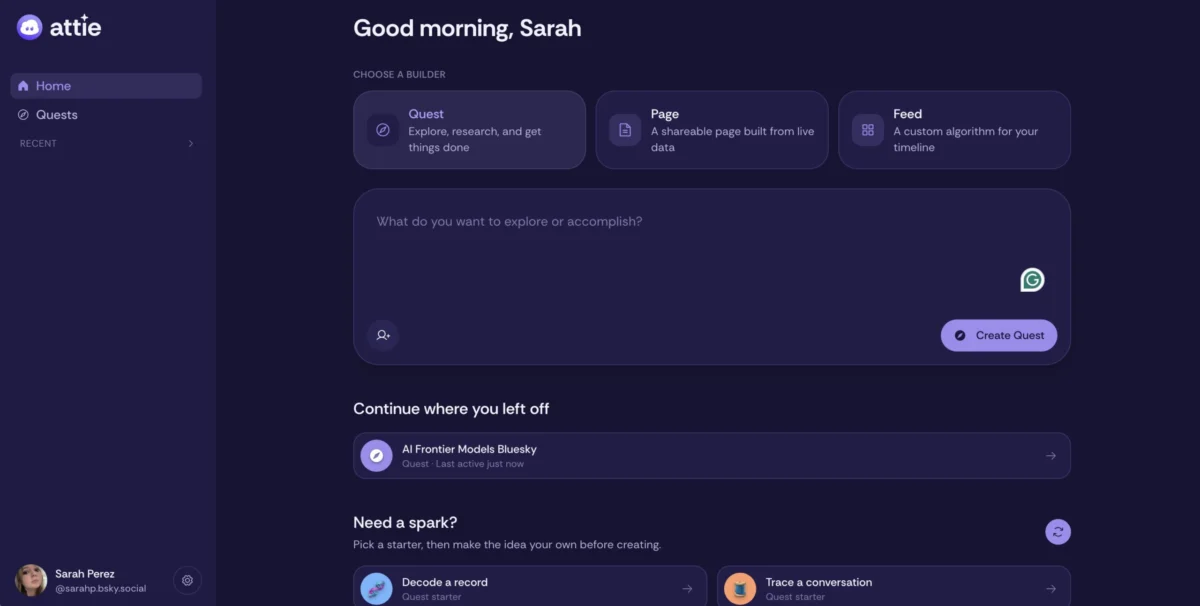
- Specialized Tools: Bluesky has expanded its product suite with "Attie," an AI-powered research and social discovery tool. Originally an internal assistant, Attie has evolved into an open social research tool that allows users to analyze trends across the decentralized web.
By positioning itself as the "plumbing" for the next generation of social media rather than just another app in the App Store, Bluesky is attempting to insulate itself from the boom-and-bust cycles of user attention.
Innovations in Privacy and User Experience
To combat the decline in public engagement, Bluesky is also pivoting toward private networking. The company is currently developing support for private data and encrypted communication within the AT Protocol. This move is intended to attract a different class of users—those who are disillusioned with the "public square" model of social media and prefer smaller, gated communities or private group interactions.
This shift mirrors a broader trend in the industry where users are moving away from broadcasting to the masses and toward "digital campfires"—smaller, more intimate spaces. If Bluesky can successfully implement robust privacy features while maintaining the benefits of a decentralized backend, it may find a sustainable niche among privacy-conscious users and professional organizations.

Analysis of Implications for the Decentralized Web
The current state of Bluesky serves as a case study for the "decentralized social" (DeSo) movement. The platform has proved that it is possible to build a functional, scalable alternative to centralized social media. Its "stickiness" rate—the ratio of daily to monthly active users—remains at a healthy 29%, which is on par with Threads. This indicates that while the user base is smaller, those who remain are highly committed and active.
However, the 52% decline from peak usage highlights the "retention gap." For decentralized platforms to truly compete, they must move beyond being "the place you go when you’re mad at X." They need to provide unique utility that cannot be found elsewhere.
Furthermore, the data suggests that the "exodus" model of growth is unsustainable. Political events can drive short-term spikes in registration, but they rarely result in long-term platform loyalty if the underlying network effect is missing. As of mid-2026, Bluesky claims nearly 46 million registered accounts, yet only about 22% of those accounts are active on a monthly basis. This disparity is a stark reminder that in the attention economy, a "registered user" is a vanity metric; the only currency that matters is consistent engagement.
Conclusion: A Niche Future or a Protocol Powerhouse?
As Bluesky moves toward the end of 2026, its path appears to be diverging from the mainstream social media race. While it may never reach the 300-million-user scale of X or the rapid growth trajectory of Threads, its influence may be felt more in the standards it sets for the industry.
The decline in app usage is a clear signal that the "Twitter-clone" strategy has reached its limit. The company’s future now rests on its ability to foster a diverse ecosystem of apps via the AT Protocol and to successfully launch its private networking features. For now, Bluesky remains a vital experiment in digital democracy and user autonomy, even as it shrinks from the massive, post-election spotlight that once defined it. Whether it can transform from a "refuge" into a "foundation" will determine if it remains a relevant player in the social media landscape of the late 2020s.
