

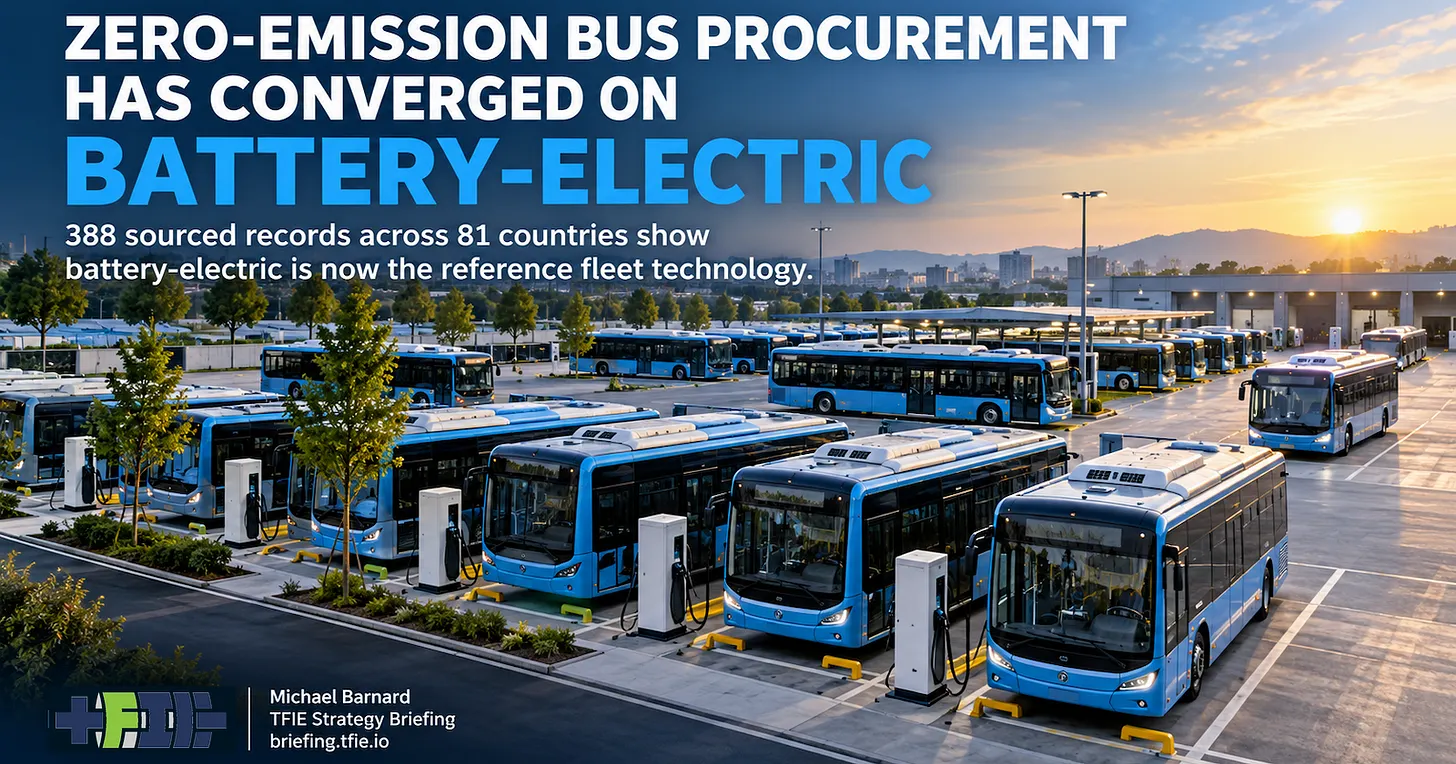
The global landscape of public transportation is undergoing a fundamental transformation as transit agencies move beyond experimental trials toward large-scale fleet electrification. Recent data from a comprehensive global procurement register indicates that battery-electric buses (BEBs) have decisively pulled ahead of hydrogen fuel-cell buses (FCEBs), establishing themselves as the primary reference technology for zero-emission transit. Across 81 countries and hundreds of procurement records, the evidence suggests that the market has moved past the stage of "technology neutrality" and is now focused on the practicalities of scaling battery-electric infrastructure.
A recent analysis of a global procurement register, comprising 388 sourced records, reveals a stark disparity in the adoption rates of these two competing technologies. On a conservative basis—counting only firm orders and awards rather than non-binding tenders or funding announcements—the register identifies 13,165 firm battery-electric bus orders compared to just 65 hydrogen fuel-cell buses. This represents a ratio of more than 200 to 1, with battery-electric technology accounting for approximately 99.5% of firm acquisitions in the documented period.
The Evolution of Zero-Emission Procurement
The transition to zero-emission buses has followed a multi-decade trajectory, moving from niche pilot programs to systemic infrastructure overhauls. In the early 2010s, many transit agencies viewed battery-electric and hydrogen fuel-cell technologies as parallel options, each with potential advantages depending on route length and refueling speed. During this period, numerous "demonstration projects" were funded by governments to test the viability of both platforms under real-world conditions.
By the late 2010s, however, the divergence began to accelerate. As battery energy density improved and the costs of lithium-ion cells plummeted—driven largely by the consumer electric vehicle market—the economic case for battery-electric buses became increasingly compelling. Simultaneously, the supply chain for BEBs matured, with major manufacturers such as BYD, Yutong, Volvo, and Solaris scaling production.
In contrast, hydrogen fuel-cell buses have struggled with high capital costs and the logistical complexity of fuel procurement. While FCEBs offer longer ranges and faster refueling times, the "well-to-wheel" efficiency of hydrogen remains significantly lower than that of direct electrification. Furthermore, the infrastructure required for hydrogen—including production, transport, compression, and high-pressure storage—has proven more difficult and expensive to deploy at scale than electrical charging stations.
Analyzing the Procurement Data
The procurement register’s findings are notable not only for the volume of vehicles but for the breadth of adoption. The 13,165 battery-electric buses were purchased by 55 different agencies and municipal bodies, representing a diverse array of climates, topographies, and operating regimes. These range from high-density urban centers in China and Europe to suburban networks in North America and Southeast Asia.

Conversely, the 65 hydrogen buses identified in the firm-order register come from only two purchasing bodies. This concentration suggests that while hydrogen remains a viable niche solution for specific use cases, it has failed to achieve the broad market replication seen with battery-electric systems.
The methodology used to compile these figures emphasizes "firm orders" to avoid the inflationary effect of press releases. In the public transit sector, a single bus purchase is often announced multiple times: first as a funding grant, then as a tender invitation, later as a framework agreement, and finally as a delivery. By filtering for firm contracts, the data provides a more accurate reflection of where transit agencies are actually committing their capital.
The Hydrogen Outliers: Qingyang and Krefeld
While the overall trend heavily favors electrification, the two primary buyers of hydrogen buses provide insight into the conditions under which fuel-cell technology still thrives.
In Qingyang, China, the adoption of hydrogen buses is part of a deliberate, top-down municipal ecosystem strategy. The city is coordinating bus procurement with the development of local hydrogen production and refueling infrastructure as part of a broader industrial development program. In this context, the buses serve as an anchor tenant for a hydrogen economy that the local government is seeking to build from the ground up.
The second case, Krefeld, Germany, represents a more commercial counterexample. The operator in Krefeld already had hydrogen buses in its fleet and chose to exercise options for more vehicles after gaining several years of operating experience. This indicates that for operators who have already cleared the high initial hurdle of infrastructure installation and technician training, hydrogen can perform reliably in daily service. However, these cases remain the exception rather than the rule.
Infrastructure and Operational Challenges
The shift to battery-electric dominance does not imply that the transition is without significant hurdles. Transit agencies moving toward 100% electric fleets face massive logistical challenges that go far beyond the vehicles themselves.
- Grid Capacity and Utility Interconnection: Converting a depot of 200 buses to electric power requires multi-megawatt connections, often necessitating the construction of new on-site substations. Coordinating these upgrades with local utilities can take years, often outlasting the lead time for the buses themselves.
- Charging Management: Unlike diesel buses, which can be refueled at any time, BEBs require sophisticated software to manage "smart charging." This ensures that buses are charged when electricity prices are lowest and that the total draw does not exceed the depot’s peak capacity.
- Workforce Transition: Maintenance departments must be completely retrained. Technicians who spent decades working on internal combustion engines must now become experts in high-voltage systems, thermal management, and power electronics.
- Operational Scheduling: Because BEBs may have shorter ranges than their diesel predecessors—particularly in extreme cold or heat—agencies must often redesign routes or implement "opportunity charging" at terminal stations to keep the fleet moving throughout the day.
Despite these "deployment problems," the procurement data suggests that agencies find these challenges more manageable or more cost-effective than the challenges associated with hydrogen.

Implications for Policy and Technology Neutrality
For years, the mantra of "technology neutrality" has dominated government transport policy. The idea was that public funding should not pick winners, instead allowing the market to decide between various zero-emission paths. However, the lopsided procurement data suggests that the market has, in fact, made its choice.
Industry analysts argue that continuing to treat BEBs and FCEBs as equal competitors in every context may now be a policy risk. By spreading funding thinly across both technologies for "comparative trials," governments may be slowing down the necessary investment in the power grids and charging infrastructure required to support the technology that is actually being bought at scale.
The consensus among many transit experts is that battery-electric should now be treated as the "default reference technology." This means that when an agency plans a zero-emission transition, they should start with the assumption of electrification. A departure toward hydrogen should only be justified if there is a specific, material constraint—such as an extremely demanding duty cycle or a total lack of available grid power—that electrification cannot solve economically.
Global Regional Trends
The transition is manifesting differently across the globe, though the end result remains consistent.
- China: China remains the global leader in bus electrification, accounting for the vast majority of the world’s electric bus fleet. This was driven by aggressive national subsidies and a strategic push to reduce urban air pollution and dependence on oil imports.
- Europe: Driven by the "Clean Vehicles Directive," European cities are rapidly phasing out internal combustion engines. While there was early interest in hydrogen in countries like Germany and the UK, the bulk of recent tenders in Paris, Berlin, and London have been for battery-electric models.
- North America: In the United States, the Bipartisan Infrastructure Law has funneled billions into the "Low or No Emission" vehicle program. While some agencies, such as Foothill Transit in California, have experimented with hydrogen, the overwhelming majority of funding requests and subsequent orders are for BEBs.
Future Outlook: Beyond the Trial Phase
The next phase of the zero-emission transition will likely focus on "fleet-scale" implementation rather than small-batch purchases. As agencies move from owning 10 electric buses to 500, the focus will shift toward resiliency and cost-optimization.
The procurement register indicates that the "pipeline" for battery-electric buses remains robust, with thousands of vehicles currently in open tender procedures. As the supplier ecosystem for batteries continues to expand and the second-hand market for electric buses begins to emerge, the barriers to entry for smaller transit agencies will continue to fall.
Ultimately, the 200-to-1 procurement gap serves as a signal to manufacturers and policymakers alike. While hydrogen may still find a home in heavy-duty long-haul trucking or specific industrial applications, the urban and suburban bus market has firmly entered the electric era. The question for transit agencies is no longer which technology to choose, but how to prepare their infrastructure for the inevitable arrival of a fully electric fleet. Solving for grid constraints, charging reliability, and financing models is now the most effective way to accelerate the decarbonization of global transit.
