

The modern real estate investment landscape has evolved far beyond the capacity of traditional, one-size-fits-all business banking. As investors scale their portfolios from single-family rentals to multi-unit complexes and diverse LLC structures, the demand for specialized financial tools has surged. Managing rental properties across multiple legal entities requires a sophisticated approach to tracking income and expenses, organizing security deposits in compliance with state laws, and ensuring that every transaction is correctly categorized for tax reporting. The shift toward specialized real estate banking represents a broader movement in the financial technology (fintech) sector to provide "verticalized" banking solutions that integrate deeply with the specific workflows of property management and real estate operations.
The Strategic Importance of Specialized Real Estate Banking
For the modern real estate operator, the bank account is no longer just a repository for cash; it is the central nervous system of the entire investment enterprise. The primary challenge facing investors with growing portfolios is the fragmentation of financial data. When an investor manages five properties across three different LLCs using a standard commercial bank, they often find themselves toggling between multiple logins, manually reconciling bank statements with spreadsheets, and struggling to provide clean "Schedule E" reports to their accountants at year-end.
Specialized banking platforms address these friction points by offering features tailored to the lifecycle of a rental property. This includes the ability to open unlimited sub-accounts for security deposits—crucial for maintaining the legal separation of tenant funds—and automated bookkeeping that recognizes real estate-specific tax categories. Industry analysts note that the adoption of these platforms can reduce the time spent on monthly reconciliation by up to 70%, allowing investors to focus on acquisition and asset management rather than administrative overhead.
A Chronology of Financial Innovation in Real Estate
The transition from traditional banking to integrated real estate fintech has occurred in distinct phases over the last two decades.
- The Traditional Era (Pre-2010): Investors relied almost exclusively on local community banks or national "Big Four" banks. Relationships were built on physical proximity and personal rapport with commercial loan officers. Financial tracking was largely manual, involving paper checks and physical ledgers.
- The Rise of General Fintech (2010–2018): Platforms like Bluevine and Mercury emerged, offering digital-first business banking with lower fees and better user interfaces. While these were an improvement over traditional banks, they lacked the property-specific categorization required by real estate investors.
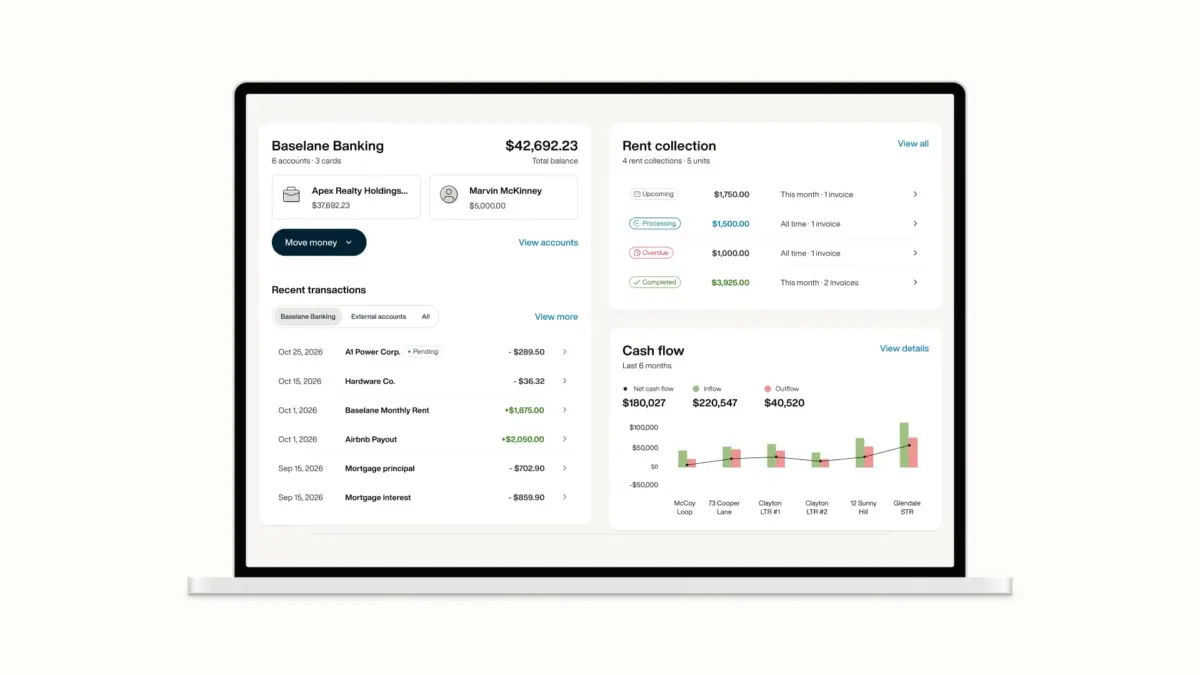
- The Vertical Integration Era (2019–Present): Companies like Baselane and Stessa entered the market, specifically designing banking shells around the needs of landlords. These platforms integrate rent collection, bookkeeping, and banking into a single ecosystem, effectively turning the bank account into a property management software suite.
Comprehensive Comparison of Leading Banking Platforms
The current market offers a spectrum of choices ranging from digital-only fintechs to established institutional giants. Selecting the right partner depends on the investor’s specific strategy, whether it be high-volume fix-and-flips, long-term buy-and-hold rentals, or large-scale commercial developments.
1. Baselane: The Integrated Leader for Multi-Property Portfolios
Baselane has positioned itself as the premier choice for investors who require a tight loop between their banking and their bookkeeping. By offering the ability to open unlimited accounts organized by property or entity, it eliminates the "commingling" risks that can lead to the piercing of the corporate veil in legal disputes. Its automated bookkeeping engine uses over 120 real estate-specific categories, significantly streamlining the preparation of IRS Schedule E forms. For short-term rental operators, Baselane’s virtual debit card feature allows for precise budget control, enabling co-hosts or cleaners to make property-specific purchases without accessing the main operating account.
2. Stessa: Property Management with Financial Depth
Stessa, headquartered in Oakland, California, serves as a comprehensive property management tool that happens to offer powerful cash management features. It is particularly effective for investors who want to track the performance of their portfolio in real-time, offering visual dashboards that show cap rates, net cash flow, and total return on investment.
3. Relay: Mastery of Cash Flow Separation
Relay is favored by investors who follow the "Profit First" methodology. It allows for up to 50 checking accounts per entity, enabling investors to set up automated percentage-based transfers. This ensures that money is always set aside for taxes, maintenance reserves, and owner draws before any other spending occurs.
4. The Institutional Giants: Chase and Wells Fargo
Traditional banks like Chase and Wells Fargo remain indispensable for investors who require physical branch access for cash deposits or those seeking large-scale commercial real estate (CRE) lending. Wells Fargo is a dominant player in multifamily financing through agency programs like Fannie Mae and Freddie Mac, while Chase’s nationwide footprint provides merchant services and business credit cards that are often more robust than those offered by fintech startups.

5. Specialized Lending Platforms: Live Oak and Axos
For investors whose primary need is capital, specialized banks like Live Oak (the nation’s leading SBA 7(a) lender) and Axos Bank (a pioneer in online DSCR loans) offer streamlined digital applications. Debt Service Coverage Ratio (DSCR) loans, in particular, have become a staple for investors who want to scale their portfolios based on the property’s cash flow rather than their personal income.
Technical Data and Market Implications
The move toward specialized banking is supported by significant shifts in the regulatory and economic environment. With the Federal Reserve maintaining a "higher for longer" stance on interest rates throughout much of 2023 and 2024, the "spread" or margin on rental properties has compressed. In such an environment, operational efficiency becomes the primary lever for maintaining profitability.
Data from recent industry surveys suggests that investors using automated bookkeeping platforms are 40% less likely to miss tax deductions compared to those using manual methods. Furthermore, the integration of high-yield savings—such as the competitive APY offered by Baselane—allows investors to earn a meaningful return on their "dry powder" or maintenance reserves, which was nearly impossible in the zero-interest-rate environment of the previous decade.
Official Responses and Regulatory Context
Regulatory bodies have begun to take a closer look at the intersection of banking and property management. The primary concern for many state regulators remains the handling of security deposits. In many jurisdictions, landlords are required to keep security deposits in interest-bearing accounts and provide tenants with annual statements of earned interest. Fintech platforms that automate this process provide a significant compliance buffer for investors who might otherwise inadvertently violate these complex local statutes.
Furthermore, the IRS has increased its focus on the "passive" versus "active" classification of real estate income. Integrated banking platforms provide the contemporaneous documentation required to prove "material participation," which can be a critical factor in a taxpayer’s ability to offset other income with real estate losses.
Broader Impact on the Real Estate Ecosystem
The democratization of sophisticated banking tools has lowered the barrier to entry for small-scale investors. What was once only available to institutional REITs (Real Estate Investment Trusts)—such as real-time cash flow analysis and automated entity-level accounting—is now available to an investor with a single duplex.
This professionalization of the "mom-and-pop" landlord segment has broader implications for the housing market. More efficient financial management often leads to better-maintained properties and more stable tenant relations, as funds for repairs are more accurately tracked and security deposit returns are more reliably managed.
Conclusion: Navigating the Future of Real Estate Finance
Choosing a banking platform is no longer a peripheral decision for real estate investors; it is a foundational one. While traditional banks offer the security of physical branches and institutional lending, the specialized fintech sector offers the agility and automation required to thrive in a data-driven market.
Investors are increasingly adopting a "hybrid" approach: maintaining a relationship with a local or national bank for lending and cash deposits, while utilizing a platform like Baselane or Stessa for daily operations, rent collection, and tax preparation. This dual-track strategy ensures that the investor has the capital they need to grow and the systems they need to manage that growth without being overwhelmed by administrative complexity. As artificial intelligence continues to integrate with these platforms, the next frontier will likely involve predictive maintenance budgeting and automated tax optimization, further cementing the role of the specialized bank as the essential partner in real estate wealth creation.
