

The genesis of one of the most storied careers in athletic history began not with a silver spoon, but with a stolen bicycle. In 1954, a 12-year-old native of Louisville, Kentucky, named Cassius Marcellus Clay Jr. discovered that his brand-new red-and-white Schwinn bicycle had been pilfered outside the Columbia Auditorium. Fuming with indignation, the young boy sought out a police officer to report the crime, vowing to "whup" whoever had taken it. The officer, Joe Martin, who happened to run the local Columbia Gym, famously replied that the boy had better learn how to fight before he started challenging people. This encounter served as the accidental catalyst for a journey that would redefine the sport of boxing and the role of the athlete in global society. Within six years, Clay would secure an Olympic gold medal in Rome, and within ten, he would ascend to the pinnacle of the heavyweight division.

On February 25, 1964, the world of professional boxing was irrevocably changed when Cassius Clay, then a 7-to-1 underdog, defeated the seemingly invincible reigning champion Sonny Liston. The victory was a display of unprecedented speed and psychological warfare, marking the arrival of a fighter who "floated like a butterfly and stung like a bee." However, the triumph in the ring was immediately followed by a seismic shift in his personal and spiritual identity. Shortly after the fight, Clay announced his membership in the Nation of Islam, a move that shocked the American public and the sporting establishment. Under the guidance of Elijah Muhammad, he shed what he called his "slave name" and became Muhammad Ali. This transition was not merely a change in nomenclature; it was the beginning of a life-long commitment to civil rights activism and spiritual exploration that would eventually lead him to Sunni Islam and global humanitarianism.
The Chicago Years and the Price of Principle
Following his conversion, Ali relocated to Chicago, the headquarters of the Nation of Islam. His residence in the Avalon Park neighborhood, a single-story brick home, was a gift from the organization and served as his domestic base during one of the most turbulent periods of his life. In 1967, at the height of his physical prime, Ali took a stand that would define his legacy as much as any knockout. Citing his religious beliefs and opposition to the Vietnam War, he refused induction into the U.S. Armed Forces. The consequences were swift and severe: he was stripped of his heavyweight title, his boxing license was revoked across the United States, and he was sentenced to five years in prison (a conviction he appealed while remaining free on bond).

During this period of forced exile, which lasted from age 25 to 28, Ali remained a resident of Chicago. It was here that he married his second wife, Khalilah Camacho-Ali (formerly Belinda Boyd), in August 1967. Deprived of his primary source of income, Ali spent these years lecturing at universities, engaging in civil rights discourse, and deepening his religious studies. Photos from this era often depict him in his Chicago home, a modest but dignified setting where he was frequently seen reading the works of Elijah Muhammad. This era solidified Ali’s status as a counter-culture icon, as he sacrificed millions of dollars and his best athletic years for the sake of his conscience.
A Growing Family and the Philadelphia Transition
As the legal battles over his draft evasion continued, Ali’s family life expanded. In 1968, he and Khalilah welcomed their first daughter, Maryum. Two years later, twins Rasheda and Jamillah were born. By late 1970, Ali had moved his family to the Overbrook Park neighborhood of West Philadelphia. This move coincided with his return to the ring, following the gradual reinstatement of his boxing licenses in various states. The Philadelphia home, a multi-story residence, was a hub of activity as Ali prepared for the "Fight of the Century" against Joe Frazier. Interestingly, the property would later be owned by the grandparents of basketball legend Kobe Bryant, creating a unique link between two of the greatest icons in sports history.

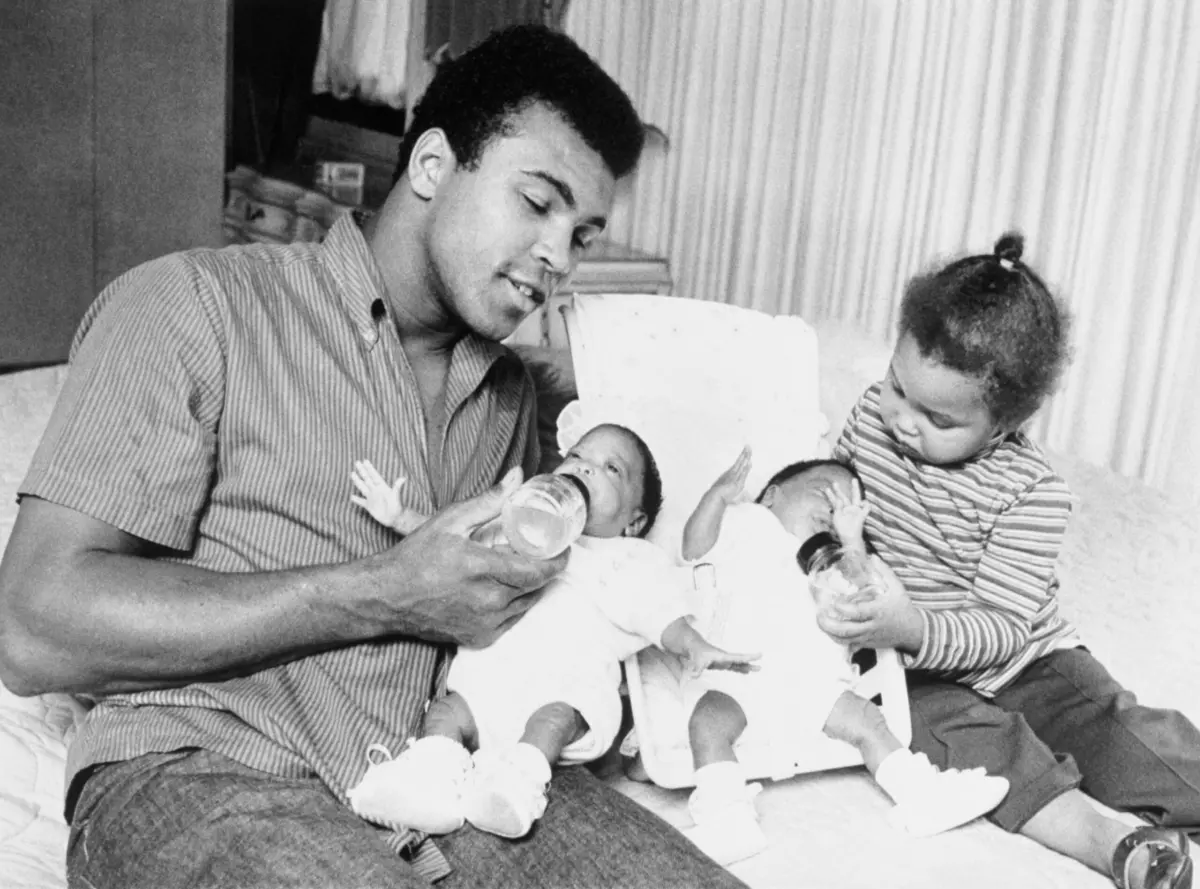
Ali’s time in Philadelphia was marked by a domesticity that contrasted sharply with his boisterous public persona. While he was known for his "Louisville Lip" and flamboyant pre-fight antics, his home life was often described as centered around his children. Photographs from this period show the heavyweight contender in quiet moments, assisting with the feeding of his infant twins or playing with Maryum, showcasing a side of "The Greatest" that the cameras at Madison Square Garden rarely captured.
Fighter’s Heaven: The Pennsylvania Sanctuary
While Ali maintained various residences, perhaps the most significant location in his professional development was "Fighter’s Heaven" in Deer Lake, Pennsylvania. Purchased in 1972 for approximately $10,000, the six-acre property was transformed into a state-of-the-art training camp. This was not a luxury resort but a rugged, purposeful retreat. Ali custom-built a log gym, a dining hall, a mosque, and several cabins for his entourage and sparring partners. He famously painted the names of legendary boxers like Jack Johnson and Joe Louis on large boulders scattered throughout the grounds.

Fighter’s Heaven was where Ali prepared for his most iconic victories, including the "Rumble in the Jungle" against George Foreman in 1974 and the "Thrilla in Manila" against Joe Frazier in 1975. Unlike many athletes who trained in seclusion, Ali kept the camp open to the public. Fans, journalists, and curious locals were often invited to watch him spar or join him for a meal in the communal dining hall. This accessibility reflected Ali’s self-perception as the "People’s Champion." He retained the property long after his retirement, eventually selling it in 1997. Today, the site stands as a restored museum and tourist destination, preserving the atmosphere of the 1970s boxing world.
The Los Angeles Era: Opulence and Retirement
In 1979, Ali moved to Los Angeles, purchasing a magnificent Italian Renaissance mansion in the exclusive Hancock Park neighborhood. Built in 1916 by architect John C. Austin—the designer of the Los Angeles City Hall and the Griffith Observatory—the 14,500-square-foot estate featured seven bedrooms and was a testament to Ali’s status as a global superstar. The home was filled with intricate dark wood carvings, crystal chandeliers, and stained-glass window panels designed by Louis Comfort Tiffany.

This period marked the beginning of the end of his boxing career. Ali briefly retired in 1979 but was lured back to the ring for a tragic fight against Larry Holmes in 1980. It was during this time that observers began to notice the early signs of Parkinson’s disease: a slight tremor and a slowing of his once-rapid speech. Despite these health concerns, Ali’s Hancock Park home remained a center of social and political activity. He lived there with his third wife, Veronica Porché, and their two daughters, Hana and Laila (who would later become a world-class boxer herself). The mansion’s trophy room became a museum of his achievements, housing his three heavyweight championship belts and countless awards for his humanitarian work.
The Final Rounds and Humanitarian Legacy
Ali was officially diagnosed with Parkinson’s syndrome in 1984, three years after his final professional fight against Trevor Berbick. Following his divorce from Porché in 1986, he married Yolanda "Lonnie" Williams, a friend from his childhood in Louisville. Lonnie became not only his wife but his primary caregiver and business manager, helping to navigate the challenges of his progressing illness.

The couple eventually settled in Paradise Valley, Arizona, a location chosen for its dry climate and tranquility. In his final decades, Ali transitioned from the world’s most famous athlete to a global ambassador for peace. Despite his physical limitations, he traveled to Lebanon and Iraq to negotiate the release of hostages, visited North Korea, and served as a United Nations Messenger of Peace. In 2005, he was awarded the Presidential Medal of Freedom, the highest civilian honor in the United States, followed by the Liberty Medal in 2012.
Muhammad Ali passed away on June 3, 2016, at the age of 74. His death triggered a global outpouring of grief, culminating in a multi-day memorial service in his hometown of Louisville that was attended by world leaders and celebrities alike. Ali’s legacy, however, is not confined to the records of his 56 wins and 5 losses. It lives on in the Muhammad Ali Center in Louisville, a museum and multicultural center dedicated to his "six core principles": confidence, conviction, dedication, giving, respect, and spirituality.

Analysis of Impact and Conclusion
The trajectory of Muhammad Ali’s life—from the Avalon Park brick house in Chicago to the Italian Renaissance mansion in Los Angeles—parallels the evolution of the Black athlete in the 20th century. Ali broke the mold of the silent, compliant sportsman, proving that an athlete could be a political force, a religious leader, and a global humanitarian without compromising their professional excellence.
His refusal to serve in the Vietnam War remains one of the most significant acts of civil disobedience in American history, influencing subsequent generations of athletes to use their platforms for social justice. Furthermore, his openness about his battle with Parkinson’s disease helped to humanize the condition and spurred significant funding for research. Muhammad Ali was more than a boxer; he was a mirror for the social and political upheavals of his time, a man who lived his life with a degree of transparency and conviction that earned him the title he gave himself: The Greatest. His homes, each reflecting a different chapter of his struggle and success, serve as the physical landmarks of a journey that continues to inspire millions across the globe.
