

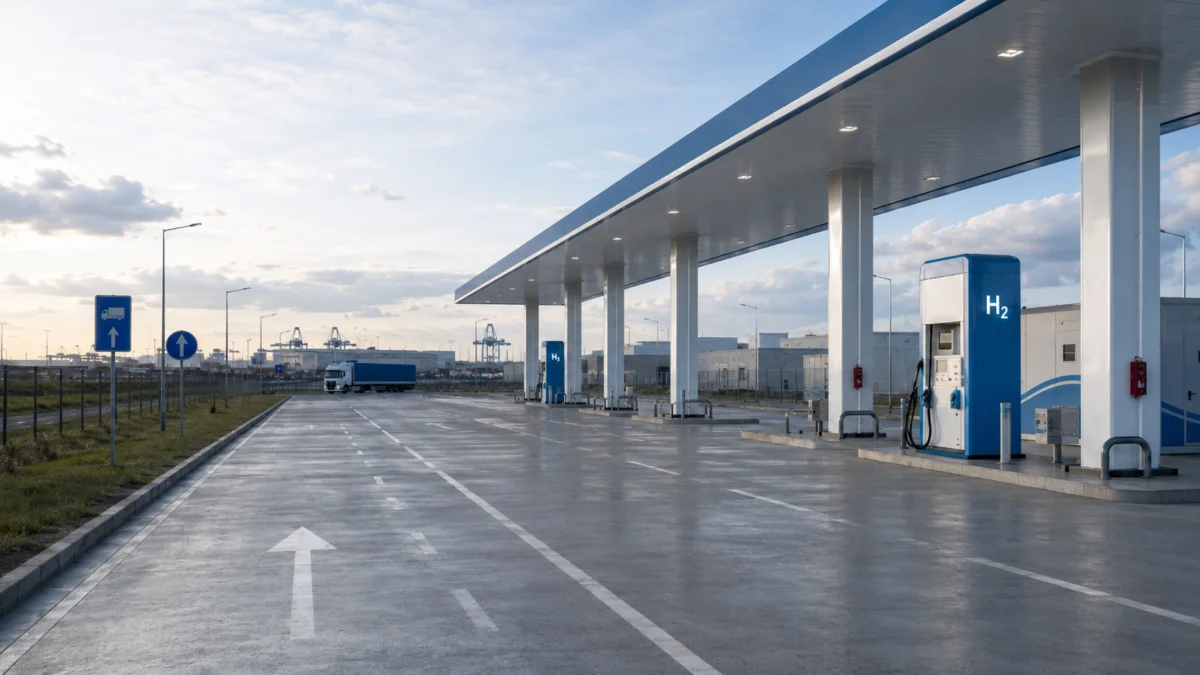
The landscape of European heavy-duty transport decarbonization is increasingly defined by ambitious infrastructure targets and the rollout of hydrogen refueling technology. In Belgium, a recent announcement regarding the expansion of hydrogen refueling stations (HRS) has highlighted a growing tension between nominal capacity and actual market utilization. Atawey, a prominent French designer and manufacturer of hydrogen refueling stations, has officially signed a contract with the Colruyt Group and Virya Energy to deploy three new high-capacity hydrogen stations across Belgium. While the technical specifications of these stations are impressive—boasting a combined distribution capacity of more than seven tonnes of hydrogen per day—industry analysts are raising critical questions about the "denominator" of these projects. The success of such initiatives, experts argue, should not be measured by the capacity printed in press releases, but by the volume of kilograms actually dispensed and the number of vehicles consistently served.
The Scale of the New Infrastructure Investment
The agreement between Atawey, Colruyt Group, and Virya Energy represents a significant capital commitment to the Belgian hydrogen ecosystem. Planned for deployment by the end of 2027, the three stations are specifically designed to cater to the heavy-duty mobility sector, including long-haul trucks and large logistics vehicles. A capacity of seven tonnes per day (7,000 kilograms) is a substantial industrial figure, positioning these stations as some of the most powerful in the Benelux region.
Colruyt Group, a leading retail corporation in Belgium, has been a pioneer in integrating hydrogen into its logistics operations, having already experimented with hydrogen-powered forklifts and heavy-duty trucks. Virya Energy, which focuses on the development and operation of renewable energy projects, provides the strategic energy framework for the initiative. Together, these partners aim to establish a corridor that supports the transition away from diesel-powered freight. However, the sheer scale of the 7,000 kg/day capacity creates a stark contrast with the current number of hydrogen-powered vehicles on Belgian roads.
A Chronology of Hydrogen Infrastructure in the Benelux Region
To understand the context of the Atawey announcement, it is necessary to look at the evolution of hydrogen trials in the region. The precursor to the current expansion was the H2Benelux program, a cross-border initiative supported by the European Commission’s Connecting Europe Facility (CEF).
- 2017–2020: The Foundation Phase. The H2Benelux project was launched to create a "Hydrogen Corridor" connecting Belgium, the Netherlands, and Luxembourg. The project aimed to deploy eight refueling stations and a trial fleet of 80 hydrogen vehicles to test real-world viability.
- 2021–2023: Capacity Benchmarking. Under the H2Benelux framework, three stations were established in Belgium. These stations typically offered a capacity of approximately 200 kg/day each, totaling roughly 600 kg/day for the Belgian segment of the project.
- 2024: The Capacity Leap. The announcement of the Atawey-Colruyt-Virya partnership marks a dramatic shift in scale. By adding 7,000 kg/day of capacity through just three stations, the new project represents an elevenfold increase in nameplate capacity compared to the earlier Belgian H2Benelux stations.
- 2027: Target Completion. The full deployment of the three high-capacity stations is scheduled for completion, aligning with the European Union’s broader deadlines for alternative fuel infrastructure.
Data Analysis: The Denominator Problem
The central challenge facing the Belgian hydrogen sector is the discrepancy between infrastructure supply and vehicle demand—a phenomenon often referred to by analysts as the "denominator problem." If the success of hydrogen mobility is measured by "stations ordered," the market appears to be in a state of rapid growth. However, if the denominator is changed to "kilograms dispensed" or "vehicles per station," the outlook becomes more complex.
Current records suggest that the Belgian hydrogen vehicle base remains remarkably small. Based on public program announcements and fleet records, there are approximately 109 hydrogen vehicles currently operational or committed in Belgium. This figure includes both light-duty pilot vehicles and a limited number of heavy-duty trucks.
When the arithmetic of utilization is applied to the new Atawey stations, the potential for underutilization becomes clear:
- Scenario A (Conservative Demand): If all 109 Belgian hydrogen vehicles were to use 5 kg of hydrogen per day, the total national demand would be 545 kg/day.
- Scenario B (Aggressive Demand): If those same 109 vehicles were heavy-duty trucks running full duty cycles and consuming 10 kg/day, the demand would rise to 1,090 kg/day.
Even in the aggressive demand scenario, the total national requirement (1,090 kg/day) is only a fraction of the capacity offered by the three new stations alone (7,000 kg/day). The new infrastructure provides approximately 6.4 to 13 times the capacity required by the current fleet. This suggests that for the stations to be economically viable, the Belgian hydrogen truck fleet would need to expand by more than 600% by 2027 just to meet the capacity of these three specific sites.
Regulatory Drivers and the TEN-T Framework
The push to build high-capacity stations ahead of demand is not merely a corporate gamble; it is heavily influenced by European Union policy. The Alternative Fuels Infrastructure Regulation (AFIR) mandates the deployment of hydrogen refueling stations along the Trans-European Transport Network (TEN-T) core corridors.
Under AFIR, EU member states are required to ensure that hydrogen refueling stations are available at regular intervals (roughly every 200 km) and in major urban nodes by 2030. This regulation prioritizes geographical coverage to eliminate "range anxiety" for international freight. However, critics point out that AFIR can create a "map-based reality" that does not necessarily reflect "market-based reality." A station might exist to satisfy a regulatory requirement for a corridor, but without a corresponding mandate or subsidy for vehicle acquisition, that station risks becoming a stranded asset.
Technical and Economic Implications of Low Utilization
Unlike battery-electric charging stations, hydrogen refueling stations involve complex mechanical and chemical processes that incur high fixed costs regardless of throughput. An HRS requires:
- Molecular Supply: A consistent source of hydrogen, often delivered via high-pressure tube trailers or produced on-site via electrolysis.
- Compression and Storage: Hydrogen must be compressed to 350 bar (for trucks) or 700 bar (for cars), requiring energy-intensive compressors and specialized storage tanks.
- Cooling Systems: To ensure rapid dispensing, the hydrogen must be pre-cooled, adding to the station’s electrical load.
- Maintenance: High-pressure systems are subject to significant wear and tear, requiring specialized technicians for regular upkeep.
When utilization is low, the cost per kilogram of hydrogen dispensed rises significantly because the fixed capital and operational costs are spread over a small volume of fuel. This creates a cycle where high fuel prices deter fleet operators from switching to hydrogen, further suppressing utilization.
In contrast, battery-electric trucking infrastructure offers a more modular scaling path. Logistics depots can install chargers incrementally as they add electric trucks to their fleets. While grid connections remain a challenge for electric trucks, the infrastructure can grow in lockstep with the vehicle count, mitigating the risk of massive overcapacity.
Belgium as a Strategic Test Case
Despite the utilization concerns, Belgium is arguably one of the most favorable environments in the world for testing the hydrogen heavy-duty case. The country serves as a critical logistics hub for Europe, featuring:
- The Port of Antwerp-Bruges: One of the world’s largest ports and a major node for hydrogen production and import.
- Dense Freight Corridors: Belgium has some of the highest truck traffic density in Europe, connecting the industrial heartlands of Germany, France, and the Netherlands.
- Corporate Commitment: The involvement of Colruyt Group and Virya Energy provides a "captive fleet" opportunity, where a company controls both the fuel supply and the vehicles, allowing for more predictable utilization.
If hydrogen refueling cannot achieve commercial traction in the Belgian "logistics triangle," it is unlikely to succeed in less dense or less industrially integrated regions. Therefore, the Atawey project will be watched closely by European policymakers as a bellwether for the industry.
Future Outlook: Moving Beyond Station Counts
As the 2027 deployment date approaches, the focus of the hydrogen industry is expected to shift from infrastructure announcements to operational transparency. To move beyond the "chicken-and-egg" argument that has characterized the sector for a decade, stakeholders are calling for more detailed reporting on:
- Actual Throughput: Moving the metric of success from "nameplate capacity" to "average daily kilograms dispensed."
- Vehicle Integration: Tracking the number of heavy-duty trucks that are actually purchased and deployed alongside the stations.
- Cost Parity: Analyzing the delivered price of hydrogen compared to diesel and electricity on a per-kilometer basis.
- Public Subsidy Efficiency: Evaluating how much public funding is required to sustain these operations until they reach a break-even point.
The announcement of three new 7,000 kg/day stations is an undeniable sign of industrial ambition and confidence from players like Atawey, Colruyt, and Virya. However, the true measure of Belgium’s progress in transport decarbonization will be found at the nozzle. Capacity is a statement of intent; utilization is a statement of market reality. For the hydrogen economy to become a permanent fixture of the European landscape, the number of trucks arriving at the pump must eventually catch up to the numbers printed in the press releases.
