

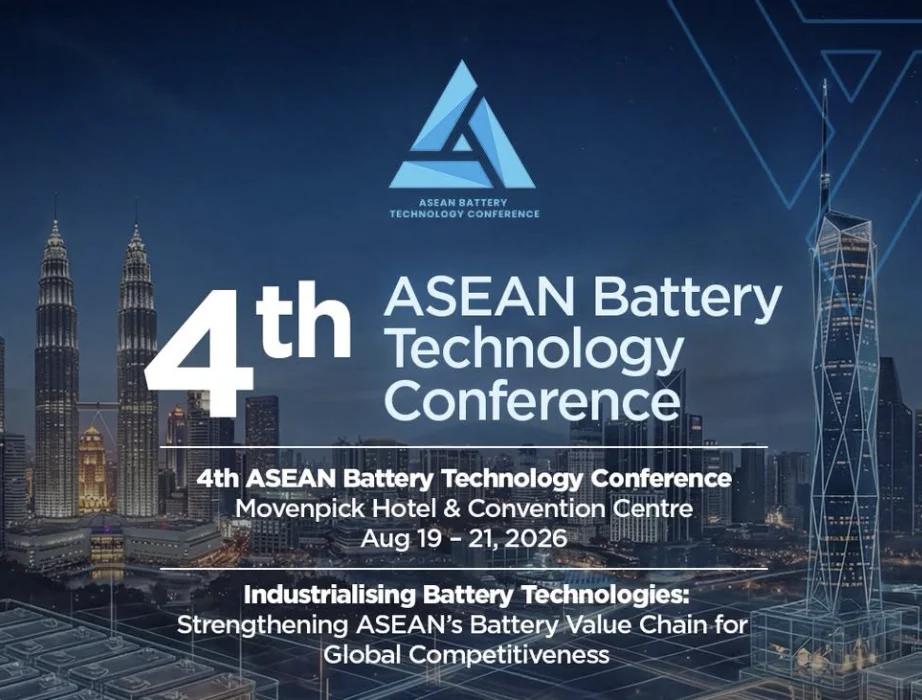
The rapid transition of Southeast Asia toward clean energy is moving from the early adoption of electric mobility to a comprehensive regional industrialization effort. When the 4th ASEAN Battery Technology Conference (ABTC) opens next month in Sepang, Malaysia, the focus will pivot from policy framework proposals toward the engineering realities of cell manufacturing, thermal runaway mitigation, and localized chemical supply loops. This transition represents an evolutionary step for the Association of Southeast Asian Nations (ASEAN). While the region has long held significant raw mineral assets, it has historically lacked the integrated manufacturing stack required to compete with global battery super-factories. The upcoming conference, scheduled for August 19 to 21 at the Mövenpick Hotel & Convention Centre KLIA under the theme “Industrialising Battery Technologies: Strengthening ASEAN’s Battery Value Chain for Global Competitiveness,” aims to address this industrial deficit.
Historically, Southeast Asia approached the energy storage economy through the lens of extraction. Indonesia, for instance, holds approximately 21 million metric tons of nickel reserves—the largest in the world—while neighboring nations like the Philippines and Vietnam manage other critical components of the global supply chain. However, the regional leadership has recognized that exporting raw precursors or unrefined ore does not create a resilient or high-value domestic industry. The technical presentations scheduled for the gathering highlight a definitive push toward domestic chemical synthesis, active material processing, and specialized cell design tailored for the unique climate and market conditions of the tropics.
The Evolution of the ASEAN Battery Landscape
The journey toward a self-sustaining battery ecosystem in Southeast Asia has been marked by a series of strategic milestones. In 2023, during the previous conference held in Phuket, Thailand, the focus was largely on the establishment of the ASEAN Battery Safety Network. This initiative was the first step in creating standardized safety testing and protocols across member states, ensuring that as batteries proliferated in urban environments, they met rigorous quality benchmarks.
The move to Malaysia for the 2024 edition signals a shift from safety standards to manufacturing scaling. Malaysia has positioned itself as a high-tech hub, attracting significant investments from global semiconductor and electronics firms. By leveraging this existing infrastructure, the region aims to bridge the gap between "resource-rich" and "technology-rich" economies. The timeline for ASEAN’s battery ambitions is aggressive, with several member states targeting 2030 as a deadline for significant electrification of their transport sectors. To meet these goals, the region must move beyond assembly and into the fundamental science of electrochemical storage.
“We are honored to host ABTC 2024 at a critical point in ASEAN’s battery journey,” said Prof. (Adj.) Dr. Rezal Khairi Ahmad, chief executive officer of NanoMalaysia Berhad Group, the event organizer. “The region has strong potential across research, manufacturing, electric mobility, energy storage, and circularity, but turning this potential into industrial capability requires closer alignment between governments, industry, researchers, and investors.”
Engineering Challenges: Solving for the Tropical Climate
A primary technical challenge for energy storage systems deployed in Southeast Asia is atmospheric and thermal management. Standard lithium-ion chemistries, developed largely for temperate climates in North America, Europe, and Northeast Asia, face unique degradation mechanisms when subjected to high ambient temperatures and persistent humidity. These environmental factors accelerate the growth of the Solid Electrolyte Interphase (SEI) layer and can lead to electrolyte decomposition, which shortens the lifespan of the battery.
Lithium-iron-phosphate (LFP) chemistry has emerged as a regional favorite due to its inherent thermal stability and lower cost compared to Nickel-Manganese-Cobalt (NMC) variants. However, maximizing LFP’s energy density requires precise manufacturing advancements. Engineers at the conference are set to focus heavily on cell architecture, exploring how localized variations in cathode coating uniformity, electrolyte additives, and separator materials can alter the lifecycle analysis of localized packs.
In tropical urban centers, light electric vehicles (LEVs) like two-wheelers and three-wheelers experience harsh duty cycles. These vehicles often undergo rapid charging multiple times a day and are subjected to constant mechanical vibration from varying road conditions. These factors increase the risk of internal short circuits that can lead to catastrophic thermal runaway. Addressing this requires deep innovation at the pack and system level—such as advanced cooling plates and flame-retardant enclosures—rather than relying solely on cell-level stability.
Strategic Partnerships and Technology Transfer
The integration of advanced chemical engineering into regional manufacturing is underscored by strategic partnerships scheduled for the event. A collaboration between NanoMalaysia Berhad and the Institution of Engineers, Malaysia (IEM), centers on formal technology transfer frameworks specifically designed for energy storage engineering. This initiative aims to bridge the gap between academic electrochemical research and shop-floor manufacturing scaling, a bottleneck that frequently stalls battery innovation before it reaches commercial viability.
Furthermore, the conference will facilitate industry agreements that reflect a pragmatic focus on deployment. For instance, a supply agreement between GigaFactory Malaysia Sdn. Bhd. and Milan Utama focuses on building prototypes for compact battery energy storage systems (BESS). These configurations require advanced cell matching, sophisticated thermal management loops, and embedded sensor suites capable of predicting voltage imbalances before they cause thermal failures.
On the electronics side, a technological tie-up between Ampace and Infineon Technologies brings advanced semiconductor control architectures into the regional conversation. Modern Battery Management Systems (BMS) must process massive amounts of state-of-health data in real-time. By utilizing precise silicon and firmware architectures, these systems can safely push cells closer to their operational limits, maximizing usable capacity without compromising the safety margins demanded by regional regulators.
Data and Economic Implications
The economic stakes for ASEAN are significant. According to recent market analysis, the ASEAN electric vehicle market is projected to grow at a compound annual growth rate (CAGR) of over 32% through 2030. This growth is driven by a combination of government subsidies, such as those in Thailand and Indonesia, and a growing consumer awareness of total cost of ownership. However, for the region to fully benefit from this growth, it must capture the "midstream" of the value chain—the refining of minerals into battery-grade sulfates and the production of anodes and cathodes.
Currently, much of the raw material extracted in ASEAN is shipped to East Asia for processing before being sold back to the region as finished cells. By localizing this processing, ASEAN could reduce the carbon footprint of its batteries and decrease costs by up to 15% through reduced logistics and tariffs.
Ts. Dr. Nurul Akmaliah Bt Dzulkurnain, chief executive officer of the International Battery Centre, noted that the conference enables regional stakeholders to approach these technical challenges collectively. “ABTC has become an important platform because it allows ASEAN countries to look at the battery industry as a shared regional opportunity,” Dzulkurnain said. “Each market brings different strengths across policy, research, manufacturing, safety, financing, and deployment. The 2024 edition in Malaysia will help sharpen these connections.”
Closing the Loop: Circularity and Grid Stabilization
The final piece of the regional industrialization puzzle is the closing of the battery lifecycle. True competitiveness cannot rely on a linear model of consumption, especially given the global volatility of battery-grade metals. Circularity is no longer viewed simply as a sustainability metric; it is treated as a strategic supply chain hedge.
The technical track at ABTC dedicated to recycling aims to dissect the chemistry of hydrometallurgical and pyrometallurgical recycling processes optimized for smaller regional facilities. Recovering high-purity lithium, cobalt, and nickel from spent packs requires precise chemical processing that must be cost-effective at a regional scale. By standardizing the physical architecture of battery packs early in the industrial scale-up phase, the region can streamline the automated disassembly and chemical processing of end-of-life cells.
This macro-level strategy is also driving advancements in grid-scale energy storage integration. As renewable energy generation, particularly solar photovoltaic (PV) arrays, expands across the region, the electrical grid requires massive stabilization buffers to handle intermittency. A scheduled partnership between Green Tenaga and Go Rental Singapore illustrates the shift toward treating battery assets as flexible, modular infrastructure. Integrating intelligent energy storage units into localized grids requires a deep understanding of power electronics, bidirectional inverter synchronization, and advanced software layers capable of orchestrating asset dispatch across diverse operating environments.
A Gathering of Global and Regional Expertise
The three-day program will feature technical contributions from international experts, bringing global scientific rigor to the regional context. Key speakers include Professor Ying Shirley Meng of the University of Chicago and Argonne National Laboratory, a world-renowned figure in battery science, and Professor Khalil Amine, an Argonne distinguished fellow.
Regional perspectives will be provided by representatives from a wide array of influential bodies, including:
- The Sustainable Energy Development Authority (SEDA)
- The Malaysia Automotive, Robotics and IoT Institute (MARii)
- Pertamina (Indonesia’s state energy firm)
- The Agency for Science, Technology and Research (A*STAR, Singapore)
- The Electric Vehicle Association of the Philippines (EVAP)
The presence of these organizations suggests a move toward a unified ASEAN battery standard, which would allow manufacturers to produce one set of products for a market of over 600 million people, rather than navigating ten different sets of national regulations.
Conclusion: Beyond Rhetoric
When researchers and industrial players gather in Sepang, the primary deliverable will not be policy rhetoric. The value of the 4th ASEAN Battery Technology Conference lies in the aligning of manufacturing tolerances, the standardization of safety testing criteria, and the concrete deployment of localized engineering talent.
As the global energy landscape shifts, Southeast Asia is no longer content to be a mere supplier of raw materials or a consumer of foreign technology. Through the rigorous application of chemical engineering, strategic corporate alliances, and a commitment to circularity, the region is securing a self-contained, high-performance role in the global energy storage landscape. The outcome of the Sepang conference will likely be measured not just in signed Memorandums of Understanding, but in the efficiency of the cells and the resilience of the grids that will power Southeast Asia’s future.
