

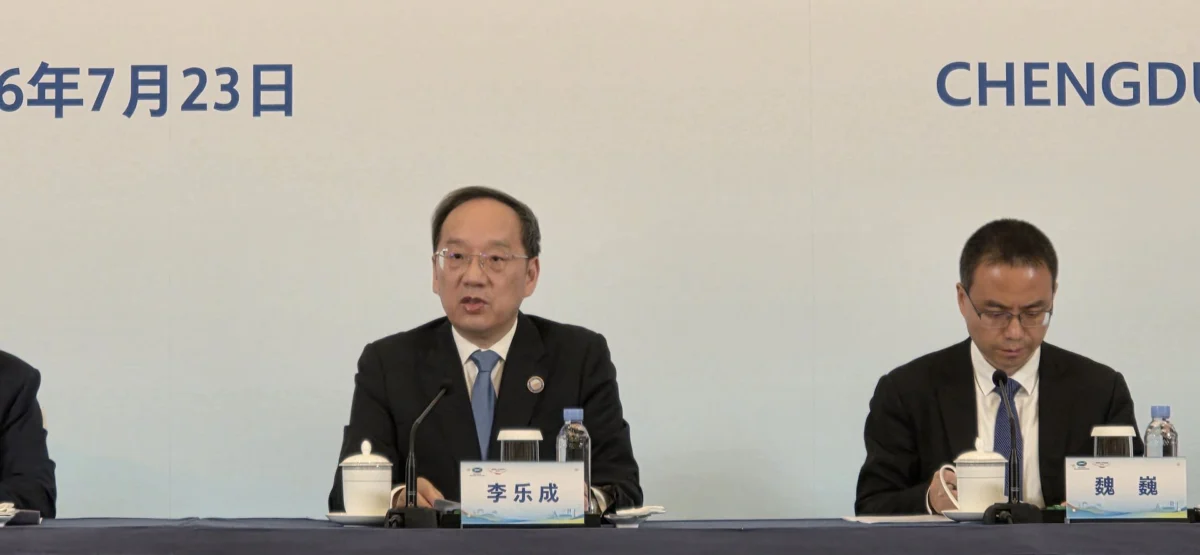
CHENGDU, China – Governments are increasingly asserting their desire for greater control over artificial intelligence development and deployment, a sentiment unequivocally articulated in a new multilateral statement from the 21 Asia-Pacific Economic Cooperation (APEC) member economies. This significant declaration, known as the "Chengdu statement on AI," emerged from the APEC Digital Weeks held in Chengdu, China, on July 23, 2026, signaling a pivotal shift in the global discourse surrounding open-source AI models. The statement, which counts both the United States and China among its signatories, emphasizes a commitment to "security, data protection and intellectual property rights" while simultaneously calling for robust support for open-source development, particularly models and projects that "employ strong security assurance through development and deployment."
The Chengdu Statement: A New Paradigm for AI Governance
The core of the Chengdu statement represents a delicate balance, acknowledging the transformative potential of open-source AI while seeking to mitigate its inherent risks through a framework of accountability and oversight. This nuanced approach marks a significant departure from the traditional, often libertarian, ethos that has historically underpinned the open-source movement. For decades, the open-source community championed unrestricted access and collaborative development, fostering innovation through shared codebases and minimal central control. However, the rapid advancement of powerful large language models (LLMs) and generative AI, capable of widespread societal impact, has compelled governments to re-evaluate this hands-off stance.
Li Lecheng, China’s Minister of Industry and Information Technology, who chaired the leaders’ meeting on Thursday, highlighted the statement’s groundbreaking nature, noting it was the first APEC ministerial-level declaration to explicitly include open-source cooperation. "All parties recognized the risks of AI," Li stated, underscoring the collective impetus behind the new guidelines. He further encouraged sustained dialogue across government, the private sector, and academia to facilitate information sharing on critical areas such as cybersecurity, supply chain resilience, and the burgeoning threat of online scams perpetuated by AI.
Wei Sun, principal analyst for artificial intelligence at Counterpoint Research, underscored the statement’s diplomatic achievement. "Getting 21 economies, including both China and the United States, to recognize trusted open-source AI as something worth supporting is meaningful," Sun remarked. She further elaborated on the strategic wording, explaining that "the phrase ‘strong security assurance’ gives more security-conscious economies room to support open models while still demanding testing, transparency, data protection and deployment controls." This suggests a global conversation evolving beyond a binary choice between "open" and "closed" models, towards a more sophisticated debate about "who can now build an open ecosystem that is also trusted enough for governments and enterprises to deploy."
APEC Digital Weeks: A Platform for Regional Consensus
The APEC Digital Weeks serve as a crucial annual forum for the Asia-Pacific region’s economic leaders to address the challenges and opportunities presented by the digital economy. APEC, established in 1989, is a premier economic forum comprising 21 member economies that account for approximately 60% of global GDP and 48% of world trade. Its mission centers on fostering sustainable economic growth and prosperity in the Asia-Pacific region by promoting free and open trade and investment. In an era increasingly defined by technological innovation, APEC has expanded its focus to encompass digital transformation, cybersecurity, and emerging technologies like AI.
The decision to host the 2026 Digital Weeks in Chengdu, a burgeoning technology hub in China, underscores the nation’s increasing prominence in the global tech landscape, particularly in AI research and development. China has strategically invested heavily in AI, aiming to become a world leader by 2030, with a focus on both foundational research and practical applications across various industries. This backdrop provides a compelling context for the discussions on AI governance, with China eager to demonstrate its leadership in shaping global norms while balancing its national interests. The event drew ministers, senior officials, and business leaders, providing a comprehensive platform for multi-stakeholder engagement on the future of the digital economy.
The Evolving Landscape of Open-Source AI
The tension between fostering innovation through open-source models and ensuring national security and intellectual property protection has been a defining characteristic of the current AI era. Historically, open-source software was championed for its ability to accelerate development, reduce costs, and democratize access to technology. However, the advent of powerful, general-purpose AI models has introduced new complexities. While open-source models like DeepSeek and GLM 5.2 from Chinese companies offer free access and download, facilitating widespread experimentation and customization, their openness also presents potential vulnerabilities. Malicious actors could theoretically adapt these models for harmful purposes, or their underlying data could contain biases or security flaws.
In contrast, leading U.S. companies like Anthropic primarily offer closed, proprietary AI models, often through pay-to-use APIs. This model provides greater control over deployment, security, and intellectual property, allowing companies to monetize their significant investments in research and development. However, it can also limit broader innovation and access, creating a potential technology gap between those who can afford premium access and those who cannot.
Winston Ma, an adjunct professor of law at New York University, highlighted the profound implications of the Chengdu statement’s "explicit alignment around open-source ecosystems and compute infrastructure." Ma suggested that this alignment confirms a regional pivot in the Asia-Pacific away from purely closed models towards "open-weight systems that are combined with state-coordinated energy, telecom and digital infrastructure." This signifies a future where open-source AI, while accessible, might operate within a more structured and government-supervised environment, leveraging national resources for development and deployment, particularly in critical sectors. This approach aims to harness the benefits of open collaboration while embedding security and regulatory compliance from the outset.
Global AI Governance in Context: APEC’s Unique Contribution
The APEC statement does not exist in a vacuum but rather contributes to a growing tapestry of international efforts to govern AI. Other significant initiatives include the European Union’s AI Act, which aims to regulate AI based on its risk level; the G7’s Hiroshima AI Process, which focuses on developing international guiding principles and a code of conduct for advanced AI systems; and various executive orders and legislative proposals in the United States addressing AI safety, security, and innovation. The United Nations has also initiated discussions on a global AI governance framework, emphasizing ethical development and equitable access.
APEC’s unique strength lies in its diverse membership, bridging economies with vastly different approaches to technology regulation and geopolitical interests. The consensus achieved in Chengdu, encompassing both the U.S. and China, is particularly noteworthy given the ongoing tech rivalry between the two superpowers. While other forums might be more homogenous in their regulatory philosophies, APEC’s ability to forge common ground on such a contentious issue as open-source AI governance suggests a pragmatic recognition among its members that collective action is necessary to manage the risks of rapidly advancing AI. This could lay the groundwork for a more harmonized approach to AI regulation across the Asia-Pacific, potentially influencing global standards.
Security, Data Protection, and Intellectual Property: Pillars of Trustworthy AI
The emphasis on "security, data protection and intellectual property rights" in the Chengdu statement reflects widespread governmental and societal concerns regarding the ethical and practical implications of AI. Data protection has become paramount in an age where AI models are trained on vast datasets, often containing sensitive personal information. Governments worldwide have enacted stringent data privacy regulations, such as the GDPR in Europe and various national laws, to safeguard individual rights. Ensuring that AI development and deployment adhere to these standards is crucial to building public trust.
Cybersecurity risks associated with AI are also escalating. AI systems themselves can be targets of cyberattacks, leading to data breaches or manipulation, or they can be weaponized to enhance the sophistication and scale of cyber threats. The call for "strong security assurance through development and deployment" directly addresses this, pushing for robust security measures to be integrated into the AI lifecycle, from design to operational use. This includes secure coding practices, vulnerability testing, and ongoing monitoring.
Intellectual property rights present another complex challenge. The development of AI models often relies on proprietary algorithms, massive datasets, and unique architectural designs, representing significant investments. The open-source model, while fostering collaboration, also raises questions about how to protect the IP of contributors and prevent unauthorized commercial exploitation. Furthermore, concerns have been raised by nations like the U.S. regarding the alleged theft of technological IP, particularly in advanced sectors like AI. The Chengdu statement’s inclusion of IP rights signals a collective commitment to creating a framework where innovation is rewarded and protected, even within an open-source ecosystem.
The Geopolitical Chessboard: US-China Dynamics in AI
The APEC Digital Weeks unfolded against a backdrop of intense geopolitical competition, particularly between the United States and China, over technological supremacy. The U.S. has repeatedly voiced concerns over Chinese companies and state actors allegedly stealing American technological intellectual property to advance their own AI capabilities. This has led to a series of export controls, sanctions, and restrictions aimed at limiting China’s access to advanced semiconductors and AI hardware, seen as critical inputs for cutting-edge AI development.
Despite this rivalry, both nations are members of APEC and participated in drafting the Chengdu statement. Their agreement to support "trusted open-source AI" with "strong security assurance" could be interpreted in several ways. It might represent a pragmatic recognition that neither nation can fully isolate itself from the global AI ecosystem, and some level of cooperation or agreed-upon norms is necessary to manage universal risks. Alternatively, it could signal a strategic alignment on certain aspects of AI governance, even as competition continues in other areas. For China, leading in open-source AI and shaping its governance aligns with its broader ambition to establish technological leadership and set global standards. For the U.S., endorsing "trusted open-source AI" allows it to support global innovation while ensuring safeguards that align with its national security interests. The phrase "strong security assurance" thus becomes a crucial point of interpretation, allowing for potentially divergent national implementations while maintaining a veneer of consensus.
Looking Ahead: The Quantum Frontier and Future Challenges
As AI technologies continue their relentless march forward, new frontiers like quantum computing are rapidly approaching, promising to revolutionize computational power but also introducing unprecedented security challenges. Janet De Silva, chair of the APEC Business Advisory Council Digital and innovation working group, seized the opportunity during the APEC Digital Weeks to urge ministers to proactively prepare for the quantum computing era. "We need trusted encryption to ensure the security of our entire financial system, ensuring that quantum computing is not only a security measure but also an opportunity to bring competitiveness," De Silva emphasized.
The intersection of AI and quantum computing presents a dual-edged sword. While quantum computers could dramatically accelerate AI research and development, they also pose an existential threat to current cryptographic standards, potentially rendering existing encryption protocols obsolete. This "quantum threat" necessitates immediate attention to post-quantum cryptography, which involves developing new encryption algorithms resilient to quantum attacks. The integrity of global financial systems, national security communications, and critical infrastructure hinges on successfully transitioning to quantum-safe encryption. The call from the APEC Business Advisory Council serves as a stark reminder that technological progress far outpaces regulatory and security frameworks, demanding continuous vigilance and adaptive governance strategies.
In conclusion, the APEC Chengdu statement on AI marks a significant milestone in the global effort to govern artificial intelligence. It underscores a growing international consensus that while open-source development is vital for innovation, it must be balanced with robust security measures, data protection, and intellectual property safeguards. This nuanced approach, forged by 21 diverse economies including the U.S. and China, reflects a pragmatic understanding of AI’s transformative power and its inherent risks. As the world hurtles towards an AI-driven future, further complicated by emerging technologies like quantum computing, the principles outlined in Chengdu will likely serve as a foundational reference point for shaping a trustworthy, secure, and beneficial AI ecosystem across the Asia-Pacific and beyond. The challenge now lies in translating these principles into actionable policies and fostering genuine collaboration amidst ongoing geopolitical complexities.
