

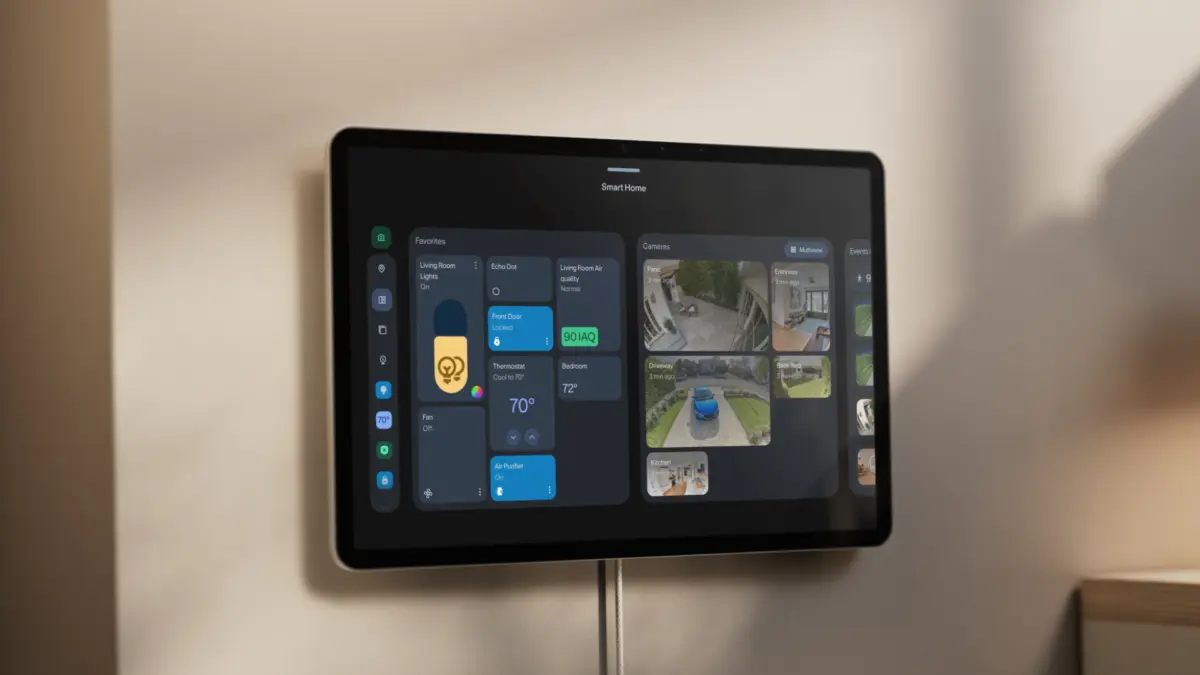
The release of the Amazon Echo Show 16 marks a significant pivot in the consumer electronics landscape, transitioning the smart display from a secondary kitchen accessory into a primary household command center. As domestic environments become increasingly saturated with digital notifications and complex scheduling requirements, Amazon’s latest hardware offering seeks to address "notification fatigue" by providing a persistent, large-format interface designed for high-traffic areas. This new iteration represents a substantial upgrade over the previous Echo Show 15, offering a larger viewing area, a significantly slimmer profile, and advanced optical hardware intended to bridge the gap between simple voice assistants and comprehensive home management systems.
A Strategic Leap in Ambient Computing
The Echo Show 16 is positioned as the flagship of Amazon’s smart display lineup, featuring a 16-inch screen that provides 10% more viewing area than its predecessor while managing to reduce the frame thickness by nearly 40%. This design philosophy aligns with the industry trend of "ambient computing," where technology is meant to blend into the home environment rather than stand out as a bulky appliance. By adopting a sleeker, picture-frame aesthetic, Amazon is targeting a demographic that prioritizes home interior design alongside technological utility.
The device is not merely a larger tablet; it is an integrated hub that combines the capabilities of a smart speaker, a streaming television, a digital photo frame, and a professional-grade organizational tool. For many households, the appeal lies in the transition from fragmented mobile applications to a centralized "family hub." This hub facilitates color-coded schedules, shared to-do lists, and meal planning, all of which are displayed on an always-on screen. This persistence is a critical differentiator from smartphones, which require active user engagement to reveal information that might otherwise be missed in a sea of push notifications.
Evolution of the Echo Show: A Chronological Perspective
To understand the significance of the Echo Show 16, it is necessary to examine the decade-long evolution of Amazon’s Echo ecosystem. Since the debut of the original Echo in 2014, the product line has moved through several distinct phases:

- The Audio Era (2014–2017): The initial focus was purely on voice interaction via the Alexa-enabled smart speaker.
- The Introduction of Visuals (2017): The first Echo Show introduced a 7-inch screen, adding a visual layer to voice responses, though the interface remained rudimentary.
- Diversification and Scaling (2018–2020): Amazon expanded the lineup to include the Echo Show 5 and Echo Show 8, catering to bedrooms and smaller countertops, followed by the Echo Show 10 with its motorized rotating base.
- The Wall-Mount Revolution (2021): The Echo Show 15 was the first to move the display off the counter and onto the wall, signaling a shift toward the "smart gallery" concept.
- The Command Center Era (Present): The Echo Show 16 (and its updated Show 21 counterpart) represents the maturation of this concept, focusing on high-definition optics, faster processing, and deeper integration with home automation protocols.
This chronology illustrates a clear trajectory: Amazon is moving away from "gadgets" and toward "infrastructure." The Echo Show 16 is designed to be a permanent fixture of the home’s architecture, much like a thermostat or a light switch, but with vastly expanded utility.
Technical Specifications and Hardware Refinement
The hardware upgrades in the Echo Show 16 are aimed at solving specific pain points identified in previous generations. The most notable improvement is the camera system. While earlier models relied on 2-megapixel or 5-megapixel sensors that struggled in low light, the Echo Show 16 features a wide-angle 13-megapixel lens. This sensor provides the widest field of view of any Echo device to date, which is essential for capturing a full room during video calls or acting as a security monitor.
Furthermore, Amazon has doubled the range of its "Visual ID" technology. Previously limited to approximately 8 feet, the new system can recognize registered users from up to 17 feet away. This allows the device to automatically update the display with a specific user’s calendar, reminders, and preferred music as they walk into the room, long before they reach the device. The addition of night vision also transforms the hub into a viable indoor security camera, allowing users to monitor their homes or pets in total darkness with significantly higher clarity than previous models.
The display itself is available with an optional "Nanomatte" anti-glare coating. This is a crucial addition for a device intended to be wall-mounted, as it mitigates the reflections from windows or overhead lighting that often render standard glossy screens difficult to read at certain times of the day.
The Smart Calendar: Solving the ‘Notification Fatigue’ Crisis
A primary driver for the adoption of large-scale smart displays is the growing inefficiency of mobile-based organization. While Google Calendar, Outlook, and Apple Calendar are powerful tools, they rely on the user proactively checking their phone or responding to ephemeral notifications. In a busy household or a home-based business environment, these notifications are frequently dismissed or buried under social media and email alerts.

The Echo Show 16 addresses this by serving as an "always-on" digital corkboard. For families managing multiple schedules, the ability to see a color-coded monthly or weekly view at a glance while walking through the kitchen or hallway is a significant productivity gain. For home-based entrepreneurs—such as those running small-scale catering or e-commerce businesses—the display acts as a dedicated production monitor, keeping order deadlines and task lists in the user’s peripheral vision throughout the workday.
Market Competition and the Premium Pricing Strategy
The Echo Show 16 enters a competitive but underserved market. Its primary rival is the Skylight Calendar, a dedicated smart display that has gained popularity for its simplicity and focus on family organization. However, the Echo Show 16 differentiates itself through its broader ecosystem. While the Skylight is primarily a calendar, the Echo Show 16 includes built-in Fire TV, allowing it to function as a secondary television for streaming content from Netflix, Prime Video, and YouTube.
The pricing reflects this multi-functional approach. Starting at $499.99, the Echo Show 16 is positioned as a premium device. When factoring in accessories such as specialized mounts or the Nanomatte display upgrade, the total cost can approach $600. This is approximately double the price of a standard 15-inch Skylight calendar. Amazon often offsets this entry barrier with promotional coupons—sometimes as high as $100—but the message is clear: this is a high-end investment in home infrastructure rather than an impulse buy.
Comparisons have also been drawn to Apple’s rumored "HomeView" display. While Apple has yet to release a wall-mounted hub, industry analysts suggest that Amazon is moving aggressively to capture the market before Apple can establish a foothold. By offering a 16-inch screen, Amazon is effectively "out-sizing" the competition, betting that for a wall-mounted hub, larger is almost always better.
Official Responses and Industry Implications
Industry analysts have noted that the Echo Show 16 is part of Amazon’s broader strategy to make Alexa indispensable in a world where AI is moving toward more complex, multi-modal interactions. By providing more screen real estate, Amazon allows its AI to present more information simultaneously—weather, news, home security feeds, and calendars—without the need for the user to ask multiple follow-up questions.

Privacy remains a central point of discussion. Amazon has responded to consumer concerns by including a physical camera shutter and a microphone-mute button on the device. Furthermore, much of the processing for Visual ID and voice recognition is now handled on-device using Amazon’s latest neural edge processors, reducing the amount of data that needs to be sent to the cloud.
The broader implication for the smart home industry is a shift toward "centerpiece" devices. For years, the smart home was a collection of disparate bulbs, plugs, and sensors. The Echo Show 16 represents the "brain" of this system, providing a visual interface for the Matter and Zigbee protocols, allowing users to control their entire home environment from a single, intuitive touchpoint.
Conclusion: A Worthy Investment in Chaos Management?
While the $500 price tag and the requirement for wall mounting may give some consumers pause, the Echo Show 16 represents a logical conclusion to the current trend of home digitization. It acknowledges that as our lives become more complex, the tools we use to manage them must become more visible and more integrated. By combining high-end optics, a massive display, and a robust software ecosystem, Amazon has created a device that is less about "checking your tech" and more about the tech checking in with you. For households struggling to manage the chaos of modern schedules, this new smart hub may well be viewed not as an expensive luxury, but as an essential piece of 21st-century furniture.
