

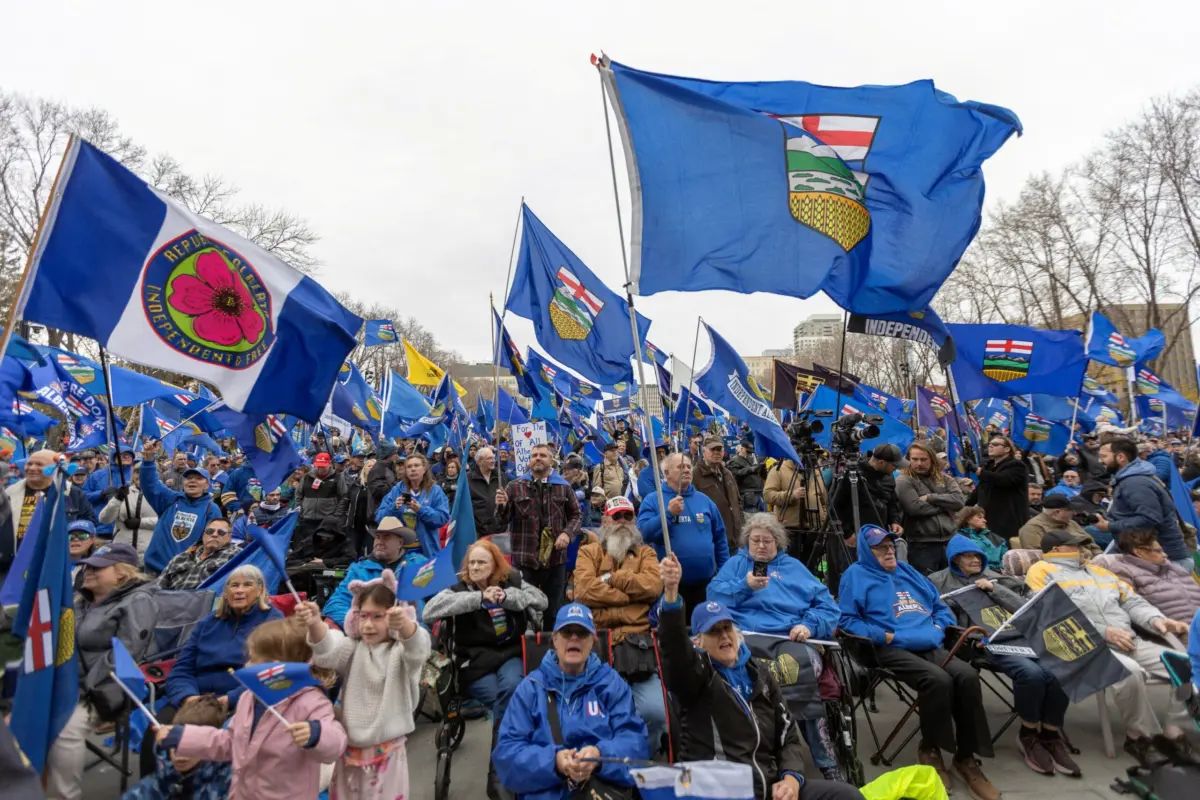
After more than a quarter-century championing the cause, Cory Morgan, founder of the advocacy organization Pathway to Independence, witnesses a pivotal moment as Albertans head to the polls on Monday for the province’s first-ever referendum on independence. While polls suggest a significant majority favour remaining part of Canada, Morgan and his fellow long-time separatists view this vote not as a definitive end, but potentially a new beginning for a movement that has successfully pushed a once-fringe idea onto the official ballot. “I would respect the will of the voters,” Morgan stated to Al Jazeera, acknowledging a potential “No” vote. “If they’ve decided it’s not time to go that route yet, then so be it. But that doesn’t mean I’ll stop.” This sentiment encapsulates the enduring resolve of a movement fueled by decades of perceived federal neglect and economic grievances.
The provincial referendum asks residents whether they would like to pursue a binding resolution in the future on the question of independence. Current data from various surveys indicates that approximately four out of five Albertans prefer to remain within the Canadian confederation. However, for proponents like Morgan, the focus remains squarely on the one in five who express a desire for greater autonomy or outright separation. “That’s not a movement that’s leaving,” he asserted, highlighting the sustained bedrock of support that underpins the separatist cause. The implications of this referendum, regardless of its outcome, are profound, raising complex questions about the future of the separatist movement and the broader fabric of Canadian national unity.
The Nuance of the Ballot Question: More Than Just ‘Yes’ or ‘No’
Monday’s ballot presents Albertans with a choice that is more nuanced than a simple declaration of independence. Voters are asked to decide between remaining part of Canada or initiating the legal process for holding a future referendum on separation. Crucially, a vote in favour of the second option does not immediately translate into an independent Alberta. The path to secession for any Canadian province is fraught with constitutional complexities and would necessitate intricate negotiations with the federal government in Ottawa, other provinces, and, significantly, the numerous Indigenous peoples whose ancestral lands and treaty rights span Alberta.
This distinction has become a strategic lever for some separatist organizers. They have actively encouraged voters to support the referendum question not necessarily out of a desire for immediate independence, but as a potent signal to Ottawa. Jared Wesley, a political science professor at the University of Alberta, observes this strategic ambiguity. “Strategic separatists and their leaders have been using that ambiguity, that lower-bar threshold, to entice folks to vote not to leave, but rather to send Ottawa a message that Albertans need to be heard,” he explained to Al Jazeera. This tactical approach appears to be resonating with a segment of the electorate. Research by Viewpoint Alberta, a University of Alberta-based initiative, suggests that a substantial two-thirds of voters who back the referendum do so for strategic reasons, aiming to convey dissatisfaction to the federal capital. Morgan refers to these individuals as “reluctant separatists,” describing them as being “at the end of their rope” and simply seeking federal acknowledgment of their concerns.
However, Prime Minister Mark Carney has issued stark warnings against this strategic voting approach. Speaking at a pro-Canada rally in Calgary, Carney cautioned Albertans, “Don’t be fooled by the idea you can ‘send a message’ with your vote. This is not poker. A vote against Canada is a dangerous bluff that will lead to years of deep division and great uncertainty.” His remarks underscore the federal government’s concern that a vote intended as a mere protest could inadvertently trigger a destabilizing constitutional crisis, similar to the protracted political and economic turmoil witnessed during the Brexit process in the United Kingdom.

The Deep Roots of Alberta’s Grievances: A History of Western Alienation
The current referendum is the culmination of decades of simmering discontent in Alberta, often termed “Western alienation.” At its core, this sentiment stems from a pervasive belief that Alberta, a province rich in natural resources and home to the world’s fourth-largest proven oil reserves, disproportionately contributes to federal coffers while receiving insufficient recognition and benefits in return. This perceived imbalance is compounded by federal energy and environmental policies that many Albertans believe stifle the province’s primary economic driver – its oil and gas industry.
The genesis of this resentment for many, including Cory Morgan, stretches back to the 1980s with the introduction of the National Energy Program (NEP) by the government of then-Prime Minister Pierre Trudeau. The NEP was a controversial federal policy designed to achieve energy self-sufficiency, increase Canadian ownership in the oil and gas sector, and redistribute oil revenues. It employed a range of measures, including price controls, taxes on oil and gas production, and ownership rules, which were widely seen in Alberta as a direct assault on provincial jurisdiction over natural resources and an appropriation of its wealth. The program significantly reduced the price Alberta received for its oil, funnelled a larger share of revenues to Ottawa, and led to a downturn in the provincial economy, cementing the NEP as a central and enduring symbol of federal overreach and Western disenfranchisement. Though repealed in 1986, its legacy continues to fuel anti-Ottawa sentiment.
Decades later, similar tensions resurfaced during the tenure of Justin Trudeau, Pierre Trudeau’s son, who became Prime Minister in 2015. His government’s climate policies, notably the imposition of a national carbon tax and increasingly stringent emissions limits, ignited fresh anger within Alberta’s oil sector and across the province. Critics argued that these policies disproportionately penalized Alberta’s energy industry, hindering its competitiveness and job creation, while failing to acknowledge the province’s efforts and contributions to the national economy. “We’ve been fighting about the same things for 50 years,” Morgan observed, highlighting the cyclical nature of these federal-provincial disputes.
Adding another layer to this complex tapestry, the COVID-19 pandemic inadvertently revitalized the separatist movement. Experts suggest that widespread demonstrations against public health restrictions and mandates mobilized a new generation of conservative activists in Alberta. These activists, often already distrustful of federal authority, found common ground with long-standing separatist arguments, injecting new energy and a broader base of support into the movement. Justin Trudeau ultimately resigned as Liberal Party leader and Prime Minister in 2025 amidst declining poll numbers, with Mark Carney elected as his successor.
Under growing pressure from within her own United Conservative Party (UCP), Alberta Premier Danielle Smith’s government last year enacted legislation making it easier to initiate referendums. This legislative change directly facilitated the placement of the independence question on the current ballot. Professor Wesley attributes the referendum more to internal UCP dynamics than a surge in public support for independence. He notes that UCP members generally exhibit higher support for separation than the broader Albertan populace. “We’re having a referendum because Danielle Smith wants us to have a referendum,” Wesley contended, suggesting the Premier is using the public vote to address internal party divisions. Despite calling the referendum, Smith has publicly stated her opposition to independence, announcing on October 14 that she had personally voted against seceding. “In my view, now is not the time to give up hope in our country, not when we have fought so long and come so far,” Smith explained in a social media video, articulating her stance.
Lessons from History: Brexit and the Long Game of Separatism
Premier Smith’s decision to call the independence referendum has drawn significant comparisons to the 2016 Brexit referendum in the United Kingdom, a parallel also highlighted by Prime Minister Carney. Then-UK Prime Minister David Cameron initiated that vote on whether Britain should leave the European Union, primarily hoping to settle a divisive debate within his own Conservative Party. The unexpected outcome – a vote to leave – plunged the UK into years of political turmoil, economic uncertainty, and complex negotiations.

However, Ian Cooper, a political scientist with roots in Alberta who now resides in Ireland, suggests a different historical parallel might be more instructive: the 1975 UK referendum on whether to remain in the European Economic Community (EEC). In that instance, British voters overwhelmingly chose to stay. Yet, Cooper points out, that decisive vote did little to deter the dedicated activists who desired Britain’s exit. “The activists who were in favour of Brexit – this is before anybody called it Brexit – they really played the long game,” he noted. “It took them 25 years, but they finally achieved it.” Cooper suspects that even a resounding defeat for Alberta independence could see separatists adopt a similar long-term strategy, steadily working to build prominence and support over decades. “My impression is that they really are true believers, and it’s really ideologically driven,” he added, emphasizing the deep conviction driving the movement.
If Monday’s independence vote fails, Cory Morgan affirmed that separatists would be compelled to critically assess their shortcomings and refine their arguments for future independence efforts. He remains convinced that Alberta’s fundamental grievances cannot be adequately addressed by working within the existing Canadian system or by merely electing a more sympathetic federal government.
Prime Minister Carney, himself an Albertan by birth, acknowledged at a rally that “the frustrations that many Albertans have felt are real.” He conceded that Ottawa had, at times, made people in the province feel “like our resources weren’t our own.” In an attempt to mend fences amidst an ongoing trade dispute with the United States, Carney’s government has sought to improve relations with Alberta. This includes commitments to key infrastructure projects and the building of a new pipeline to Canada’s west coast, a long-standing demand from the province’s energy sector. Morgan admits that for those primarily seeking greater leverage in Ottawa, “it’s pretty clear the movement has been effective.” He observed, “We’ve seen more love from a federal prime minister in the last year than we’ve seen in the last 10.” However, for dedicated independence advocates like him, the underlying structural issues persist. “The problem though, when it comes to stubborn independence folks like me, is nothing has changed in the system,” Morgan asserted, emphasizing that federal political tides can turn quickly. “Prime ministers come and go. We’re just one election away from another hostile one.”
Beyond Independence: The Significance of Other Referendum Questions
The independence question is not the sole item on Monday’s ballot. Albertans are also asked to vote on nine other proposals, many of which aim to increase provincial autonomy within the Canadian federation. These include questions such as restricting temporary residents’ access to healthcare and education, and allowing Alberta to choose its own judges. Premier Smith has actively encouraged Albertans to vote in favour of these nine proposals, framing them as a means to strengthen her government’s negotiating position with Ottawa. “Many Albertans I speak with tell me they want to send Ottawa a message, and I would suggest the best way to do that is to give us a strong mandate on the other nine questions,” she posted on social media.
The outcome of these other questions holds significant weight. If Albertans overwhelmingly endorse these proposals, and Ottawa subsequently resists making concessions, political scientist Ian Cooper believes this would provide separatists with fresh ammunition. It would bolster their argument that meaningful change within the current Canadian system is indeed impossible, thereby fueling future calls for independence. “Buried in the nine other questions are the seeds for a future referendum,” Cooper warned, suggesting a strategic long-term vision behind their inclusion.
The Future of the Movement: Unity and Identity
The long-term viability and unity of Alberta’s separatist movement remain subjects of debate. Professor Wesley cautions that the movement draws individuals for a multitude of reasons. If the prospect of genuine independence appears unrealistic following the referendum, he speculates that the diverse group of activists might splinter, potentially redirecting their energies towards other conservative issues, such as immigration.

Furthermore, some experts question whether Alberta’s separatist movement, primarily united by economic grievances, possesses the same enduring power as Quebec’s long-standing sovereignty movement, which is deeply rooted in a distinct linguistic and cultural identity. Just two weeks prior to the Alberta vote, the largely French-speaking province of Quebec elected the separatist Parti Québécois, which has vowed to hold a third referendum on independence after a specified political event.
Morgan, however, argues that Alberta does possess a distinct culture, one forged by generations of individuals who have migrated to the province seeking economic opportunity and prosperity. “The type of person drawn to do that is often an individualistic type of person,” he explained. “They want the opportunity to go out and succeed or fail on their own.” He believes this shared ethos, though not as ancient or linguistically distinct as Quebec’s, has fostered a unique Albertan identity. “And that builds a kind of a distinct culture on its own, even if it’s not a long-built one, as you would see in a distinct area like Quebec with a linguistic difference or in another country.”
Even if the independence question is ultimately rejected, Morgan maintains that the movement has already achieved a significant objective: forcing Ottawa to acknowledge and more seriously address the province’s long-standing frustrations. “Hopefully some people understand that eventually something has to give,” he concluded. “So whatever the results are… I do hope, at the very least, they’ve served as a wake-up call to a lot of people.” The referendum, irrespective of its immediate outcome, has undeniably brought Alberta’s grievances to the national forefront, ensuring that the dialogue about its place within the Canadian federation will continue for the foreseeable future.
