

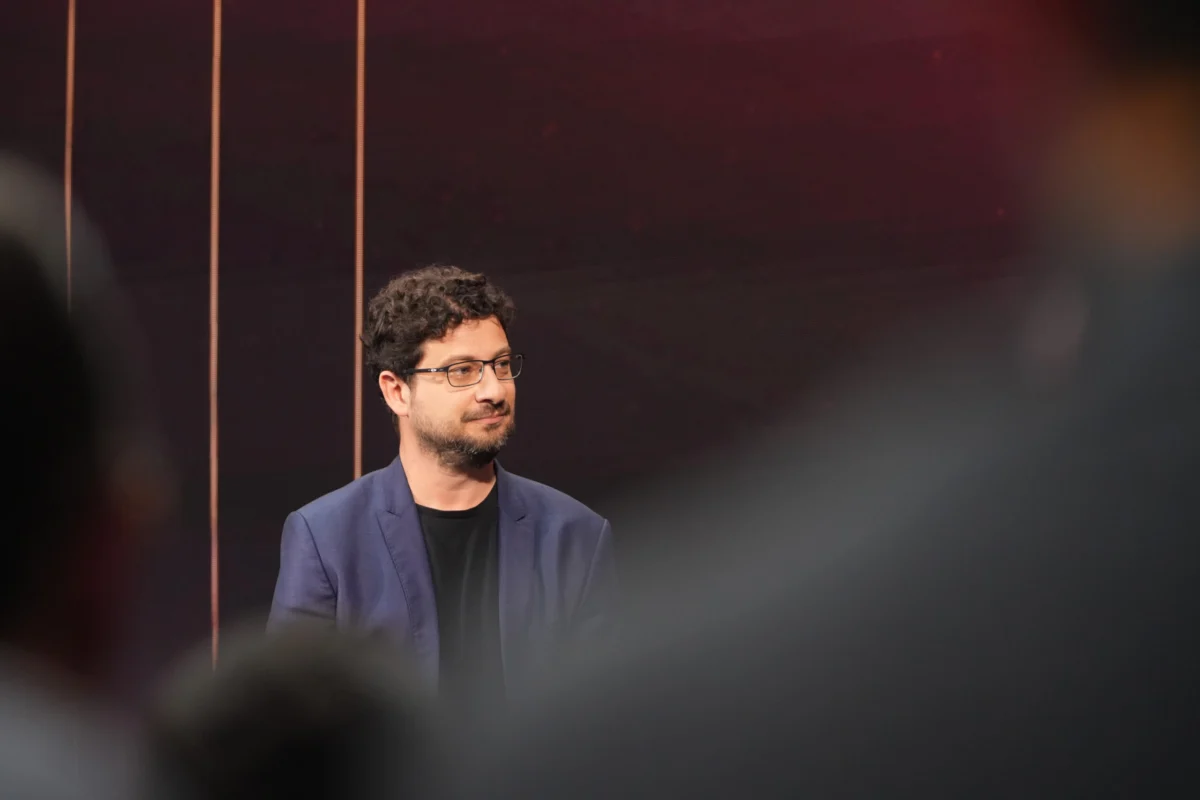
The digital landscape has long been dominated by software that exists purely within the confines of screens and servers, but a new frontier is emerging where code meets the physical world. Jean-Baptiste Kempf, the renowned French developer behind the ubiquitous VLC Media Player—a software suite with more than 6 billion downloads and a recognizable orange traffic-cone icon—is now turning his attention to the burgeoning field of robotics. Kempf’s latest venture, Kyber, has recently emerged from stealth with a $5 million seed funding round led by Lightspeed Venture Partners. The startup aims to provide the foundational infrastructure necessary to manage what Kempf predicts will be "hundreds of millions of robots and drones" roaming streets, warehouses, and skies within the next decade.
Kyber, based in Paris, is positioning itself as the essential "plumbing" for the era of Physical AI. While the tech world has been captivated by Large Language Models (LLMs) and generative AI, the next logical step in the evolution of artificial intelligence is its integration into physical machines. This shift, however, presents a monumental technical challenge: synchronizing complex video feeds, audio streams, sensor data, and control inputs in real-time with near-zero latency. Kyber’s core offering is a Software Development Kit (SDK) designed to bridge the gap between a remote operator or AI agent and a physical device, ensuring that the interaction is seamless, regardless of the distance or the complexity of the environment.
The Technical Genesis: From Media Playback to Real-Time Control
The transition from a media player to a robotics infrastructure platform is more logical than it might appear at first glance. Kempf’s expertise lies in the highly specialized field of video and audio synchronization—the same technical hurdles that define the success or failure of remote-controlled machinery. Kyber began as a side project during Kempf’s tenure as the Chief Technology Officer at Shadow, a French cloud gaming startup. In the world of cloud gaming, even a few milliseconds of lag can render a game unplayable. This environment provided the perfect laboratory for Kempf to refine the protocols necessary for high-performance, low-latency streaming.
The name "Kyber" itself is a nod to the "kyber crystals" used to power lightsabers in the Star Wars universe, symbolizing the focus on speed and precision. "If you control things in the real world, every millisecond matters," Kempf noted in a recent interview. In a scenario where a remote operator is piloting a drone through a crowded urban environment or a surgeon is performing a procedure via a robotic arm from another city, a delay of even 100 milliseconds could lead to catastrophic failure. Kyber’s SDK is engineered to minimize this "lag" by optimizing how data is packetized, transmitted, and reassembled at the destination.
The platform is built to solve the "three-body problem" of remote operations: the operator, the compute power, and the physical action. In many modern systems, these three elements are geographically dispersed. An AI model might be running on a server in a data center in Virginia, while the operator is in London, and the robot being controlled is in a factory in Singapore. Kyber provides the infrastructure layer that ensures all three components remain in perfect sync, even as network conditions fluctuate.
Strategic Investment and the Rise of Physical AI
The $5 million investment from Lightspeed Venture Partners signals a significant vote of confidence in Kempf’s vision. Lightspeed is a heavyweight in the venture capital world, with a portfolio that includes AI giants like Anthropic and Mistral AI. Their involvement suggests that Kyber is viewed not just as a niche robotics tool, but as a critical component of the broader AI ecosystem. In a statement regarding the investment, Lightspeed emphasized that "Physical AI is only as good as the underlying systems running it." This sentiment reflects a growing realization in the industry that while the "brain" (the AI model) is important, the "nervous system" (the infrastructure) is what allows the brain to interact with the world effectively.
The funding will be used to expand Kyber’s team, which currently consists of 25 full-time employees, and to scale its operations globally. While headquartered in Paris, the company has already established a presence in San Francisco and Singapore. This international footprint is essential for a company aiming to serve a global client base across diverse sectors including defense, telecommunications, robotics, and industrial automation.
Addressing the Scalability Gap
One of the primary problems Kempf aims to solve is the issue of scale. Currently, even the most advanced robotic fleets, such as those used by autonomous vehicle companies or logistics giants, rarely exceed a few thousand units. Managing a fleet of 3,000 vehicles is a manageable engineering feat; managing a fleet of 3 million is an entirely different proposition.
"The largest fleets today have maybe 2,000 or 3,000 vehicles," Kempf explained. "Imagine you need to manage millions of them; that’s not the same thing." As the number of devices grows, the requirements for "observability"—the ability to monitor the health and status of every device in real-time—become exponential. Kyber’s platform is designed with this eventual scale in mind, incorporating robust tools for remote monitoring, diagnostics, and software updates.
The ability to push software updates to millions of devices simultaneously without requiring physical access is a game-changer for the industry. It allows for the rapid deployment of new AI models or security patches, ensuring that a global fleet of robots can evolve and improve in real-time. This capability is particularly vital for AI agents, which require constant data loops to learn and adapt to their environments.
Diverse Use Cases: From Defense to Remote IT
Kyber has identified three primary market segments where its technology is currently being deployed:
- Robotics: This includes everything from autonomous delivery robots and warehouse automation to complex humanoid robots designed for industrial tasks. Kyber provides the real-time link that allows these machines to be monitored or taken over by human operators when they encounter "edge cases" the AI cannot yet handle.
- Drones: In both commercial and defense sectors, drones require high-bandwidth, low-latency video feeds for navigation and mission execution. Kyber’s SDK is particularly well-suited for the challenging RF (radio frequency) environments where drones often operate.
- Remote IT Access: While perhaps less "glamorous" than robotics, the market for remote IT access is massive. Kempf views Kyber as a potential challenger to established players like Citrix. Current solutions for remote desktop and server management often suffer from latency issues and high costs. Kyber aims to provide a more performant, open-source-based alternative that can handle high-resolution graphics and complex inputs with ease.
The "Remote IT" segment is already seeing strong demand. Many large corporations have spent years and millions of dollars building bespoke internal solutions for remote access because off-the-shelf products were insufficient. Kyber’s mission is to productize the high-end infrastructure that only the wealthiest tech companies previously could afford to build.
The Open Source Philosophy and the Palantir Model
Following in the footsteps of Kempf’s work with VLC and the VideoLAN project, Kyber is maintaining a strong commitment to open-source principles. The core of the Kyber project is open source, allowing developers around the world to build upon and improve the technology. This strategy serves two purposes: it fosters a community of developers who become familiar with the Kyber ecosystem, and it provides transparency and security—a critical requirement for clients in sensitive sectors like defense and telecommunications.
However, Kyber is very much a commercial enterprise. The company sells a "productized" version of its software to enterprise customers, which includes additional features, support, and integration services. To facilitate these complex integrations, Kyber employs "Forward Deployed Engineers" (FDEs). This model, popularized by companies like Palantir, involves sending engineers directly to client sites to help implement and customize the software for specific use cases. Given the complexity of integrating a real-time SDK into a diverse range of hardware and network environments, the FDE model is seen as a crucial component of Kyber’s go-to-market strategy.
Market Implications and Future Outlook
The launch of Kyber comes at a pivotal moment for the tech industry. As the initial hype surrounding LLMs begins to stabilize, the focus is shifting toward practical, "embodied" AI. Companies like Tesla, Boston Dynamics, and Figure AI are making rapid strides in hardware, but the software infrastructure to support these machines at scale has remained a significant bottleneck.
Kyber’s entry into the market suggests that the "Infrastructure for Physical AI" will be one of the most competitive and lucrative sectors of the next decade. By providing a standardized, high-performance layer for remote control and data synchronization, Kyber could do for robotics what AWS did for web development—lowering the barrier to entry and allowing developers to focus on the "logic" of their machines rather than the underlying connectivity.
The implications for the labor market and global logistics are profound. High-performance remote control allows for "tele-operations," where a worker in a low-cost region could operate a forklift or a delivery robot in a high-cost city with the same precision as if they were physically present. This could lead to a new era of globalized physical labor, facilitated by the millisecond-precision infrastructure that Kempf and his team are building.
As Kyber moves forward with its $5 million in fresh capital, the tech community will be watching closely. Kempf has already proven his ability to create software that defines an era; with Kyber, he is betting that the next era will be defined not by what we see on our screens, but by the millions of intelligent machines moving through our world, powered by the invisible crystals of low-latency code.
