

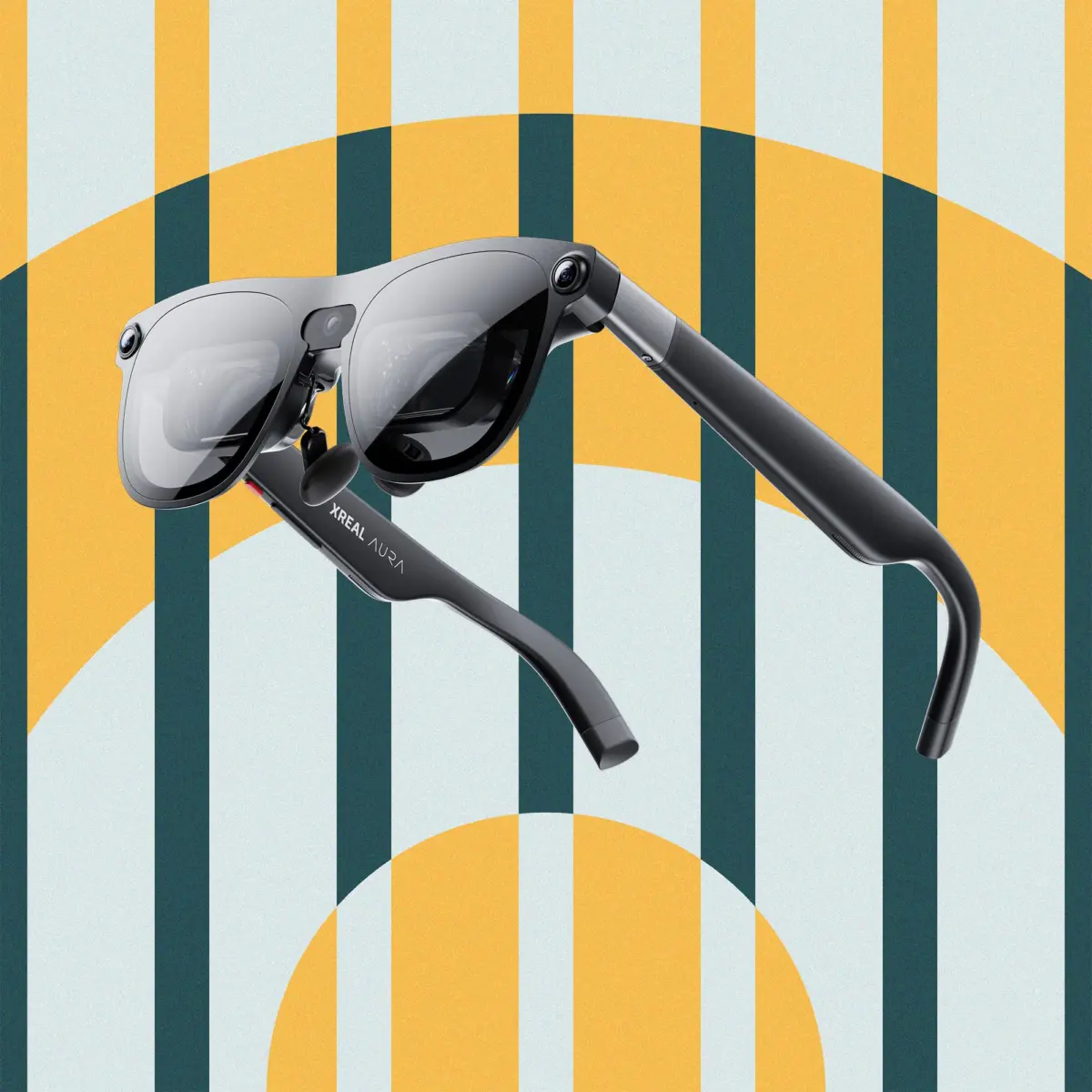
The extended reality (XR) landscape has witnessed a significant shift with the official unveiling of the Xreal Aura, a $1,279 pair of sophisticated glasses designed to bridge the gap between lightweight smart eyewear and high-performance virtual reality headsets. Positioned as the company’s "magnum opus," the Aura represents a strategic pivot for Xreal, moving away from simple screen mirroring toward a fully integrated spatial computing experience powered by Google’s nascent Android XR platform. This launch places Xreal in direct competition with tech giants such as Meta and Apple, as well as the upcoming hardware collaboration between Google, Samsung, and Qualcomm.
The Xreal Aura is engineered to project high-fidelity virtual screens into the wearer’s immediate field of vision while maintaining a transparent view of the physical world. Unlike previous iterations of the company’s hardware, which often served as secondary displays for smartphones or laptops, the Aura is a standalone compute environment. However, this power comes with a specific design choice: a tethered architecture that separates the optics from the processing unit to maintain a lightweight form factor on the user’s face.
Technical Specifications and Hardware Architecture
The engineering philosophy behind the Xreal Aura centers on wearer comfort without sacrificing visual clarity. The glasses themselves weigh approximately 95 grams, a figure that is significantly lower than the 500-to-600-gram weight of traditional VR headsets like the Meta Quest 3 or the Apple Vision Pro. To achieve this, Xreal has offloaded the battery and primary processing components to an external "compute puck."
This puck, roughly the size of a modern smartphone and weighing just over half a pound, connects to the glasses via a USB-C cable that attaches to the end of one of the frame’s arms. The compute unit is offered in configurations of 12 GB or 16 GB of memory, ensuring sufficient overhead for multitasking within the Android XR environment. The internal battery is rated to provide between four and five hours of continuous use, a duration that exceeds many standalone VR headsets currently on the market.
The visual experience is driven by a display system offering 1920 x 1200 pixels per eye. This resolution is a marked improvement over previous Xreal models, providing sharper text rendering and more vibrant colors for media consumption. One of the most notable features is the 70-degree field of view (FOV). While this does not provide the total immersion of a fully enclosed VR headset, it offers a expansive "canvas" for virtual windows. The 70-degree FOV ensures that virtual elements occupy a significant portion of the user’s sightline while leaving the peripheral vision open to the real-world environment, a design choice intended to reduce motion sickness and increase situational awareness.
Audio is handled by a four-microphone array integrated into the frames, complemented by speakers tuned with Bose EQ technology. This partnership suggests a focus on high-fidelity spatial audio, though the device also supports Bluetooth connectivity for users who prefer private listening via external wireless headphones.
The Strategic Importance of Android XR
The Xreal Aura is one of the first consumer devices to ship with Google’s Android XR platform. This software move is critical for Xreal, as it allows the device to tap into a vast ecosystem of existing Android applications. Theoretically, any app available on the Google Play Store can be projected and interacted with in a spatial environment using the Aura.
The adoption of Android XR is a direct response to Meta’s dominance with its Horizon OS and Apple’s introduction of visionOS. By aligning with Google, Xreal gains access to standardized developer tools, which could accelerate the creation of custom AR and XR content. For Google, the Aura serves as a high-end proof of concept for its software before the much-anticipated release of its collaborative hardware with Samsung and manufacturers like Warby Parker and Gentle Monster.
Industry analysts suggest that the "Android-ification" of XR hardware is inevitable. Just as Android unified the fragmented smartphone market in the late 2000s, Google aims to provide a stable, feature-rich foundation for various hardware manufacturers to build upon. Xreal’s early entry into this ecosystem gives it a first-mover advantage in the premium "glass-style" XR segment.
Evolution of the XR Market: A Chronology
To understand the significance of the Aura, one must look at the timeline of Xreal’s development and the broader industry trends.
- 2017–2020: Xreal (then known as Nreal) pioneered the "Light" and "Air" series, focusing on tethered glasses that acted as wearable monitors. These devices were popular among early adopters but lacked a dedicated operating system.
- 2021–2023: The market saw the rise of the Meta Quest 2 and 3, which popularized standalone VR. Meanwhile, Xreal expanded its reach by making its glasses compatible with gaming consoles like the Steam Deck and Nintendo Switch.
- Early 2024: Apple released the Vision Pro, validating the "spatial computing" category but at a prohibitive $3,499 price point.
- Late 2024: Xreal announces the Aura, positioning it as a middle ground—offering the sophistication of spatial computing and Android integration at a $1,279 price point, significantly lower than Apple but higher than Meta’s consumer-grade headsets.
- 2025–2027 (Projected): Google and Samsung are expected to launch their "intelligent eyewear," and Meta is slated to release its true AR glasses (Project Orion/Nazare) by early 2027.
The Aura represents Xreal’s transition from a hardware peripheral manufacturer to a platform-centric technology company. It is no longer just selling a screen; it is selling an interface for the future of work and play.
Use Cases: Entertainment, Productivity, and Gaming
Xreal has categorized the primary utility of the Aura into three distinct pillars:
1. Immersive Entertainment
The primary draw for current XR users remains media consumption. The Aura allows users to project a massive, cinema-sized screen into their room. Users can choose to have the screen "pinned" to a specific location in their physical space (spatial anchoring) or have it follow their head movements. This makes the device an ideal companion for long-haul travel or for users in small living spaces who want a theater-like experience.
2. Spatial Productivity
By running Android XR, the Aura can display multiple app windows simultaneously. A user could have a Slack window to their left, a browser in the center, and a video call to the right. While the 70-degree FOV limits the number of visible windows at a single glance compared to the Apple Vision Pro, the lightweight nature of the glasses makes them more viable for extended work sessions.
3. Gaming and External Displays
While the Aura is designed to run apps natively from its compute puck, it retains the ability to function as a high-end display for external devices. Xreal has highlighted compatibility with the Steam Deck and other handheld gaming PCs. However, initial testing has shown that high-performance, graphics-intensive titles—such as Cyberpunk 2077—can push the limits of the tethered connection and the display’s refresh capabilities, suggesting that while the Aura is a versatile display, it may not yet replace dedicated high-refresh-rate gaming monitors for professional-level play.
Market Implications and Competitive Analysis
The $1,279 price tag of the Xreal Aura is a bold statement. It is significantly more expensive than the Meta Quest 3 ($499), which offers full VR immersion and a robust library of games. However, Xreal is betting that there is a substantial market of professionals and tech enthusiasts who find traditional VR headsets too bulky and socially isolating.
The Aura’s main competition in the "smart glasses" space currently includes the Ray-Ban Meta glasses. However, the Ray-Ban Meta glasses lack a display, focusing instead on audio, AI, and cameras. The Aura, by contrast, is a full visual computer. Its true rivals will be the upcoming wave of Android XR devices from Samsung. By launching now, Xreal is attempting to capture the high-end enthusiast market before Samsung’s inevitable marketing blitz.
The inclusion of the compute puck is a double-edged sword. While it allows the glasses to remain slim and lightweight—a key factor for long-term wearability—the presence of a wire is a hurdle for some users. Meta and Apple are both striving for "all-in-one" designs, though Apple’s Vision Pro also utilizes an external battery pack. Xreal’s decision to put the "brains" in the puck allows for easier hardware upgrades in the future; theoretically, a user could upgrade their compute puck while keeping the same pair of high-quality glasses.
Challenges and Considerations
Despite the technological achievements of the Aura, several challenges remain for Xreal and the broader XR industry. The "tethered" experience is often cited as a friction point for consumers who have become accustomed to the wireless freedom of modern electronics. Furthermore, the 70-degree FOV, while impressive for glasses, still creates a "window effect" where the edges of the virtual screen are clearly visible, breaking the illusion of total immersion.
There is also the question of app optimization. While Android XR can run standard Android apps, the experience is often suboptimal unless the app is specifically redesigned for a spatial interface. Xreal will be heavily dependent on Google’s ability to convince developers to optimize their software for this new medium.
Conclusion
The Xreal Aura is a landmark device that signals the arrival of serious competition in the spatial computing era. By combining a lightweight, aesthetically pleasing design with the power of Google’s Android XR and a dedicated compute unit, Xreal has created a product that challenges the necessity of bulky VR headsets.
As the industry moves toward 2027—a year many analysts believe will be the "iPhone moment" for augmented reality—the Xreal Aura serves as a vital stepping stone. It proves that the technology for high-resolution, wearable spatial computing is available today, provided users are willing to accept the trade-off of a wired connection. For those seeking a glimpse into the future of mobile computing without the weight of a traditional headset, the Aura stands as the most advanced option currently available on the market.
