

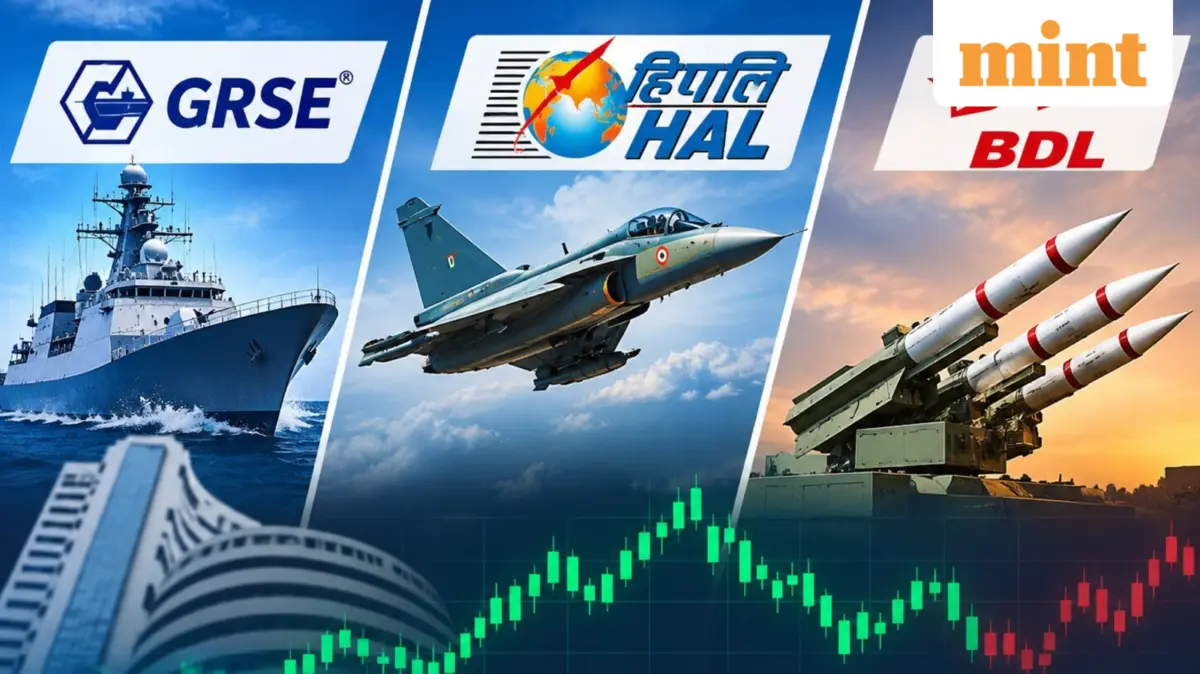
The second-quarter earnings season for the financial year 2026-27 has provided a comprehensive look into the health of India’s defense industrial complex, revealing a stark divergence in the performance of three pivotal Public Sector Undertakings (PSUs). While Hindustan Aeronautics Limited (HAL) and Garden Reach Shipbuilders & Engineers (GRSE) maintained their upward trajectory with double-digit profit growth, Bharat Dynamics Limited (BDL) faced significant headwinds, characterized by a sharp contraction in operational profitability despite a surge in top-line revenue. This performance comes at a time when the Indian government is doubling down on its "Aatmanirbhar Bharat" (Self-Reliant India) initiative, aiming for a turnover of $25 billion in defense manufacturing by 2025-26. As the market processes these results, the technical outlook for these stocks suggests a period of consolidation and selective buying, reflecting the cautious sentiment currently pervading the broader defense sector.
Divergent Financial Performance: A Comparative Analysis
The Q2 FY27 results highlight the varying operational efficiencies and execution capabilities of the three defense giants. HAL, the crown jewel of India’s aerospace sector, reported a consolidated net profit of ₹1,936 crore, marking a 16% year-on-year (YoY) increase from ₹1,669 crore in the corresponding quarter of the previous year. This growth was underpinned by a 14.9% rise in revenue from operations, which climbed to ₹7,613.25 crore. The Bengaluru-headquartered major benefited from timely project deliveries and a steady stream of maintenance, repair, and overhaul (MRO) contracts, which provide high-margin recurring revenue.
In the maritime domain, Garden Reach Shipbuilders & Engineers (GRSE) demonstrated resilience. The Kolkata-based shipbuilder reported a 12% YoY increase in net profit, reaching ₹172 crore for the July-September quarter, compared to ₹154 crore in the year-ago period. GRSE’s performance is largely tied to its execution of major warship projects, including the P17A frigates and the Anti-Submarine Warfare Shallow Water Craft (ASW SWC). The company’s ability to maintain profit growth suggests a disciplined approach to project management and cost control in an industry notorious for long gestation periods and complex supply chains.
Conversely, Bharat Dynamics Limited (BDL) presented a more complex financial picture. While the missile and ammunition manufacturer saw its revenue from operations jump by 45% YoY to ₹1,660 crore, its net profit fell by 15% to ₹180 crore. The most concerning metric for BDL was the 46% decline in absolute EBITDA (Earnings Before Interest, Taxes, Depreciation, and Amortization). This suggests that while the company is delivering on its order book, the costs associated with production, raw materials, or perhaps liquidated damages due to delivery delays have significantly squeezed its margins.
The Strategic Context: Indigenization and Order Books
To understand these financial results, one must look at the broader strategic landscape of the Indian defense sector. The Ministry of Defence (MoD) has implemented several "Positive Indigenization Lists," which mandate that a vast array of equipment be sourced only from domestic manufacturers. This policy has created a massive tailwind for HAL, GRSE, and BDL.
HAL’s growth is fueled by a massive order book that includes the Tejas Light Combat Aircraft (LCA) Mk1A, the Light Combat Helicopter (LCH) "Prachand," and various engine manufacturing projects in collaboration with global majors like GE Aerospace. The company’s recent elevation to ‘Maharatna’ status has also granted it greater operational and financial autonomy, allowing for faster decision-making on large-scale investments and joint ventures.
GRSE is currently riding a wave of naval modernization. The Indian Navy’s push for a 175-ship fleet by 2035 ensures a steady pipeline for shipbuilders. GRSE has also been successful in the export market, recently delivering a passenger-cum-cargo ocean-going ferry to the Republic of Guyana, showcasing its ability to compete on the international stage.
BDL, as the primary manufacturer of the Akash missile system, the Astra air-to-air missile, and various anti-tank guided missiles (ATGMs), occupies a critical niche. However, the company has been grappling with supply chain disruptions, particularly in high-tech components that are not yet fully indigenized. The divergence between its revenue growth and profit decline in Q2 FY27 points toward these underlying structural challenges.
Technical Outlook: Navigating the Market Volatility
Market analysts and technical researchers have noted that the "euphoria" surrounding defense stocks in early 2026 has transitioned into a more calculated and volatile phase. Virat Jagad, Senior Technical Research Analyst at Bonanza, provides a detailed technical breakdown of the three stocks following their Q2 announcements.

GRSE: A Potential Reversal
GRSE has shown signs of a base reversal after hitting lows around ₹1,850. The stock recently closed at ₹2,184.65, and while it ended the session slightly lower, the technical structure suggests a "buy on dips" opportunity. Jagad recommends entry points between ₹2,160 and ₹2,205, with a target range of ₹2,330 to ₹2,415. The stop loss for this trade is suggested at ₹2,090. Despite a 23.46% decline over the last six months, the recent 13.46% surge in two weeks indicates renewed buyer interest.
HAL: Range-Bound Consolidation
HAL remains the most stable of the three, yet it is currently trapped in a consolidation phase. Closing at ₹4,819.90, the stock is holding above key moving averages, but the Relative Strength Index (RSI) of 44 suggests weakening momentum. A major resistance level is identified at ₹5,176. Analysts believe a sustained breakout above this level is required to trigger a new bull run, while a drop below ₹4,750 could signal a deeper correction.
BDL: Sustained Downtrend
BDL’s technical chart is the most bearish of the group. The stock closed at ₹1,030.90, facing consistent rejection from its 20-day and 50-day Exponential Moving Averages (EMAs) between ₹1,062 and ₹1,112. With the RSI at 42.6 and the price trading below all major moving averages (20, 50, 100, and 200 EMAs), the momentum is clearly to the downside. Immediate support is seen at the ₹980–₹1,000 range. A breakdown below ₹980 could lead to further significant losses.
Chronology of Key Events Leading to Q2 FY27
- April 2026: HAL receives a significant order for the upgrade of Su-30MKI fighter jets, boosting long-term revenue visibility.
- June 2026: GRSE signs a Memorandum of Understanding (MoU) with a European defense firm for the joint development of green energy-propulsion systems for coastal vessels.
- August 2026: BDL announces a delay in certain missile component shipments from overseas suppliers, leading to market concerns over margin compression.
- October 2026: The Ministry of Defence announces a record ₹1.5 lakh crore allocation for domestic procurement in the upcoming fiscal cycle, buoying sentiment for PSUs.
- November 13, 2026: All three companies release their Q2 results, leading to a mixed market reaction and a general softening of stock prices as investors book profits.
Broader Impact and Industry Implications
The performance of these three PSUs serves as a barometer for India’s broader defense sector. The growth in HAL and GRSE’s profits suggests that the "heavy engineering" and "aerospace" segments of the domestic industry are maturing, with better project management and higher indigenization levels leading to stable margins.
However, the BDL results serve as a cautionary tale. They highlight that revenue growth alone—often driven by the sheer size of the government’s order book—does not guarantee profitability if operational efficiencies and supply chain dependencies are not addressed. This "margin-vs-volume" struggle is likely to be a recurring theme for defense electronics and missile manufacturers in the coming quarters.
Furthermore, the export potential of these companies is becoming a critical factor for valuation. The Indian government has set an ambitious target of ₹35,000 crore ($5 billion) in annual defense exports by 2025. HAL’s efforts to sell the Tejas to Southeast Asian and Middle Eastern nations, and BDL’s export of the Akash missile system to friendly foreign countries, will be vital in diversifying their revenue streams and reducing their dependence on the Indian MoD’s annual budget.
Conclusion: The Road Ahead for Defence PSUs
As the dust settles on the Q2 FY27 results, HAL emerges as the most consistent performer, balancing growth with operational stability. GRSE remains a strong play for those betting on naval expansion, showing an ability to grow profits despite the inherent complexities of shipbuilding. BDL, meanwhile, faces a period of introspection where it must align its operational costs with its massive delivery schedules to restore investor confidence.
For investors, the technical outlook suggests that the "easy money" phase in defense stocks has concluded. The focus is now shifting toward "execution-led" growth. Stocks like GRSE offer tactical opportunities on dips, while HAL requires a breakout above key resistance to confirm its next leg up. BDL remains a "wait and watch" story until its margin profile stabilizes.
In the larger context of national security and economic policy, these PSUs remain central to India’s strategic autonomy. Their ability to innovate, manage costs, and execute on time will determine not just their share prices, but the success of India’s journey toward becoming a global defense manufacturing hub. As the financial year progresses, the market will closely watch for updates on major contracts, particularly the multi-role fighter aircraft (MRFA) deal and further naval orders, which could provide the next major catalyst for these defense giants.
