

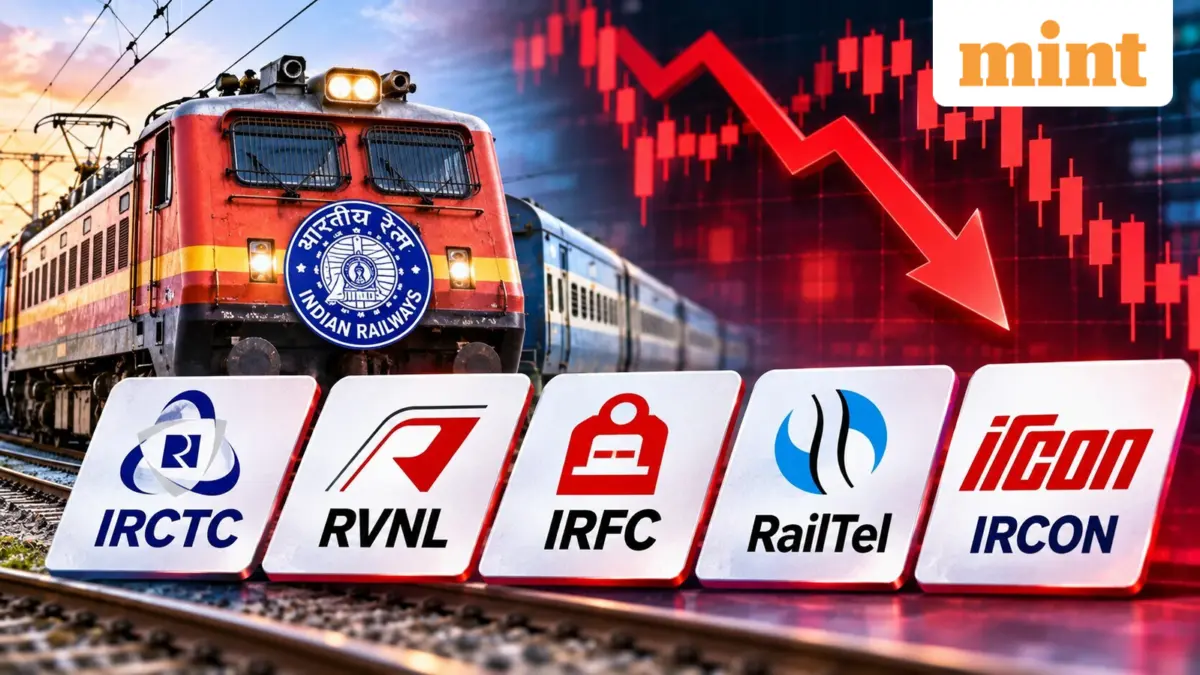
The Indian equity markets witnessed a notable downturn in the railway sector during Wednesday’s trading session, as major Public Sector Undertakings (PSUs) within the segment faced significant selling pressure. Leading the decline was the Indian Railway Catering and Tourism Corporation (IRCTC), which saw its share price tumble by nearly 3%. Other key players were not far behind, with Rail Vikas Nigam Limited (RVNL) dropping approximately 2.50%, while IRCON International and RailTel Corporation of India recorded losses of around 2%. The Indian Railway Finance Corporation (IRFC), often considered a bellwether for the sector’s financial health, also slipped by roughly 1.90%. This collective retreat comes at a time when the broader market is grappling with volatility, driven by a combination of domestic regulatory shifts and global macroeconomic shifts.
Market analysts suggest that this downturn is not merely a momentary fluctuation but a reflection of deeper structural and fundamental adjustments within the railway industry. For the past two years, railway stocks have been the darlings of the Indian stock market, delivering multi-bagger returns on the back of aggressive government spending and a massive infrastructure push. However, the current phase appears to be one of consolidation and "price-to-reality" correction. Experts point toward a cocktail of margin compression, execution hurdles, and a broader "risk-off" sentiment among Foreign Institutional Investors (FIIs) as the primary catalysts for the current southward movement in share prices.
Understanding the Fundamental Shift in Rail Contracts
One of the most significant factors weighing on the valuations of railway PSUs is the transition in how projects are awarded. Historically, many of these entities benefited from "nominated" contracts, where the Ministry of Railways directly assigned projects to specific PSUs. These contracts often came with healthy, predictable margins. However, in a bid to increase transparency and efficiency, there has been a decisive shift toward competitive open-bidding processes.
Avinash Gorakshkar, Founder of Avinash Mentor Research, notes that this transition is putting immense pressure on profit margins. In a competitive bidding environment, companies are forced to bid aggressively to secure projects, which naturally thins out the bottom line. Furthermore, the execution of high-profile projects, such as the Vande Bharat Express rollouts and the implementation of the Kavach anti-collision system, has faced logistical and technical challenges. While the order books of companies like RVNL and IRCON remain robust, the market is now questioning the speed and profitability of that execution. Investors are no longer satisfied with large order books; they are looking for tangible revenue growth that can justify the high Price-to-Earnings (P/E) multiples these stocks reached during their peak.
Broader Market Headwinds and FII Outflows
The slump in railway stocks cannot be viewed in isolation from the broader trends affecting the National Stock Exchange (NSE) and the Bombay Stock Exchange (BSE). The Indian market is currently navigating a period of sustained FII outflows. Analysts suggest that a "China rotation"—where global investors move capital from Indian equities to perceived cheaper valuations in Chinese markets—has drained liquidity from high-beta sectors like railway PSUs.
Anuj Gupta, a SEBI-registered market expert, points out that the monthly Futures and Options (F&O) expiry volatility is also playing a role. Railway stocks, being high-beta and heavily retail-owned, are often more susceptible to sharp swings during expiry weeks. The current "risk-off" wave means that investors are moving away from capital expenditure-heavy sectors and seeking safety in more defensive plays. As the central government’s capital expenditure (Capex) cycle enters a more mature phase, the market is recalibrating its expectations for the next leg of growth in these government-owned enterprises.
A Chronology of the Railway Sector’s Market Performance
To understand the current decline, it is essential to look at the timeline of the railway sector’s performance over the last 24 months.

- The Post-Pandemic Surge (2022-2023): Following the pandemic, the Indian government announced record-breaking allocations for the Ministry of Railways in consecutive Union Budgets. This led to a massive rally where stocks like RVNL and IRFC grew by 300% to 500% within a short span.
- The Valuation Peak (Early 2024): By the beginning of 2024, railway stocks reached all-time highs. P/E ratios for many of these companies soared far above their historical averages, fueled by retail euphoria and the anticipation of even larger budget outlays.
- The Reality Check (Mid-2024): Post-election and following the latest Union Budget, while the Capex remained high at ₹2.52 lakh crore for FY25, the market began to realize that the pace of incremental growth might be slowing.
- Current Correction (Late 2024): The present scenario represents a "buy on rumors, sell on news" aftermath, compounded by the margin pressures mentioned by Gorakshkar. The market is now seeking a floor where valuations align more closely with actual quarterly earnings.
Analysis of Key Railway Players
Each of the major railway stocks is facing unique challenges despite the collective sector-wide decline:
- IRCTC: As the sole provider of online ticketing and catering for the Indian Railways, IRCTC has a monopoly. However, its growth is tied to passenger volumes and the ability to hike convenience fees or catering prices. The 3% drop suggests concerns over slowing volume growth and the impact of broader market weakness on high-valuation monopoly stocks.
- RVNL: As an infrastructure execution arm, RVNL has a massive order book. However, its reliance on government funding and the shift to competitive bidding makes its margin profile vulnerable.
- IRFC: The financing arm of the railways is relatively more stable because its business model is based on a "cost-plus" margin on the assets it leases to the Ministry. Despite the 1.90% dip, it remains a favorite for value investors due to its role in funding the massive Capex pipeline.
- RailTel: Focusing on telecom and signaling, RailTel is integral to the modernization of the railway network. Its decline reflects the general cooling of sentiment toward tech-heavy railway infrastructure.
Expert Views: Is This a Buying Opportunity?
Despite the prevailing gloom, some experts believe the correction offers a strategic entry point for long-term investors. The fundamental story of Indian Railway modernization remains intact. The National Rail Plan 2030 aims to create a "future-ready" railway system, and the government’s commitment to shifting freight from road to rail is a multi-decade tailwind.
Avinash Gorakshkar suggests that investors looking for value should focus on IRFC. "The company deals in credit lending, and some recent Capex pipeline announcements are expected to benefit IRFC specifically. For those looking for a value pick amidst this correction, IRFC presents a compelling case," he noted. Since IRFC acts as the primary borrowing arm for the Ministry of Railways, its revenue stream is highly predictable, and it is less exposed to the execution risks that plague construction-focused PSUs like RVNL or IRCON.
On the technical front, Sumeet Bagadia, Executive Director at Choice Broking, has analyzed the IRFC chart patterns. He observes that the stock is currently consolidated within a specific range. "The stock is in the ₹75 to ₹90 range. On breaking above ₹90 on a decisive basis, we can expect the IRFC shares to touch ₹100 and ₹110 in the near term," Bagadia explained. This technical outlook suggests that while the stock is under pressure, it is building a base for a potential recovery once market sentiment stabilizes.
Broader Implications for the PSU Sector
The decline in railway stocks is also a cautionary tale for the broader PSU (Public Sector Undertaking) theme that has dominated the Indian markets recently. Defense, Power, and Railway PSUs have all seen similar trajectories—massive rallies followed by sharp corrections. The current trend suggests that the market is shifting from "hope-based" investing to "performance-based" investing.
For the Indian Railways, the focus is now on the implementation of the ₹1 trillion plan to procure new rolling stock over the next few years. If companies can demonstrate that they can maintain margins while winning competitive bids, the sector could see a renewed interest from institutional investors. Until then, the volatility is expected to persist, driven by global cues and the upcoming quarterly earnings reports.
Conclusion and Outlook
The current sell-off in IRCTC, RVNL, IRFC, and others serves as a reminder of the cyclical nature of infrastructure-linked stocks. While the long-term structural story of India’s railway transformation is far from over, the era of "easy gains" in these stocks appears to have paused. Investors are advised to look beyond the headlines of falling prices and focus on the internal health of these companies—specifically their order book execution speed and their ability to protect margins in a competitive landscape.
As the market approaches the end of the year, all eyes will be on the Ministry of Railways’ project update reports and the next round of quarterly financial results. For the discerning investor, this "buy on dip" scenario requires a selective approach, favoring companies with strong balance sheets and essential roles in the railway ecosystem, such as IRFC, over those facing intense competition and execution bottlenecks. The railway sector remains a cornerstone of India’s economic growth, but for now, it is navigating a necessary and healthy market correction.
