

Private companies frequently leverage ownership incentives, such as stock options and equity grants, as a cornerstone strategy to attract, retain, and motivate their most crucial senior executives. The underlying principle is straightforward: by granting a stake in the company’s future, leaders are incentivized to drive long-term value creation and remain invested in the organization’s success. However, groundbreaking new research from Chief Executive Group suggests a pervasive and often overlooked flaw in this common practice: many businesses are failing to ensure these incentives are truly meaningful by neglecting to clearly communicate their actual worth. This oversight can significantly diminish the motivational power of these awards, leaving valuable compensation tools underutilized.
The core objective of providing senior executives with a stake in the business is twofold: to foster a deep sense of investment in the company’s trajectory and to encourage decision-making that cultivates enduring value. Yet, a critical question arises: what happens when the executives who hold these stakes are unaware of their current and potential worth? New research indicates that this lack of visibility may represent a significant weakness in the compensation frameworks of many private companies. While a substantial number of businesses offer equity or phantom equity incentives to their leadership teams, a surprisingly small proportion consistently measure and communicate the gains associated with these awards. This deficiency can undermine one of the most potent motivational tools available to private enterprises.
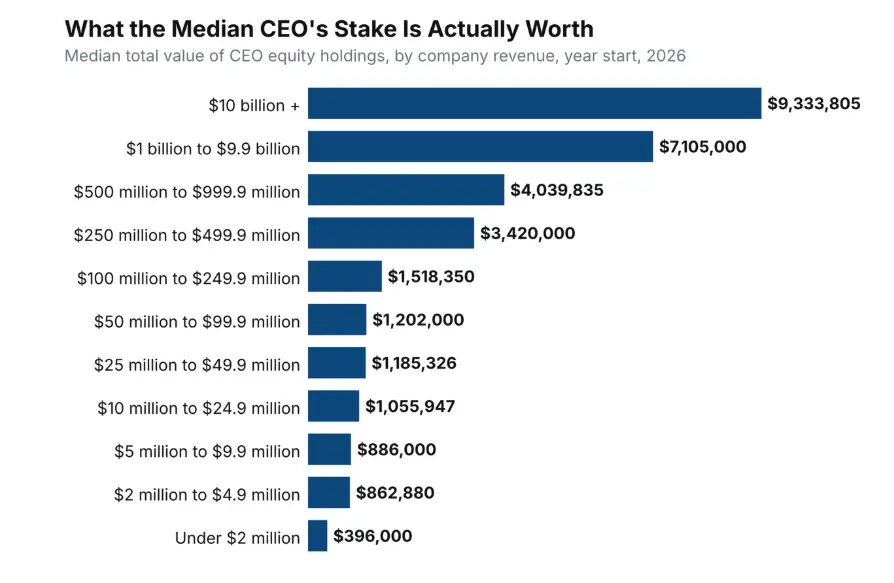
The financial value of an executive’s equity stake can vary dramatically, influenced heavily by the size of the company. For instance, at companies with annual revenues under $2 million, the median equity stake for a CEO is valued at approximately $396,000. This figure escalates significantly with company scale, reaching a median of $7.1 million for CEOs at companies generating between $1 billion and $9.9 billion in annual revenue. This wide disparity underscores the substantial potential value of these incentives, yet the ability for executives to perceive and track this value is often hampered by a lack of transparency.
The Value Nobody Sees: A Blind Spot in Private Company Compensation
Unlike their counterparts in publicly traded companies, where fluctuating share prices provide a readily accessible, real-time indicator of ownership value, executives in private companies often operate with limited visibility into the worth of their equity awards from one year to the next. This information asymmetry can create a disconnect between the intended motivational impact of the incentives and the actual perceived value by the recipient.
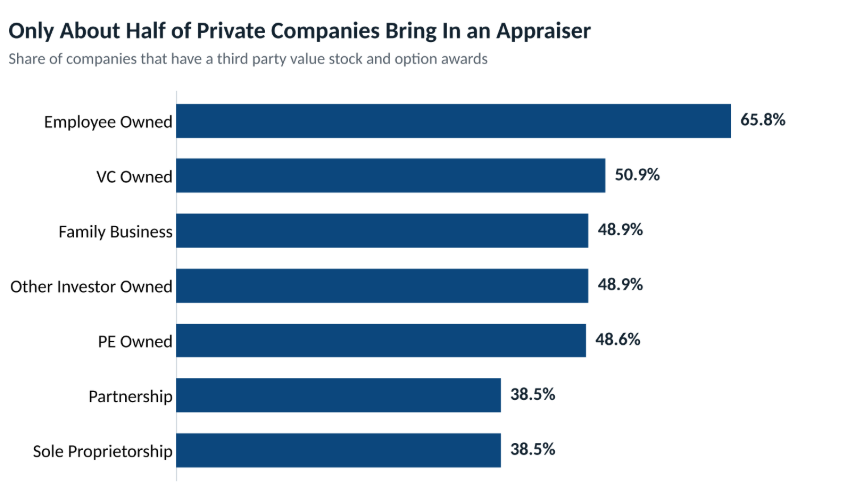
The Chief Executive Group’s research highlights a stark reality: only about half of private companies engage external parties to formally value stock and option awards. Employee-owned companies demonstrate a greater propensity for this practice, with 66 percent utilizing external valuations. Conversely, sole proprietorships and partnerships lag behind, with only 39 percent seeking professional valuations. The remaining companies typically rely on internal estimates, often provided by the Chief Financial Officer or other internal staff, or employ formulas tied to specific financial metrics such as profits or sales.
The report further indicates that private equity- and venture capital-backed companies generally exhibit a stronger commitment to regularly valuing and communicating equity gains compared to other privately held businesses. However, even within this segment, the adoption of independent appraisers for valuation purposes places them in the middle tier. This distinction is crucial because the true value of an equity incentive extends beyond the eventual payout; it encompasses the ongoing financial stake that executives perceive themselves to be building over time. Without regular, transparent valuations and clear communication of these figures, executives may struggle to connect their daily decisions and the company’s performance directly to their potential rewards. The consequence can be a compensation program that, while designed to foster long-term commitment, delivers a diminished motivational impact than originally intended.
Case Studies in Transparency: Making Equity Incentives Count
The practical implications of this research are evident in the experiences of companies that prioritize valuation transparency. Pete Ensch, CEO of Sani-Matic, a private equity-backed manufacturing firm, explained his company’s approach. Working in conjunction with their sponsor, Sani-Matic tracks the company’s value on a quarterly basis and commissions a formal valuation annually. This year, the company took a significant step forward by initiating the practice of providing each equity holder with a personalized statement detailing the current worth of their stake, along with a projected range of potential outcomes in the event of a sale.
"Everybody was doing the same thing, just doing their own math," Ensch commented, reflecting on the previous ad hoc methods of valuation. He candidly acknowledged that such transparency can have a dual effect. In earlier, more challenging business environments, valuations sometimes brought disappointment rather than enthusiasm. "It comes down to the numbers," he stated, emphasizing the importance of objective financial reality.
Another example is Parr Instrument Company, a venerable manufacturer with a 127-year history in Moline, Illinois. This company has maintained its independence and operates under a distinct ownership structure. Jim Nelson, President and CEO, shared that an independent appraiser conducts a valuation of the business annually. Furthermore, Parr Instrument Company periodically offers key employees the opportunity to purchase shares at a discount of approximately 40 percent relative to the appraised fair market value. This discount is precisely why the annual valuation is essential: the difference between what an employee pays and the fair market value is recognized as taxable income in the year of purchase, necessitating accurate and timely appraisals.
Both Sani-Matic and Parr Instrument Company also require their executives to invest their own capital to acquire equity. This practice, while demonstrating a commitment from leadership, is not widespread. Research indicates that only 22 percent of companies mandate that employees invest their own funds to obtain equity incentives. This is a missed opportunity, as requiring personal investment aligns executives with the company’s performance, exposing them to both the downside risks and the potential upside rewards.
The Growing Importance of Equity in Private Company Growth
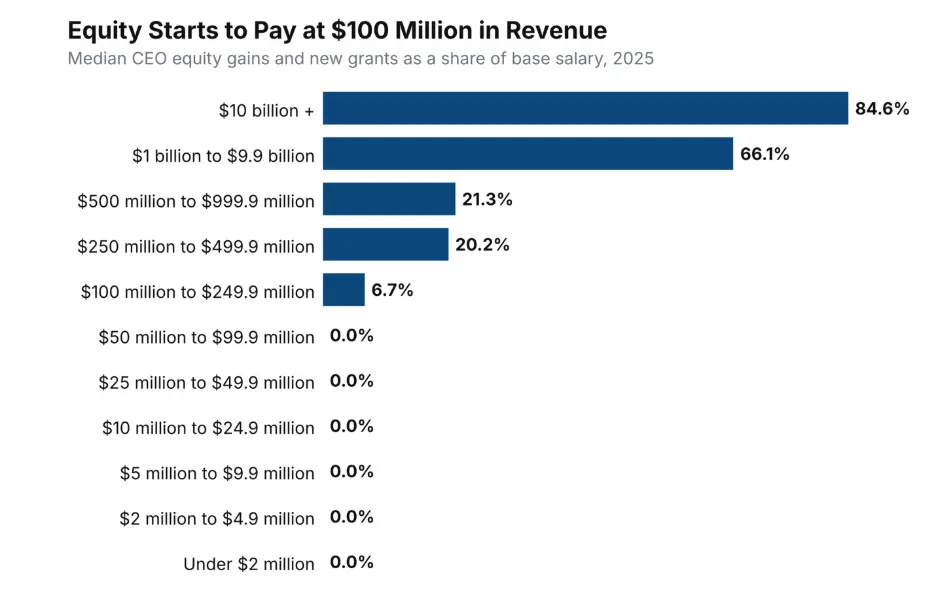
As private companies scale and mature, equity incentives become increasingly critical components of their compensation strategies. The Chief Executive Group’s report provides compelling data illustrating this trend. In 2025, the median CEO at companies generating between $100 million and $249.9 million in annual revenue saw equity gains and new grants equivalent to roughly 7 percent of their base salary. This figure saw a notable increase to 20 percent for CEOs at companies with revenues between $250 million and $499.9 million. For the largest companies in the survey, those with revenues ranging from $1 billion to $9.9 billion, the equity component reached a substantial 66 percent of base salary. Conversely, at companies with revenues below $100 million, the median CEO reported no equity gains or new grants whatsoever, highlighting a significant disparity in incentive structures across different company sizes.
The vesting schedule of equity shares also presents a divergent approach among private companies. Time-based vesting is contingent solely on the passage of time, while performance-based vesting requires the achievement of specific, measurable targets. Most private companies appear to favor time-based vesting, with nearly half of them vesting equity based on time alone. Performance-based vesting accounts for 19 percent, and a combination of both time and performance metrics is used by 34 percent of companies. This means that an equity stake can remain on the books for years without a clear, quantifiable value attached, even though the median CEO’s holding is worth at least twice their base salary across all company sizes surveyed. The fundamental question for business owners is not only whether an award incentivizes the correct behaviors but also whether anyone within the organization can definitively state its current worth.
Strategic Implications for Enhancing Executive Motivation
As private company CEOs look ahead and review their executive compensation programs, particularly in anticipation of the coming years, the research from Chief Executive Group offers several actionable recommendations.
Firstly, the report strongly advocates for the implementation of regular, independent valuations of equity and option awards. This process should be conducted by qualified third-party appraisers at least annually, and ideally more frequently for rapidly growing or volatile businesses. This ensures an objective and credible assessment of the incentive’s worth.
Secondly, clear and consistent communication of these valuation outcomes to executives is paramount. This involves providing personalized statements that detail the current value of their holdings, explaining how their decisions and company performance impact this value, and projecting potential future outcomes. This transparency bridges the gap between effort and reward, making the incentives more tangible and motivational.
Thirdly, companies should consider requiring executives to invest their own capital into equity incentives. This "skin in the game" approach fosters a deeper sense of ownership and shared risk, aligning executive interests more closely with those of the company and its shareholders. It also provides a more realistic understanding of the potential financial commitment and reward.
The overarching goal of these recommendations is not necessarily to increase overall compensation costs or to grant more equity gratuitously. Instead, the objective is to ensure that the ownership incentives already in place are fully understood, clearly valued, and strategically aligned with the company’s long-term ambitions. For private company owners, this distinction is crucial. A potentially valuable reward that executives cannot readily evaluate or connect to their performance is likely to be far less effective than one whose value and its direct linkage to business success are unequivocally clear. By embracing transparency and robust valuation practices, private companies can unlock the full potential of their executive ownership incentives, driving greater engagement, performance, and sustainable long-term value creation.
The Chief Executive Group’s 2026-2027 CEO & Senior Executive Compensation Report offers detailed benchmarks for executive compensation, including insights into equity incentives, compensation practices, and variations based on company size, industry, and ownership structure. This comprehensive report serves as a valuable resource for private companies seeking to optimize their compensation strategies and ensure their incentive programs are as effective as they are intended to be.
