

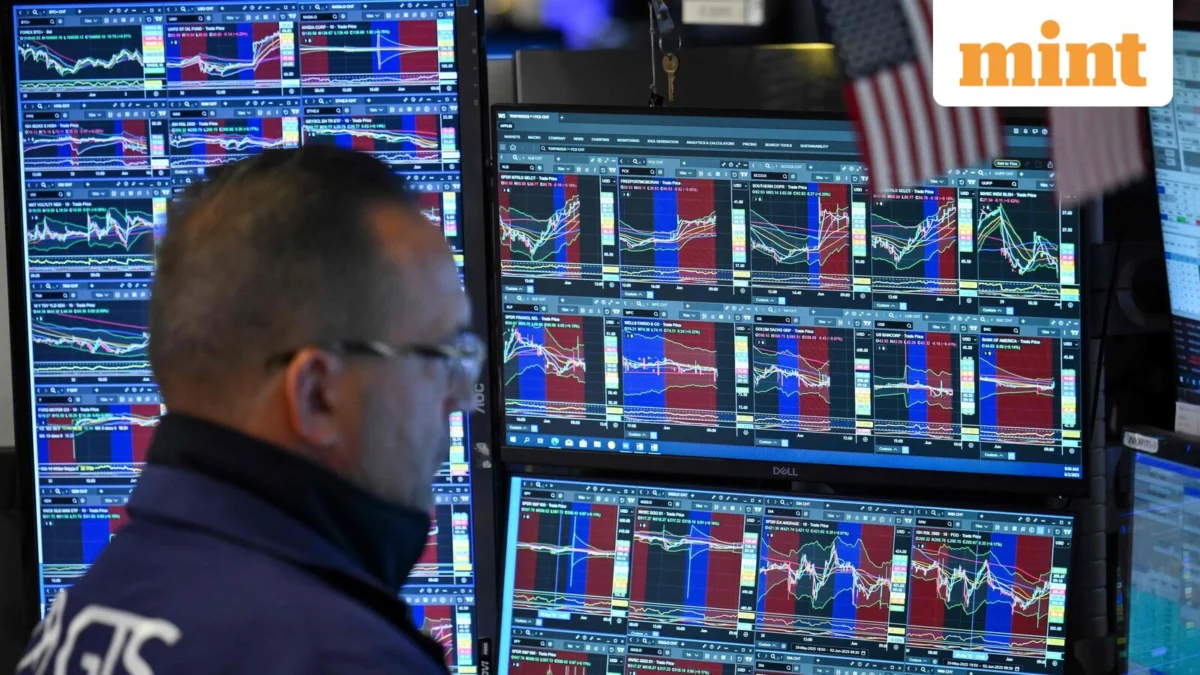
United States stock futures trended lower during the early hours of Monday, May 18, as global investors braced for a week defined by high-stakes corporate earnings and a worsening geopolitical crisis in the Middle East. Market participants are primarily focused on Nvidia’s upcoming quarterly results, which are seen as a litmus test for the longevity of the artificial intelligence-driven bull market. Simultaneously, a protracted stalemate between Washington and Tehran has sent shockwaves through energy markets, pushing crude oil prices to levels that threaten to reignite inflationary pressures and complicate the Federal Reserve’s monetary policy path.
Futures tied to the S&P 500 declined by 0.4%, while Nasdaq 100 futures slipped 0.3%. The Dow Jones Industrial Average futures saw a more pronounced retreat, falling 0.8% as industrial and blue-chip stocks faced the brunt of rising energy costs. These movements follow a tumultuous Friday session where all three major indices closed down by more than 1%, ending a week of record-breaking highs on a somber note. The primary catalyst for the late-week sell-off was a sharp spike in Treasury yields, with the 30-year yield hitting its highest point in nearly a year, reflecting growing anxiety over long-term interest rate trajectories.
The Nvidia Factor: A $5.6 Trillion Question
The spotlight this week is firmly on Nvidia, the semiconductor giant that has become the de facto barometer for the global technology sector. On Wednesday, the company is scheduled to report its latest financial results, an event that analysts believe will determine whether the current AI-led rally has more room to run or if the market has reached a point of exhaustion.
Last week, Nvidia shares surged by 4.7%, propelling the company’s market capitalization to a staggering $5.6 trillion. This valuation not only reinforces Nvidia’s status as the most valuable company in the world but also places an immense burden of expectation on its earnings performance. The Nasdaq and S&P 500 both reached fresh record highs last week, driven almost single-handedly by the "AI halo effect" emanating from Nvidia and its peers. However, the 0.3% dip in Nasdaq futures on Monday suggests that traders are locking in profits and hedging their bets ahead of the Wednesday announcement.
Market analysts suggest that for the rally to sustain its momentum, Nvidia must not only beat earnings estimates but also provide forward guidance that justifies its current valuation. Any sign of a slowdown in data center spending or supply chain bottlenecks could trigger a broader correction in the technology sector, which has been the primary engine of growth for US equities throughout the year.
Geopolitical Gridlock: The US-Iran Standoff and the Strait of Hormuz
While technology dominates the corporate narrative, the geopolitical landscape is increasingly dictating market sentiment. The conflict between the United States and Iran has now entered its 80th day with no clear resolution in sight. The standoff has centered on the Strait of Hormuz, one of the world’s most critical maritime chokepoints, through which approximately one-fifth of the world’s oil consumption passes.
The disruption of shipping lanes in the Strait has led to a significant risk premium being baked into energy prices. Efforts to resolve the crisis through diplomatic channels have stalled. A highly anticipated two-day summit between US President Donald Trump and Chinese President Xi Jinping concluded last week without any concrete progress regarding the reopening of the Strait or a de-escalation of tensions.
On Sunday, President Trump intensified his rhetoric, warning Tehran that the window for negotiation was closing. "Iran needs to get moving, or there won’t be anything left," Trump stated, signaling a potential shift toward more aggressive measures if talks remain unproductive. Iranian state media, meanwhile, reported that the negotiations are at an impasse, claiming the US has offered "no tangible concessions" to address Tehran’s security and economic concerns. The ongoing blockade has forced global shipping companies to reroute vessels, adding significant costs and delays to global trade.
Energy Markets and the Inflationary Threat
The geopolitical tension has had an immediate and sharp impact on the commodities market. Crude oil prices started the week on a bullish note, extending a rally that saw Brent crude surge by 8% last week. On Monday, Brent crude, the international benchmark, rose by $2.60 to reach an intraday high of $111.86 per barrel. This represents a nearly 80% increase in the price of Brent since the start of the year.
US benchmark crude followed a similar trajectory, rising $2.58 to approximately $108 per barrel. The volatility in energy markets is a primary concern for central bankers. Elevated oil prices act as a double-edged sword: they increase the cost of production and transportation, thereby fueling headline inflation, while also dampening consumer discretionary spending.
Kotak Securities noted in a market update that the current risk premium in oil is heavily dependent on the Strait of Hormuz. "Crude remains strongly supported as long as Hormuz disruptions persist and geopolitical negotiations remain stalled," the firm stated. "However, any breakthrough in US-Iran talks, easing regional tensions, or restoration of normal shipping flows could trigger sharp profit-booking. Near-term sentiment continues to favour elevated volatility."
The Federal Reserve and the "Warsh Era"
The surge in oil prices and bond yields comes at a sensitive time for the Federal Reserve. Markets are awaiting the release of the minutes from the Fed’s latest policy meeting on Wednesday, which are expected to provide clarity on the central bank’s internal debate regarding interest rates.
Compounding the uncertainty is the transition in leadership at the Fed. New Fed Chair Kevin Warsh, who is awaiting formal swearing-in, is stepping into the role at a moment when the "transitory" inflation narrative is once again being challenged. Warsh will likely face immediate pressure to define his stance on whether the central bank should maintain an easing bias or shift toward a more restrictive "neutral" stance to combat rising energy-driven inflation.
The US 30-year Treasury yield’s climb to a one-year high indicates that bond markets are already pricing in a "higher-for-longer" interest rate environment. If the Fed minutes suggest that policymakers are becoming more hawkish, the pressure on equity valuations—particularly in the high-growth tech sector—could intensify.
Corporate Developments: Berkshire, SpaceX, and the Space Economy
Beyond the macro-economic and geopolitical headlines, several individual stocks are moving on specific news. UnitedHealth Group saw its shares tumble by as much as 5.6% in premarket trading following the news that Warren Buffett’s Berkshire Hathaway had entirely exited its position in the health insurance giant. The move by Berkshire is being closely scrutinized as a potential signal of cooling sentiment toward the healthcare services sector.
Conversely, the "New Space" sector is seeing a wave of optimism. Stocks such as EchoStar, Rocket Lab, and AST SpaceMobile rallied in premarket trading. This surge was triggered by reports that Elon Musk has returned to Texas to expedite the initial public offering (IPO) of SpaceX. Investors are eagerly awaiting the filing of the SpaceX IPO prospectus, which is expected in the coming days. The potential public listing of the world’s leading private aerospace company is viewed as a landmark event that could unlock significant value across the space technology ecosystem.
Market Implications and Outlook
As the trading week begins, the convergence of high energy prices, geopolitical instability, and pivotal corporate earnings has created a climate of heightened caution. Vested Finance, a global brokerage, observed that the market’s previous resilience is starting to show cracks.
"For weeks, investors largely ignored the surge in crude and instead focused on AI-led earnings momentum," the brokerage stated. "However, higher energy prices are now feeding directly into inflation concerns and pushing bond yields higher globally. Markets can withstand high oil prices for a short period, but if the Middle East conflict drags on and bond yields continue to rise, pressure on equities, especially high-growth AI-related stocks, could intensify sharply."
The chronology of the next 72 hours will be vital for market direction. The sequence begins with the absorption of Monday’s energy price hikes, followed by the anticipation of Nvidia’s earnings and the Federal Reserve’s minutes on Wednesday. If Nvidia fails to meet the lofty expectations of the market, or if the Fed signals a more aggressive stance against inflation, the record highs seen last week—including the Dow’s brief foray above the 50,000 mark—could become a distant memory in a broader market retreat.
For now, the global financial community remains in a "wait-and-see" mode, balanced between the transformative potential of artificial intelligence and the harsh realities of traditional geopolitical and inflationary risks. The resolution of the Strait of Hormuz crisis and the tone set by the new Federal Reserve leadership will likely dictate the market’s trajectory for the remainder of the quarter.
