

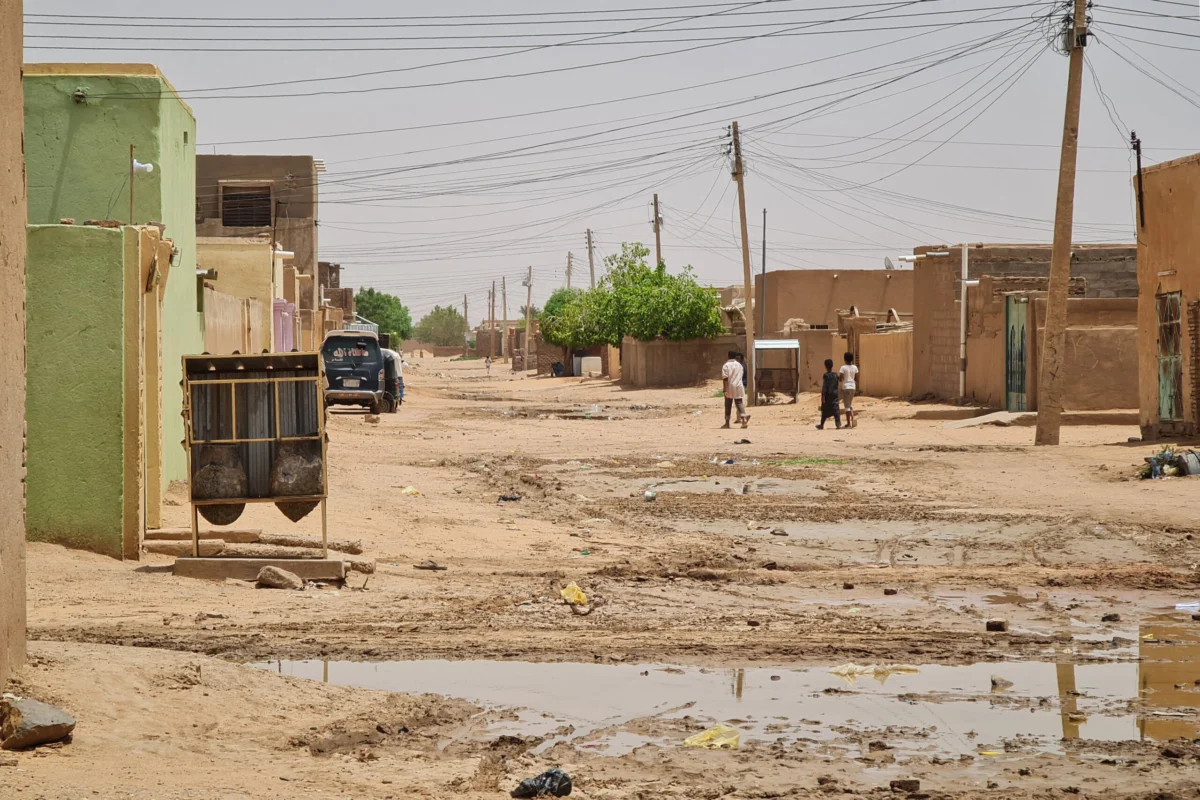
The devastation of Sudan’s ongoing civil war reached a harrowing new peak on Saturday as an airstrike tore through a residential neighborhood in the capital city of Khartoum, claiming the lives of at least 17 individuals, including five children. This latest escalation in the urban theater of war underscores the increasingly indiscriminate nature of the violence between the Sudanese Armed Forces (SAF) and the paramilitary Rapid Support Forces (RSF). Health officials in the region confirmed that the strike leveled multiple homes in the Yarmouk district, a strategic area in southern Khartoum that has become a flashpoint for intense fighting due to its proximity to military industrial complexes and logistical hubs.
The Ministry of Health reported that in addition to the fatalities, at least 25 houses were completely destroyed or severely damaged, leaving dozens of families buried under rubble or displaced in an instant. While the specific nature of the strike—whether conducted by a piloted fighter jet or an unmanned aerial vehicle (drone)—remains under investigation, the aftermath has left the local community in a state of shock. The RSF has frequently accused the military of using its air superiority to target civilian-occupied zones where paramilitary fighters are embedded, while the SAF maintains that it only targets legitimate military objectives and accuses the RSF of using civilians as human shields.
Context of the Yarmouk Strike and Immediate Aftermath
The Yarmouk neighborhood has seen some of the most sustained combat in recent weeks. The area is home to a major military facility, which the RSF has attempted to seize on multiple occasions. Saturday’s strike hit a densely populated civilian pocket near the industrial zone. Local volunteer groups, known as "Emergency Rooms," which have become the backbone of humanitarian aid in the absence of international NGOs on the ground, reported that at least 11 people were wounded in the blast. These volunteers worked through the heat of the day to pull survivors from the debris of brick and corrugated metal.
Images circulating on social media and verified by local activists depicted the grim reality of the strike: children being carried into makeshift clinics, men searching through the dust of their former homes, and the charred remains of vehicles. The RSF issued a statement shortly after the event, claiming they had successfully downed a SAF MiG fighter jet in the vicinity, though this claim has not been independently verified by military observers or satellite imagery. The Sudanese military, led by General Abdel Fattah al-Burhan, has not issued a formal rebuttal to the specific casualty figures reported by the Ministry of Health.
A Chronology of Escalation: April to June 2023
To understand the gravity of the Yarmouk strike, it is necessary to trace the rapid descent of Sudan into chaos. The conflict erupted on April 15, 2023, following months of friction regarding the integration of the RSF, led by General Mohamed Hamdan "Hemedti" Dagalo, into the regular army.
- April 15–20: Initial clashes broke out at the RSF headquarters and the Khartoum International Airport. What began as a power struggle between two generals quickly transformed into a full-scale urban war.
- Late April: Massive evacuations of foreign diplomats and citizens took place as the capital’s infrastructure began to collapse.
- May 2023: The United States and Saudi Arabia brokered the "Jeddah Declaration," a commitment to protect civilians. However, multiple short-term ceasefires were violated within hours of being signed.
- Early June: The fighting shifted from a battle for government buildings to a war of attrition in residential neighborhoods. The SAF utilized heavy artillery and airstrikes, while the RSF utilized mobile anti-aircraft guns and snipers nested in civilian apartments.
- June 14–16: The conflict took an even darker turn in the western region of Darfur, culminating in the high-profile assassination of West Darfur Governor Khamis Abdalla Abkar, shortly after he publicly criticized the RSF.
- June 17: The Yarmouk airstrike occurred, marking one of the deadliest single incidents in the capital since the start of the holy month of Ramadan.
Supporting Data: The Human and Economic Cost
The statistics emerging from Sudan paint a portrait of a nation in freefall. According to the United Nations and the International Organization for Migration (IOM), the conflict has displaced more than 2.2 million people. Of these, approximately 1.7 million are internally displaced within Sudan, while over 500,000 have sought refuge in neighboring countries such as Chad, Egypt, and South Sudan.
The death toll is difficult to quantify due to the inability of medics to reach many conflict zones, but conservative estimates from the Armed Conflict Location & Event Data Project (ACLED) suggest well over 2,000 fatalities, with the actual number likely being significantly higher. In Khartoum alone, the healthcare system has largely disintegrated. The Sudanese Doctors’ Trade Union reported that approximately 70% of hospitals in conflict-affected areas are out of service. Those that remain open are operating without consistent electricity, water, or life-saving medicines.
Economic data is equally bleak. Sudan was already grappling with triple-digit inflation before the war. Now, the central bank’s operations are crippled, and the looting of markets and warehouses has led to a total breakdown of the supply chain. The World Food Programme (WFP) has warned that more than 19 million people—nearly 40% of the population—are now facing acute food insecurity.
Official Responses and Geopolitical Stagnation
The international response to the Yarmouk strike and the broader Sudanese conflict has been characterized by diplomatic frustration. The African Union (AU) and the Intergovernmental Authority on Development (IGAD) have repeatedly called for an immediate cessation of hostilities, but neither General al-Burhan nor Hemedti has shown a willingness to compromise on their respective visions for the country’s future.
The United States has imposed sanctions on key companies linked to both the SAF and the RSF, aiming to choke off the financial resources fueling the war. However, analysts suggest these measures have had limited impact on the ground. "The warring parties believe they can achieve a total military victory," noted a regional security expert. "Until that perception changes, ceasefires will remain nothing more than tactical pauses to regroup and rearm."
In a televised address, military leaders have framed their campaign as a "war of dignity" against a rebellious militia, while the RSF portrays itself as a champion of "marginalized groups" fighting against a corrupt military elite. These narratives have served to polarize the population and complicate grassroots peace efforts.
The Darfur Dimension and Ethnic Cleansing Concerns
While the Yarmouk strike highlights the dangers of urban warfare in the capital, the situation in the Darfur region has taken on a more sinister, ethnically motivated character. The city of El Geneina in West Darfur has become a graveyard. Following the death of Governor Abkar, reports have surfaced of "Janjaweed" militias—Arab paramilitary groups allied with the RSF—systematically targeting the Masalit community and other non-Arab groups.
Activists in the region have described "killing fields" where civilians are targeted based on their ethnicity. The RSF has denied involvement in these killings, attributing the violence to "long-standing tribal feuds." However, the UN High Commissioner for Human Rights has warned that the patterns of violence in Darfur bear a chilling resemblance to the genocide that occurred in the region two decades ago. The influx of tens of thousands of refugees into Chad has created a secondary humanitarian crisis in one of the world’s poorest countries, further destabilizing the Sahel region.
Implications and the Path Forward
The strike on the Yarmouk neighborhood is a microcosm of the broader Sudanese tragedy: a civilian population caught in the crossfire of a zero-sum power struggle. The strategic implications of continued fighting in Khartoum are profound. If the SAF continues to lose ground in the capital, they may resort to even more intensive aerial bombardments, further increasing civilian casualties. Conversely, if the RSF maintains its grip on residential areas, the city will remain a fractured landscape of checkpoints and sniper alleys.
The failure of the Jeddah talks suggests that a new diplomatic framework may be required—one that involves a broader array of Sudanese civilian stakeholders and regional powers. There is a growing consensus among international observers that a military solution is unlikely and that a prolonged conflict will only lead to the total collapse of the Sudanese state, creating a vacuum that could be exploited by extremist groups.
As the smoke clears from the Yarmouk neighborhood, the immediate priority remains the protection of civilians and the establishment of humanitarian corridors. However, with both generals dug into their positions, the path to peace remains obscured by the very rubble created on Saturday. The death of five children in a single afternoon serves as a grim reminder that in the battle for control of Sudan, it is the most vulnerable who pay the highest price. The international community now faces the daunting task of moving beyond condemnations to find a mechanism that can effectively halt the bloodshed before the country reaches a point of no return.
