

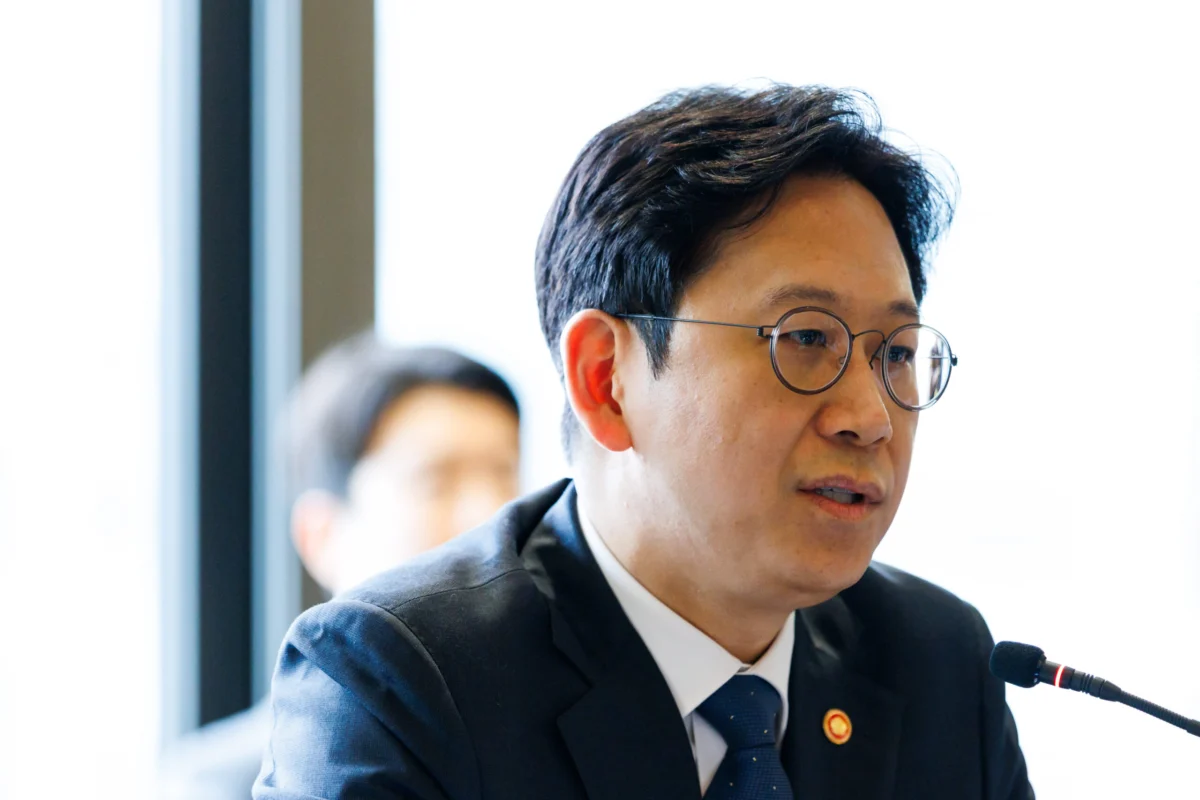
In a period of unprecedented technological transformation and market volatility, South Korean Deputy Prime Minister and Minister for Science and ICT, Bae Kyung-hoon, has articulated a vision for an "AI-inclusive society," emphasizing that the massive wealth generated by artificial intelligence must be distributed equitably to prevent widening social inequality. Speaking in late May 2026, Bae addressed the complex intersection of rapid industrial advancement, labor unrest at the nation’s largest conglomerate, and a stock market increasingly decoupled from traditional economic indicators. His remarks come at a pivotal moment as Seoul attempts to balance its ambitions as a global AI superpower with the domestic need for social stability and economic fairness.
The government’s stance highlights a growing concern among global policymakers: while AI promises to unlock trillions of dollars in global productivity, the concentration of that wealth within a handful of "super-large companies" threatens to marginalize the workforce and disrupt social cohesion. For South Korea, a nation whose economy is inextricably linked to the fortunes of high-tech manufacturing, the stakes of this transition are particularly high.
Labor Tensions and the Human Cost of Automation
The dialogue surrounding AI’s economic impact has been sharpened by recent industrial action at Samsung Electronics, the crown jewel of the South Korean economy. In May 2026, the company narrowly avoided a catastrophic 18-day strike by unionized workers after government officials intervened to facilitate a last-minute suspension of the walkout. The labor dispute centered on the distribution of the record-breaking profits Samsung has reaped from the AI-driven demand for high-bandwidth memory (HBM) chips.
Workers at the National Samsung Electronics Union (NSEU) demanded a formalization of bonus structures within their contracts, the removal of caps on performance-based pay, and a specific payout of 15% of the company’s operating profits as bonuses. While a tentative deal was reached on Wednesday, May 20, the underlying friction remains. Bae Kyung-hoon noted that such conflicts are likely to become more frequent as AI increases corporate profitability while simultaneously threatening traditional job security.
"In the age of AI, more of these super-large companies will continue to emerge," Bae stated. "In that process, labor-management conflicts may continue to arise, and when they do, it will be important to resolve them wisely through dialogue."
The tension is not limited to the semiconductor sector. Bae also pointed to the automotive industry, specifically Hyundai Motor Group, which has aggressively integrated advanced robotics into its manufacturing lines. The deployment of "Atlas" robots—developed by the Hyundai-owned Boston Dynamics—has sparked "many concerns and worries" among workers regarding the potential for large-scale displacement of human labor in the manufacturing process. The government’s challenge is to ensure that these productivity gains do not lead to a hollowed-out middle class.
The AI Dividend and the Market Paradox
The debate over wealth distribution took a controversial turn in mid-May 2026, when Kim Yeong Beom, a high-ranking presidential official, suggested on social media that the government should consider distributing excess tax revenue generated from the AI and semiconductor sectors directly to citizens. This "AI dividend" proposal sent shockwaves through the financial markets, with investors weighing the benefits of social stability against the potential for increased corporate tax burdens.
While the Blue House later clarified that Kim’s post represented a personal opinion rather than an official policy proposal, the incident underscored the growing political pressure to address the "winner-takes-all" nature of the AI economy. The South Korean stock market, the Kospi, has become a vivid illustration of this concentration. In 2026, the index has surged by more than 86%, following a 75% gain in 2025. However, these gains are heavily concentrated in a few tech titans.
Samsung Electronics has posted a year-to-date gain of nearly 144%, while its rival SK Hynix has skyrocketed by almost 200% since January 1, 2026. This "shaky rally" has raised questions about the health of the broader ecosystem. When asked if the concentration of gains in the tech sector constituted a systemic weakness, Bae defended the structure of the Korean market, noting that the success of these giants supports a vast "ecosystem of related companies" including equipment manufacturers, material suppliers, and software developers.
The K-Moonshot Project and Global Strategic Alliances
To maintain its competitive edge and ensure that AI benefits the public, South Korea is launching ambitious state-led initiatives. Chief among these is the "K-Moonshot" project, a national endeavor designed to harness AI to solve complex scientific and social problems. On April 27, 2026, Bae Kyung-hoon signed a memorandum of understanding (MoU) with Google DeepMind in Seoul, marking a significant partnership in this effort.
The K-Moonshot project aims to move beyond generic AI applications and focus on specialized areas where South Korea has a historical advantage, such as advanced materials, biotechnology, and high-precision manufacturing. By partnering with global leaders like DeepMind, Seoul hopes to accelerate its transition from a hardware-centric economy to one that leads in AI software and foundational research.
Bae emphasized that the goal of K-Moonshot is not just economic growth but the creation of "great wealth" that can be leveraged for the public good. This includes using AI to address South Korea’s demographic crisis, optimize energy consumption, and improve public healthcare. The government’s philosophy is centered on building an "AI-inclusive society" where the digital divide is minimized and no citizen is left behind by the pace of innovation.
The Emergence of Physical AI
A key pillar of South Korea’s future strategy is the development of "Physical AI." While generative AI (like large language models) has dominated headlines, Physical AI refers to intelligence embedded in machines that interact with the real world—including autonomous vehicles, industrial robots, and smart infrastructure.
Bae expressed strong confidence that South Korea can lead in this sector due to its existing dominance in hardware. "In a way, semiconductors and AI infrastructure provide the fundamental foundation," he explained. "On top of that, Korea is trying to build out the full spectrum of AI capabilities, including various hardware equipment, software, and related services."
The transition to Physical AI is seen as a natural evolution for a country that is already a global leader in robotics density. By integrating AI into its world-class manufacturing base, South Korea intends to create a new category of exportable technology. However, this shift also necessitates a new social contract, as the "reasoning and sensing" capabilities of Physical AI will bring machines into more direct competition with human workers in physical spaces.
Chronology of Key Events in 2026
The current policy landscape is the result of a rapid succession of events in the first half of 2026:
- January 1 – May 22: Samsung and SK Hynix lead a historic rally on the Kospi, with gains of 144% and 200% respectively, driven by the global AI infrastructure boom.
- April 27: The Ministry of Science and ICT signs a landmark MoU with Google DeepMind to collaborate on the K-Moonshot project, focusing on complex problem-solving via AI.
- May 12: Presidential aide Kim Yeong Beom floats the idea of an "AI Dividend" from excess tax revenue, leading to market volatility and a subsequent government clarification.
- May 20: A planned 18-day strike by the National Samsung Electronics Union is suspended following government mediation, with a tentative wage and bonus deal reached.
- May 22: Deputy Prime Minister Bae Kyung-hoon outlines the government’s vision for an "AI-inclusive society" in an international forum, emphasizing dialogue and wealth distribution.
- May 23–27: Samsung union members vote on the tentative deal, a process viewed as a litmus test for future labor relations in the AI era.
Implications for the Future
The strategy articulated by Bae Kyung-hoon suggests that South Korea is attempting to forge a "Third Way" in AI governance—one that avoids the purely market-driven approach of the United States and the highly centralized model of other nations. By focusing on "dialogue" and "inclusivity," Seoul is signaling that it views social stability as a prerequisite for technological leadership.
However, significant challenges remain. The concentration of wealth in the "super-large companies" creates a political dilemma: how to tax the engines of economic growth without stifling the very innovation that keeps the country competitive. Furthermore, the integration of Atlas robots and other Physical AI systems will require a massive retraining of the workforce, a task that will test the limits of South Korea’s educational and social welfare systems.
As the voting at Samsung concludes and the K-Moonshot project moves into its operational phase, the world will be watching to see if South Korea can indeed create a society where AI-generated wealth benefits the many, rather than the few. The success of this "inclusive" model could serve as a blueprint for other industrialized nations grappling with the same disruptive forces. For now, the South Korean government remains committed to the idea that technological progress and social equity are not mutually exclusive, but rather two sides of the same coin in the age of artificial intelligence.
