

The geopolitical landscape of the Middle East has shifted into a new phase of high-stakes economic and logistical warfare following a series of bold proclamations from United States President Donald Trump regarding the status of the Islamic Republic of Iran. In a characteristically assertive statement issued via his Truth Social platform, the President claimed that the United States has successfully implemented a near-total blockade on the Iranian state, asserting that "very little gets into, or out of, Iran!" This declaration follows the formal announcement by the United States Central Command (CENTCOM) of a specialized military initiative dubbed Task Force Iron Gate, designed to sever Tehran’s remaining continental and maritime supply conduits.
The emergence of Task Force Iron Gate represents a significant escalation in the U.S. strategy of "maximum pressure," moving beyond traditional naval blockades and financial sanctions into the realm of active disruption of land-based and inland water transport networks. According to CENTCOM, the unit is specifically tasked with monitoring and obstructing the flow of advanced weaponry, dual-use technologies, and sanctioned materials across Iran’s terrestrial borders and the Caspian Sea. While the Trump administration frames this as the final piece in a containment puzzle, military analysts and regional experts suggest that the reality on the ground is far more complex, involving a web of ancient trade routes, reluctant regional partners, and the shadow of Russian and Chinese influence.
The Mandate and Structure of Task Force Iron Gate
Task Force Iron Gate is not envisioned as a massive deployment of conventional ground troops to the Iranian border, but rather as what defense experts describe as an "intelligence fusion cell." Based at CENTCOM headquarters in Tampa, Florida, the unit is designed to coordinate a multi-agency effort involving the Department of Defense, the Department of the Treasury, and various intelligence communities. Its primary objective is to identify the specific nodes through which Iran procures military components and exports energy products in defiance of international sanctions.
Michael Mulroy, a former U.S. Deputy Assistant Secretary of Defense for the Middle East, noted that the task force seeks to answer critical operational questions: where weapon systems are entering the country, how those routes can be physically or electronically disrupted, and the specific mechanisms Iran uses to generate illegal revenue. By integrating satellite imagery, high-altitude drone surveillance, intercepted communications, and financial intelligence, the task force aims to create a real-time map of Iranian procurement networks.
The scope of the mission is broad, covering everything from the movement of drone components and explosives to the illicit transfer of petroleum products. CENTCOM has stated that the unit will focus on "preventing the movement of advanced weapons systems, dual-use technologies, sanctioned materials, and illegal revenue streams." This implies a focus on the "gray zone" of trade—commercial transactions that mask military acquisitions.
Chronology of the Containment Strategy
The launch of Task Force Iron Gate is the latest in a series of escalatory measures that have defined the U.S.-Iran relationship over the past several years. To understand the current context, one must look at the timeline of events leading to this new initiative:
- The Re-imposition of Sanctions: Following the U.S. withdrawal from the Joint Comprehensive Plan of Action (JCPOA), the administration began a systematic effort to drive Iranian oil exports to zero.
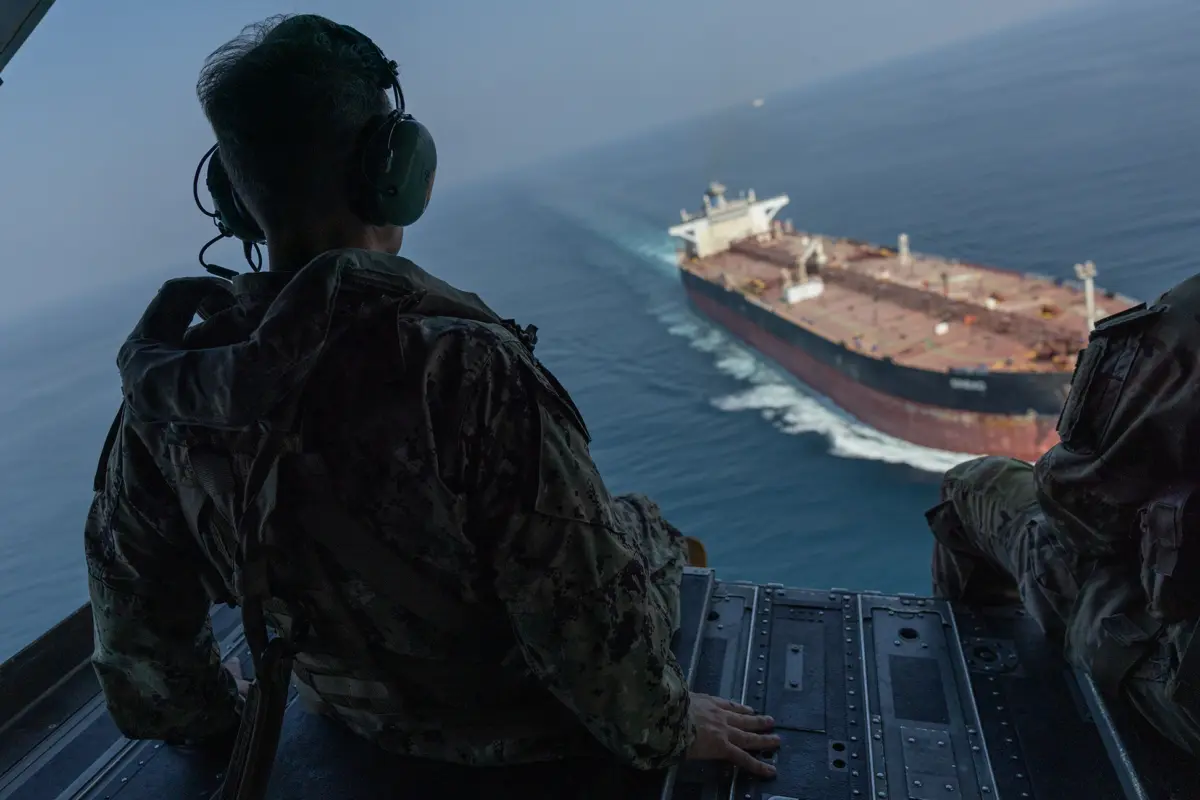
- Naval Blockade of the Strait of Hormuz: The U.S. Navy, in coordination with allied forces, increased its presence in the Persian Gulf, implementing a de facto blockade intended to monitor and seize illicit Iranian shipments.
- The Rise of the "Shadow Fleet": In response to naval pressure, Iran developed an extensive network of "ghost ships"—tankers that turn off their transponders and engage in ship-to-ship transfers to bypass detection.
- The Caspian Pivot: As the Persian Gulf became increasingly contested, Tehran shifted a significant portion of its strategic trade north toward the Caspian Sea, deepening its logistical ties with the Russian Federation.
- The Announcement of Task Force Iron Gate: On Sunday, CENTCOM officially unveiled the task force as a direct response to the "continentalization" of Iranian supply lines.
President Trump’s claim that the task force is already in "full force and effect" suggests a rapid transition from planning to operational status, though the physical infrastructure required to "seal" a border of thousands of kilometers remains a subject of intense debate.
The Caspian Sea and the Russian Connection
One of the most ambitious aspects of Task Force Iron Gate is its focus on the Caspian Sea. Historically, the Caspian has been a "Russian-Iranian lake," largely shielded from Western naval interference due to its landlocked geography and the 2018 Convention on the Legal Status of the Caspian Sea, which explicitly prohibits the presence of non-regional military forces.
In recent years, the Caspian has become a vital artery for the "North-South Transport Corridor." U.S. intelligence reports suggest that Russia has utilized this route to send drone components and explosives to Iran, while Tehran has reportedly received Russian technological assistance for its supersonic cruise missile program via the same channel.
Mahjoob Zweiri, a professor at Qatar University, argues that the U.S. mission in the Caspian is "symbolic" because the United States lacks a physical naval presence in those waters. Without the cooperation of littoral states like Azerbaijan, the U.S. must rely almost entirely on remote sensing and economic pressure on shipping companies, which may have limited impact on state-to-state military transfers between Moscow and Tehran.

Geopolitical Friction and Regional Cooperation
The success of Task Force Iron Gate depends heavily on the cooperation of Iran’s neighbors—a prospect that analysts view with skepticism. Iran shares land borders with seven countries: Iraq, Turkey, Armenia, Azerbaijan, Turkmenistan, Afghanistan, and Pakistan. Each of these nations has a unique and often precarious relationship with both Washington and Tehran.
- Iraq: While Washington holds significant financial leverage over Baghdad, Iranian-aligned militias and political factions are deeply integrated into the Iraqi state. These networks facilitate the movement of goods and personnel that are vital to Iran’s "Axis of Resistance."
- Turkey: As a NATO member, Turkey often aligns with U.S. security interests, but it also maintains a massive volume of trade with Iran and has historically been reluctant to participate in blockades that could destabilize its own economy or border regions.
- Pakistan: Islamabad currently finds itself in a delicate position, attempting to mediate between Washington and Tehran. Analysts suggest Pakistan is unlikely to participate in any overt U.S.-led effort to seal its border with Iran, fearing domestic unrest and a breakdown in regional diplomacy.
- Central Asian States: Turkmenistan and Azerbaijan are wary of upsetting the balance of power. While Azerbaijan has a close security relationship with Israel and the U.S., it must also manage its complex relationship with Russia, making "discreet cooperation" the most likely but limited outcome.
Andreas Krieg, an associate professor at King’s College London, emphasizes that "twenty people cannot police thousands of kilometers of frontiers." Without boots on the ground or the active participation of neighboring border guards, the task force is limited to "making Iranian military procurement progressively more expensive, slower, and riskier," rather than stopping it entirely.
Internal Dissent and the Risk of "Mission Creep"
The announcement of Task Force Iron Gate has not been without controversy within the U.S. defense and diplomatic establishment. Some former officials have raised alarms regarding "mission creep"—the potential for a small intelligence-gathering unit to evolve into a catalyst for direct military conflict.
Joe Kent, a former U.S. counterterrorism official who resigned in protest of the administration’s Iran policy, characterized the task force as an attempt by CENTCOM leadership to subvert diplomatic channels. Kent argued that by taking actions that almost guarantee Iranian retaliation, the military is engaging in "policy by CONOP" (Concept of Operations), essentially forcing the President’s hand into an escalatory spiral.
The concern is that as Task Force Iron Gate identifies supply nodes, the pressure to act on that intelligence will mount. This could lead to kinetic strikes or "discreet ground operations" to confiscate components, as suggested by Matthew Savill of the Royal United Services Institute (RUSI). Such actions, if carried out on the sovereign territory of Iran’s neighbors, could widen the theater of war and draw neighboring states into a conflict they have desperately tried to avoid.
Historical Resilience and the "Trading Nation" Factor
Rami Khouri, a fellow at the American University of Beirut, points to Iran’s long history as a central hub of the Silk Road as a reason for the likely failure of a total blockade. Iran has been a trading nation for millennia, developing an "enormous web of contacts" that spans the globe, with a particular emphasis on Asian markets.
"It’s virtually impossible for the U.S. to seal off every one," Khouri noted, highlighting the informal and commercial links that exist between Iranian traders and partners in the region. These decentralized networks are notoriously difficult to track, let alone dismantle, as they often involve small-scale transactions and legitimate commercial front companies.
Implications for Global Security and Energy Markets
The attempt to "seal off" Iran has implications that extend far beyond the Middle East. If the U.S. successfully disrupts Iranian energy exports through land and sea routes, the resulting supply shock could impact global energy prices, particularly in markets that still rely on Iranian crude via secondary buyers.
Furthermore, Iran’s response to such a blockade is expected to be asymmetrical. Analysts predict that Tehran may intensify its maritime coercion in the Strait of Hormuz or utilize its proxies, such as the Houthis in Yemen, to increase pressure on international shipping in the Bab al-Mandeb strait and against Saudi Arabian infrastructure.
In conclusion, while President Trump’s rhetoric suggests a country under total siege, the operational reality of Task Force Iron Gate is one of persistent, incremental disruption rather than a physical wall. The initiative marks a sophisticated evolution of modern warfare—one where intelligence, financial data, and satellite imagery are the primary weapons. However, the success of this "invisible blockade" remains tethered to the shifting loyalties of regional neighbors and the enduring resilience of Iran’s ancient and modern trade networks. As CENTCOM moves forward with its mandate, the world watches to see if this task force will lead to a containment of Iranian influence or the spark of a much larger conflagration.
