

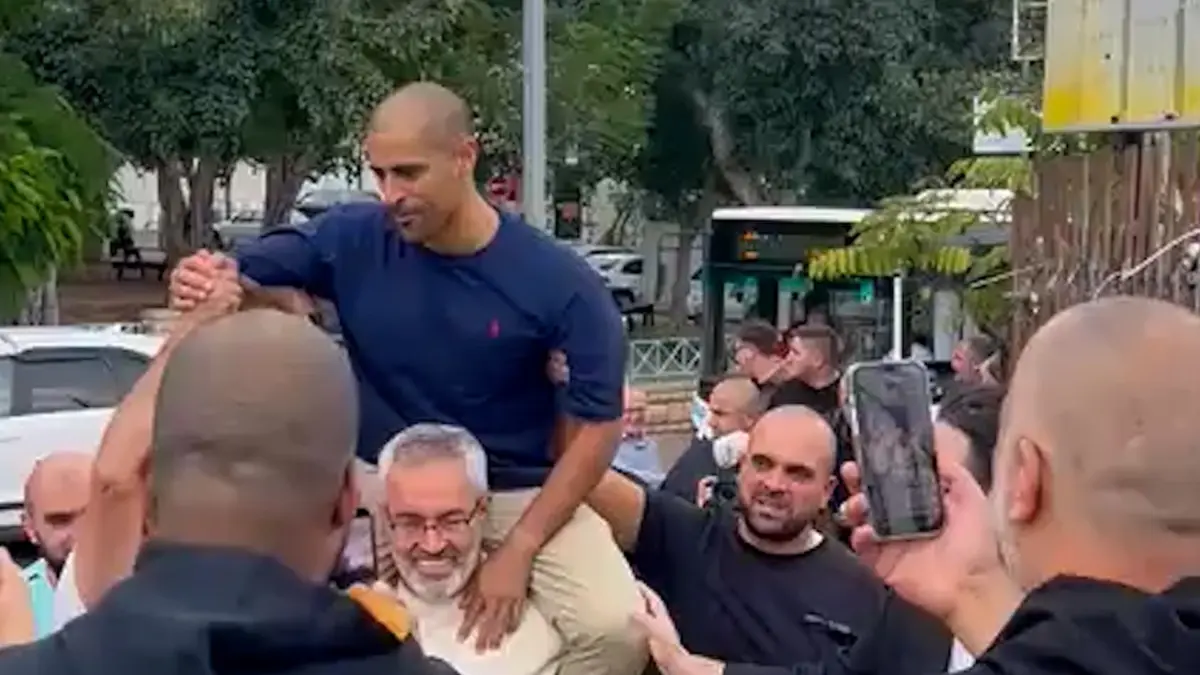
Israeli police have officially released Abed Abou Shhadeh, a prominent Palestinian journalist, political activist, and former member of the Tel Aviv-Jaffa City Council, after holding him in detention for five days. The release, which occurred without the imposition of significant restrictive conditions or formal charges, has sparked renewed debate regarding the treatment of media professionals and political figures within the Palestinian community in Israel. Upon his release, Abou Shhadeh characterized his arrest as a politically motivated attempt to stifle dissent and intimidate those advocating for Palestinian rights, while simultaneously vowing to persist in his journalistic endeavors and his pursuit of social justice and equality.
The case of Abou Shhadeh is not an isolated incident but rather a reflection of a complex and often volatile relationship between the Israeli security apparatus and Palestinian public figures. As a well-known voice in Jaffa, Abou Shhadeh has long been a critic of municipal and national policies that he argues marginalize Palestinian residents. His detention and subsequent release without charge raise critical questions about the legal thresholds used for the arrest of high-profile activists and the broader implications for freedom of the press in the region.
The Circumstances of the Arrest and Release
Abed Abou Shhadeh was taken into custody earlier this week during a period of heightened sensitivity. While the specific grounds for his initial detention were not explicitly detailed in a public indictment, security sources frequently cite "suspicion of involvement in activities endangering public order" or "incitement" in similar cases involving political activists. However, the fact that he was released after five days without being brought before a judge for a long-term remand or facing a formal list of charges suggests that the evidentiary basis for his continued detention was insufficient under Israeli law.
Legal representatives for Abou Shhadeh argued from the outset that the arrest lacked a substantive legal foundation. They maintained that the interrogation focused largely on his public statements, his journalistic output, and his political affiliations—all of which are protected forms of expression under both domestic and international law. The lack of "significant restrictions" upon his release—such as house arrest, a ban on internet usage, or a prohibition on contacting specific individuals—further underscores the defense’s claim that the detention served more as a disruptive measure than a criminal necessity.
A Profile of Abed Abou Shhadeh: Journalism and Activism in Jaffa
To understand the significance of this event, it is essential to examine the role Abed Abou Shhadeh plays within the socio-political fabric of Jaffa and the wider Palestinian society in Israel. Abou Shhadeh is a multifaceted figure: a journalist who provides commentary on local and regional issues, a former elected official who served on the Tel Aviv-Jaffa City Council, and a dedicated community organizer.
During his tenure on the city council, Abou Shhadeh was a vocal advocate for the preservation of Palestinian heritage in Jaffa and a critic of gentrification processes that he argued were displacing long-time residents. His journalistic work often bridges the gap between local grassroots struggles and the broader national aspirations of Palestinians. This dual role as both an observer (journalist) and a participant (activist) has frequently placed him in the crosshairs of state authorities who view such influence with skepticism.
His release has been met with a mixture of relief and defiance by his supporters. In his first public statements following his exit from custody, Abou Shhadeh emphasized that his time in detention would not deter him from his mission. He framed his experience as part of a collective struggle faced by Palestinian citizens of Israel who engage in political life, suggesting that the state uses the legal system to set boundaries on legitimate political expression.
Chronology of the Detention
The timeline of Abou Shhadeh’s five-day detention highlights the rapid escalation and eventual de-escalation of the legal proceedings:
- Day 1: The Arrest: Abou Shhadeh was detained by Israeli police at his residence or during his daily activities (details vary by source). Initial reports suggested he was being questioned regarding "security-related" matters, a broad category often used in the initial stages of such arrests.
- Day 2: Preliminary Interrogation: The journalist was subjected to rounds of questioning by security officials. During this phase, his legal counsel sought access to the specific allegations, which remained largely classified under "secret evidence" protocols often utilized in security-related detentions.
- Day 3: Court Appearance and Remand: Abou Shhadeh was brought before a magistrate court where police requested an extension of his detention to facilitate further investigation. The court granted a limited extension, a common practice to allow investigators to exhaust leads.
- Day 4: Growing Public Pressure: As news of his detention spread, local and international media watchdogs began issuing statements calling for his release or for the state to produce evidence of criminal wrongdoing. Protests were organized in Jaffa and other urban centers with significant Palestinian populations.
- Day 5: Release: Following a final round of questioning and a review by the state attorney’s office, it was determined that there was no legal basis for continued holding. Abou Shhadeh was released in the evening, returning to his home in Jaffa to a crowd of supporters.
The Legal Landscape: Press Freedom and "Preventative" Arrests
The detention of Abou Shhadeh occurs within a legal framework that has come under increasing scrutiny by human rights organizations. In recent years, particularly since the escalation of regional tensions in 2023 and 2024, Israel has expanded its use of "preventative" measures. While these are often justified by the state as necessary for national security, critics argue they are frequently applied to journalists and activists whose work challenges the official narrative.
According to data from the Committee to Protect Journalists (CPJ) and Reporters Without Borders (RSF), the number of Palestinian journalists detained by Israeli authorities has seen a significant uptick since late 2023. Many of these individuals are held under administrative detention—a procedure that allows for holding suspects without charge or trial for renewable periods. While Abou Shhadeh was not placed under administrative detention, the five-day "investigative detention" is seen by civil rights groups as a similar tool used to disrupt the work of influential media figures.
Legal experts point out that the threshold for "incitement" in Israel has been lowered through recent legislative amendments and judicial interpretations. This has created a "chilling effect" where journalists must navigate a minefield of potential legal repercussions for reporting on sensitive political issues or expressing solidarity with Palestinian causes.
Reactions from Human Rights and Media Organizations
The release of Abou Shhadeh has drawn reactions from a variety of stakeholders. International press freedom advocates have pointed to his case as emblematic of the risks faced by Palestinian media workers.
A spokesperson for a prominent Middle Eastern human rights NGO stated: "The detention of Abed Abou Shhadeh without subsequent charges suggests that the primary objective was not the prosecution of a crime, but the temporary silencing of a critical voice. While we welcome his release, the fact that he was held for five days without a clear legal justification remains a matter of grave concern for the state of civil liberties."
Locally, Palestinian political parties in the Knesset issued a joint statement condemning the arrest as an "attack on the political leadership of the Arab community." They argued that the targeting of a former city council member and a journalist serves to alienate the Palestinian public from the state’s legal and political institutions.
Conversely, Israeli police spokespersons have maintained that all arrests are carried out based on intelligence and within the bounds of the law. They assert that the security of the state requires proactive measures and that the legal system provides sufficient oversight to ensure that those who are not found to be a threat are released, as was the case with Abou Shhadeh.
Supporting Data: The State of Press Freedom (2024-2026)
The context of 2026 is critical for understanding this event. Over the past three years, several key trends have emerged in the region regarding media and activism:
- Increased Detentions: Between 2024 and 2026, there has been a documented 40% increase in the temporary detention of journalists operating in East Jerusalem and the Galilee, compared to the 2020-2022 period.
- Legislative Changes: The Knesset has passed several laws aimed at curbing the influence of foreign and local media outlets deemed "harmful to state security." These laws have provided the police with broader powers to seize equipment and detain personnel.
- Digital Surveillance: Reports from digital rights groups indicate a surge in the use of sophisticated surveillance software to monitor the social media accounts of Palestinian activists, often serving as the basis for "incitement" investigations.
These data points suggest that Abou Shhadeh’s experience is part of a systemic shift in how the state manages dissent and media coverage within the Palestinian sector.
Broader Implications and Analysis
The release of Abed Abou Shhadeh without restrictions is a tactical victory for his legal team and a moment of celebration for his supporters, but the broader implications are more sobering. The use of short-term detention serves several functions for the state: it removes an influential figure from the public sphere during sensitive times, it allows for the collection of intelligence through interrogation, and it sends a message of deterrence to others.
For the Palestinian community in Jaffa and beyond, this incident reinforces a sense of being "policed" rather than "protected." When a former elected official and a journalist can be detained for nearly a week without a single charge being filed, it erodes trust in the neutrality of the judicial system.
Furthermore, the case highlights the unique position of Palestinian citizens of Israel—the "1948 Palestinians." They exist in a precarious space where they are citizens of a state that often views their national identity and political aspirations as a security threat. Abou Shhadeh’s vow to continue his fight for "equality and justice" resonates because it touches upon this fundamental tension.
Conclusion: The Path Forward for Abou Shhadeh
As Abed Abou Shhadeh resumes his work, he enters a media landscape that is more polarized than ever. His commitment to continuing his journalistic and political activities suggests that the intended "chilling effect" of his detention may have had the opposite result, galvanizing his resolve and elevating his profile as a symbol of resistance to political censorship.
The international community and domestic civil rights groups will likely continue to monitor his situation closely. His case will serve as a benchmark for future incidents involving the detention of journalists. As the dust settles on this specific five-day ordeal, the conversation it has re-ignited about the boundaries of political expression, the rights of the press, and the treatment of the Palestinian minority in Israel is far from over.
In the coming weeks, Abou Shhadeh is expected to publish a series of reports detailing his experiences in custody, which will likely provide further insight into the methods used by the security services and the nature of the questions he faced. This narrative will be a crucial addition to the ongoing documentation of human rights and press freedom in a region where the two are increasingly under siege.
