

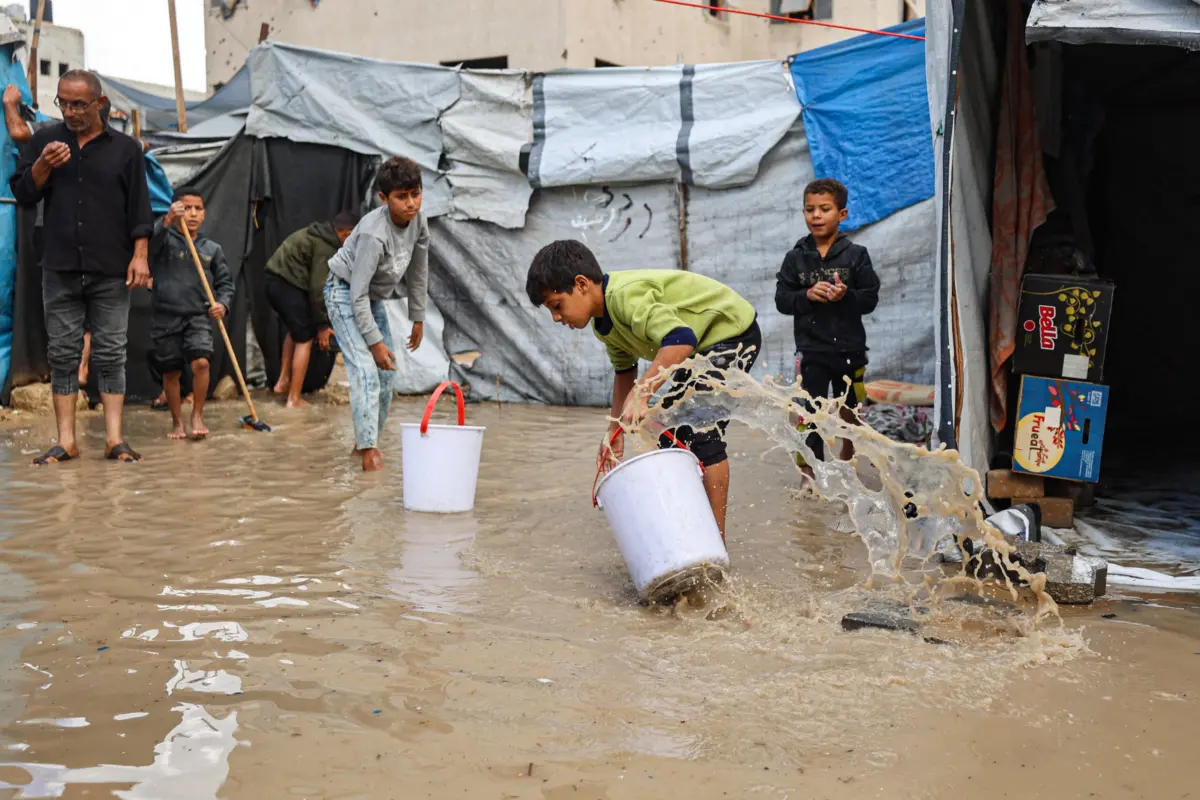
The humanitarian crisis in the Gaza Strip reached a new and perilous stage this weekend as the first major storm of the winter season inundated makeshift camps, leaving tens of thousands of displaced Palestinians without even the meager shelter they had managed to maintain. Local authorities in the besieged enclave reported on Saturday that heavy rainfall had flooded approximately 70,000 tents across the territory, exacerbating a situation already characterized by extreme food insecurity, lack of clean water, and ongoing military operations. The flooding has not only destroyed the belongings of families who have been displaced multiple times but has also caused structural collapses in war-damaged buildings, resulting in several critical injuries.
According to the Palestinian Civil Defence, the onset of the storm late Friday and early Saturday triggered a deluge that overwhelmed the primitive drainage systems and temporary settlements that now characterize the Gazan landscape. In Gaza City’s Remal neighborhood and various districts in northern and central Gaza, water levels were reported to have risen by as much as 300 to 400 millimeters (12 to 16 inches) in a matter of hours. This surge of water turned tent cities into muddy swamps, forcing families to flee in the middle of the night to seek higher ground or more stable structures, many of which are already riddled with holes from shelling and air strikes.

The Immediate Impact of the Storm
The scale of the destruction became clear as dawn broke on Saturday. Palestinian authorities issued a statement confirming that the "first day of rains" had immediately compromised the living conditions of a vast portion of the population. Beyond the 70,000 flooded tents, the weight of the water and the softening of the earth led to the collapse of dozens of "cracked walls and roofs" in partially destroyed buildings where some displaced people had sought refuge. These collapses caused numerous injuries, with medical sources describing several cases as critical.
Mahmoud Basal, the spokesperson for the Palestinian Civil Defence, told the AFP news agency that his teams were inundated with more than 1,500 urgent calls for assistance during the night. The requests ranged from people trapped in flooded tents to those needing rescue from rising waters in low-lying areas. However, the ability of the Civil Defence to respond was severely limited. Basal emphasized that the agency is currently "operating without any equipment or capabilities," a direct result of the ongoing blockade and the destruction of the agency’s infrastructure over the past 14 months of conflict.
"We have issued an urgent distress call to the international community and humanitarian organizations to intervene immediately to save hundreds of thousands of displaced people from the flooding of their tents," Basal stated. "We cannot face the consequences of this storm on our own."

Chronology of the Environmental Disaster
The weather event began as a forecasted low-pressure system moving across the Eastern Mediterranean. While seasonal rains are expected in November, the infrastructure of the Gaza Strip is currently in a state of total ruin, making even moderate rainfall a catastrophic event.
- Friday Evening: Rain begins to fall steadily across northern Gaza and Gaza City. By midnight, the intensity increases, and the first reports of tent leakages begin to emerge from the Remal neighborhood and Jabalia.
- Saturday 2:00 AM: Water levels in makeshift camps in central Gaza, including areas near Deir el-Balah, begin to rise rapidly. Families are forced to abandon their belongings as water enters their sleeping quarters.
- Saturday 4:00 AM: The Palestinian Civil Defence reports a surge in distress calls. Emergency crews, lacking fuel and functional vehicles, are forced to prioritize only the most life-threatening situations, often reaching sites on foot.
- Saturday Morning: Gaza authorities release initial assessments, citing 70,000 flooded tents. Images from the ground show men, women, and children using buckets and plastic containers to bail out muddy water from their dwellings.
- Saturday Midday: International agencies, including the UN Office for the Coordination of Humanitarian Affairs (OCHA), begin assessing the damage, warning that nearly a million people are at risk as the storm system continues to sit over the region.
Humanitarian Logistics and Aid Restrictions
The severity of the flooding’s impact is inextricably linked to the restrictions on humanitarian aid and the ongoing siege of the Gaza Strip. Since the beginning of the current conflict in October 2023, the entry of essential supplies—including waterproof tents, tarpaulins, fuel for water pumps, and heavy machinery for drainage maintenance—has been strictly controlled or entirely blocked by Israeli authorities.
Humanitarian organizations have repeatedly warned that the "winterization" of Gaza was behind schedule due to these logistical hurdles. Most of the tents currently in use are made of thin nylon or repurposed fabric that offers little protection against heavy rain or wind. Furthermore, the lack of fuel has paralyzed the Gaza Power Plant and municipal water pumps, preventing the clearing of flooded streets and the management of sewage systems, which are now overflowing and mixing with rainwater.

The Office for the Coordination of Humanitarian Affairs (OCHA) has provided data indicating that approximately 950,000 displaced people in Gaza are currently residing in areas classified as "highly exposed to flooding." These areas include coastal sands, which are prone to erosion, and low-lying inland depressions where water naturally collects. Without the ability to import more durable shelter materials or the fuel necessary to run drainage equipment, aid agencies are essentially powerless to prevent the seasonal weather from turning into a mass-casualty or mass-displacement event.
Supporting Data and Population Vulnerability
The vulnerability of the Gazan population is underscored by the sheer density of displacement. Recent UN figures suggest that nearly 1.9 million people—out of a total population of 2.3 million—have been displaced at least once since the war began. Many have been displaced five or six times, losing their belongings with each move.
- Shelter Deficit: Prior to this storm, humanitarian groups estimated a shortage of at least 200,000 winter-grade tents. The 70,000 tents flooded on Saturday represent nearly a third of the existing makeshift housing stock in the affected areas.
- Rainfall Intensity: The 300-400mm rise in water levels reported in some camps is equivalent to several months of average rainfall for the region, concentrated into a single 24-hour period.
- Public Health Risk: The World Health Organization (WHO) has warned that the mixing of rainwater with raw sewage significantly increases the risk of waterborne diseases. Cases of Hepatitis A and chronic diarrhea are already at record highs in Gaza; the flooding is expected to trigger a new wave of infections.
- Equipment Shortages: The Palestinian Civil Defence reports that over 80% of its specialized rescue vehicles have been destroyed or rendered inoperable due to lack of spare parts and direct military strikes.
Official Reactions and Global Appeals
The reaction from local and international officials has been one of alarm, mixed with frustration over the political barriers to aid. Municipal officials in Gaza City issued a statement on Saturday afternoon declaring the city a "disaster zone" due to the combination of infrastructure destruction and weather conditions. They noted that the lack of fuel has made it impossible to operate the remaining mobile pumps that could potentially clear the flooded streets.

UNRWA, the UN agency for Palestinian refugees, emphasized that its facilities are already at double or triple their intended capacity, meaning there is nowhere for the newly displaced families to go. "Our shelters are overflowing, and the streets are rivers of mud and waste," an UNRWA spokesperson noted in a brief social media update. "The people of Gaza are being squeezed between the violence of war and the cruelty of the elements."
Israeli authorities have maintained that restrictions on aid are necessary for security reasons, to prevent supplies from being diverted. However, international human rights organizations and several UN member states have argued that the current level of restriction constitutes collective punishment and is creating an unmanageable humanitarian catastrophe.
Analysis of Broader Implications
The flooding in Gaza is not merely a natural disaster; it is a "threat multiplier" that complicates every other aspect of the humanitarian response. From a public health perspective, the cold and damp conditions are expected to lead to a spike in respiratory infections among children and the elderly, who are already malnourished. The loss of stored food supplies in the flooding will further exacerbate the hunger crisis, as many families had used their tents to store whatever meager dry goods they had received from aid distributions.

Furthermore, the destruction of tents creates a new cycle of displacement. Families who had managed to find a semblance of stability in a specific camp are now forced back into a state of transit, searching for dry ground in a territory where such space is increasingly non-existent due to military "no-go zones" and the sheer volume of debris.
As the winter progresses, the frequency of such storms is likely to increase. Without a significant change in the volume and type of aid allowed into the Gaza Strip—specifically fuel, construction materials, and specialized drainage equipment—the international community may be witnessing the beginning of a seasonal tragedy that could claim as many lives through exposure and disease as the conflict has through direct violence. The events of this Saturday serve as a grim preview of the months ahead, highlighting the urgent need for a humanitarian corridor that accounts for the environmental realities of a region in ruins.
