

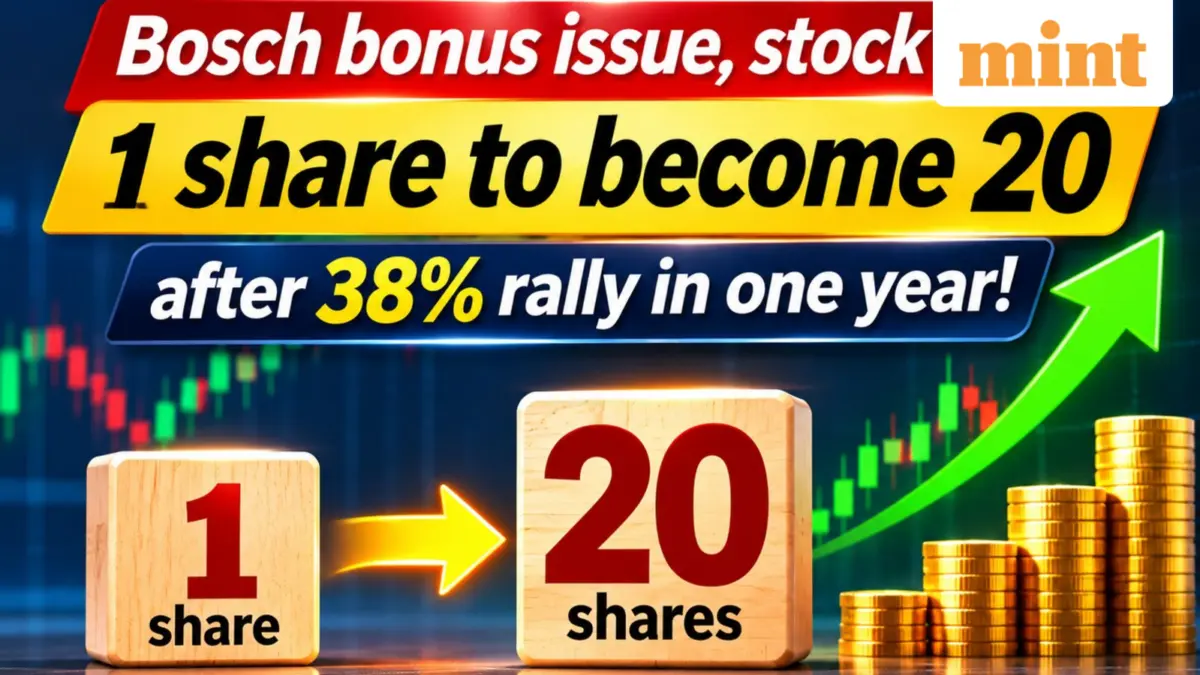
Bosch Limited, a leading global supplier of technology and services and a heavyweight in the Indian automotive ancillary sector, has officially announced a significant capital restructuring plan that includes both a sub-division of equity shares (stock split) and a subsequent bonus issue. This dual corporate action, approved by the company’s board of directors during their recent meeting to review the financial results for the second quarter of the 2026-27 financial year, is designed to enhance market liquidity and make the shares more accessible to a broader base of retail investors. Following the announcement, the company’s stock witnessed a robust rally, surging nearly 8.41% over the past week and maintaining a positive trajectory during the special Diwali Muhurat trading session on Sunday, November 8.
The Mechanics of the Capital Restructuring: From 1 Share to 20
The proposed corporate actions by Bosch Limited are structured in two distinct phases. The first phase involves a stock split, or sub-division of shares, in a ratio of 1:5. Under this arrangement, every existing equity share with a face value of ₹10 will be divided into five equity shares, each having a face value of ₹2. This move is a direct response to the high absolute price of Bosch shares, which have recently traded above the ₹50,000 mark, placing them among the most expensive stocks on the Indian bourses in terms of nominal value. By reducing the face value and increasing the number of outstanding shares, the company aims to lower the entry barrier for smaller investors.
The second phase of the restructuring is a bonus issue in the ratio of 3:1. This action will be applied to the post-split shares. Specifically, for every one equity share (with a face value of ₹2) held by an investor after the split, the company will issue three additional bonus equity shares of the same face value. When these two actions are combined, the cumulative effect is a 20-fold increase in the number of shares held by an investor without any additional capital outlay. For example, an investor who currently holds a single share of Bosch Limited will see their holding transform into five shares following the 1:5 split. Subsequently, the 3:1 bonus issue will grant them an additional 15 shares (3 bonus shares for each of the 5 post-split shares), resulting in a total holding of 20 equity shares.
Market Performance and Investor Sentiment
The market’s reaction to the dual announcement has been overwhelmingly positive. On the Bombay Stock Exchange (BSE), Bosch shares closed the special Muhurat trading session at ₹50,990 per share, marking a 0.44% increase for the day. This brought the company’s total market capitalization to approximately ₹1,50,400.61 crore. The stock has demonstrated remarkable resilience and growth over various timeframes, reflecting strong investor confidence in the company’s fundamental health and its strategic positioning within the automotive ecosystem.
In the short term, the stock has delivered an 8.41% return over the past seven days. Looking at the medium-term performance, the shares have appreciated by 17.8% in one month and a staggering 33.7% over the last six months. On a year-on-year basis, Bosch has provided a return of approximately 38.47%, significantly outperforming many of its peers in the auto ancillary segment and keeping pace with the broader recovery in the Indian automotive market. This upward trend is attributed not only to the corporate action news but also to the company’s consistent operational performance amidst a shifting landscape characterized by the transition to electric vehicles (EVs) and more stringent emission norms.
Strategic Rationale: Liquidity and Retail Participation
The decision to implement a stock split and a bonus issue simultaneously is a strategic maneuver often employed by high-priced "blue-chip" companies to address the issue of low trading volumes. At a price point exceeding ₹50,000, Bosch shares had become less liquid, as the high cost of a single lot often deterred retail participants and smaller portfolio managers. By bringing the price down to a more manageable level—theoretically 1/20th of the pre-action price, adjusted for market fluctuations—Bosch intends to foster a more vibrant secondary market for its securities.
Furthermore, a bonus issue is traditionally viewed as a sign of management’s confidence in the company’s future earnings potential. Since bonus shares are issued out of the company’s accumulated reserves, the move signals that Bosch possesses a strong balance sheet and sufficient retained earnings to capitalize its reserves. While a bonus issue does not change the intrinsic value of the company, it often leads to a positive psychological impact on the market, as it suggests that the company is committed to sharing its long-term growth with its shareholders.
Chronology of Events and Approval Process
The timeline for these corporate actions is currently in its initial stages. The board of directors gave their formal approval during the first week of November 2024, coinciding with the Q2 FY2026-27 earnings call. However, the implementation of the stock split and bonus issue is subject to several regulatory and procedural milestones:
- Board Approval: Completed in the first week of November.
- Shareholder Approval: The company has indicated that it will seek the consent of its shareholders through a postal ballot. This process allows all shareholders to vote on the resolution electronically or via physical mail, ensuring a democratic approval process.
- Notification of Record Date: Once shareholder approval is secured, Bosch Limited will notify the stock exchanges (BSE and NSE) of the "Record Date." This is the cut-off date determined by the company to identify the eligible shareholders who will receive the split shares and the bonus shares.
- Execution: Following the record date, the shares will trade "ex-split" and "ex-bonus," and the new shares will be credited to the demat accounts of eligible investors.
As of the current report, the company has yet to specify the exact dates for the postal ballot or the record date, but analysts expect these to be finalized within the current quarter.
Contextual Background: Bosch in the Indian Automotive Landscape
Bosch Limited’s performance must be viewed through the lens of the evolving Indian automotive industry. As a subsidiary of the German multinational Robert Bosch GmbH, the Indian entity has been a cornerstone of the domestic manufacturing sector for decades. The company’s product portfolio is vast, spanning gasoline and diesel injection systems, aftermarket parts, electric power tools, and home appliances.
The company’s recent focus has been heavily tilted toward supporting the "Green Mobility" transition in India. Bosch has been investing significantly in localization, particularly in components related to Bharat Stage VI (BS-VI) transition and beyond, as well as electronic components for the burgeoning EV market. The Q2 results, which served as the backdrop for the bonus and split announcement, reflect the company’s ability to navigate supply chain complexities and fluctuating raw material costs while maintaining healthy margins.
Industry analysts suggest that Bosch’s decision to reward shareholders now is a reflection of its robust cash flow generation. By increasing the share count, the company is also preparing for a future where a more diversified shareholding pattern could provide greater stability against market volatility.
Implications for Investors and the Broader Market
For existing shareholders, the primary implication is a significant increase in the number of units held, which may provide greater flexibility in managing their portfolios. For example, an investor wishing to liquidate only a small portion of their holding will find it much easier to do so when they hold 20 shares at ₹2,500 each rather than one share at ₹50,000.
For the broader market, the Bosch announcement is seen as a bellwether for the auto ancillary sector. It suggests that despite global economic headwinds and the capital-intensive nature of the shift to new mobility technologies, top-tier Indian manufacturers remain profitable and optimistic. The move may also prompt other high-priced stocks in the Nifty Auto index to consider similar capital restructuring measures to remain attractive to retail investors who have become a dominant force in the Indian equity markets over the last three years.
Official Responses and Future Outlook
While official statements from the company’s leadership have focused on the technical aspects of the Q2 earnings, the inferred sentiment from the board’s decision is one of long-term value creation. In previous communications, Bosch management has emphasized their commitment to the "Make in India" initiative and their role as a technology partner to almost every major Original Equipment Manufacturer (OEM) in the country.
Looking ahead, the company’s outlook remains tied to the recovery of the commercial vehicle segment and the continued premiumization of the passenger vehicle market. With the festive season providing a seasonal tailwind to auto sales, Bosch is well-positioned to capitalize on increased demand for its mobility solutions. The successful execution of the stock split and bonus issue will likely serve as a milestone in the company’s corporate history, marking a new chapter of increased market participation and capital efficiency.
In conclusion, Bosch Limited’s decision to undergo a 1:5 stock split and a 3:1 bonus issue is a multifaceted strategic move. It addresses the practical necessity of share price moderation while simultaneously rewarding long-term investors and signaling internal financial strength. As the company moves toward obtaining shareholder approval, the market will be watching closely for the announcement of the record date, which will trigger the final implementation of this 1-to-20 share transformation. For now, the 8% weekly surge in share price stands as a testament to the market’s approval of Bosch’s forward-looking capital management strategy.
