

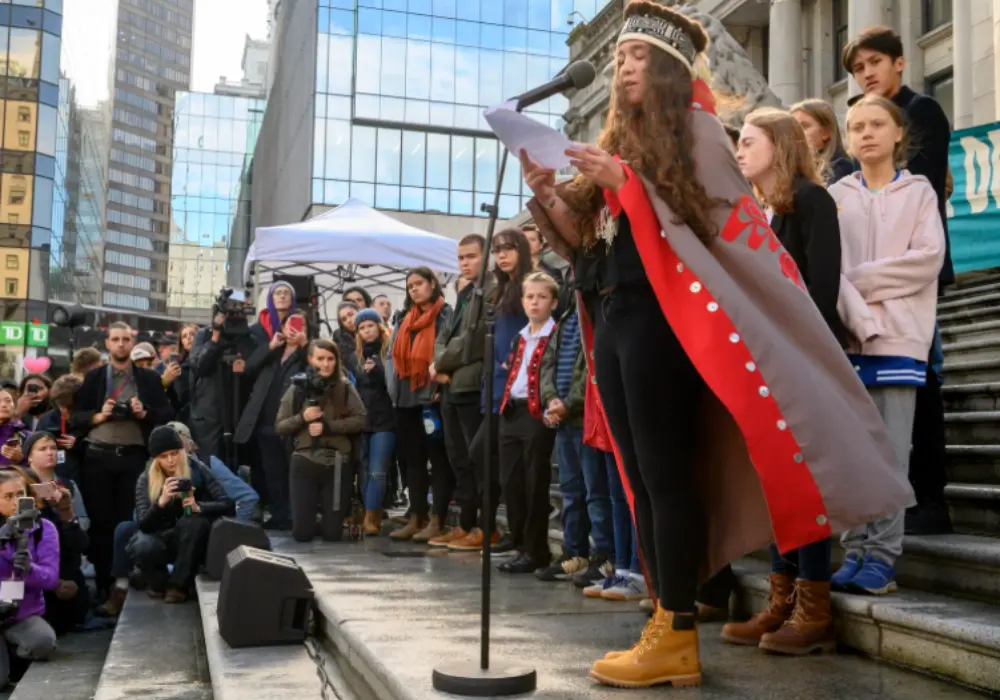
In a Vancouver courtroom on Monday, the emotional and legal weight of the climate crisis took center stage as Kira Young, now 20, recounted the harrowing experience of evacuating her home in Yellowknife during the record-breaking wildfire season of 2023. Young, one of 15 youth plaintiffs in the historic La Rose vs. Canada lawsuit, described a summer defined by suffocating smoke, ash-strewn skies, and the profound psychological toll of wondering if she would ever see her neighborhood again. Her testimony marked the beginning of a full evidentiary trial that seeks to hold the Canadian federal government accountable for its climate policies, arguing that inadequate action on greenhouse gas emissions constitutes a violation of the fundamental rights of young citizens.
The case represents a watershed moment in Canadian jurisprudence. While climate-related litigation has surged globally, La Rose vs. Canada is the first federal youth climate case in the nation’s history to proceed to a full trial. The plaintiffs, who were between the ages of 10 and 18 when the suit was first filed in 2019, contend that the government’s failure to implement a science-based emissions reduction plan infringes upon their rights under Section 7 and Section 15 of the Canadian Charter of Rights and Freedoms. Specifically, they point to Section 7, which guarantees the right to life, liberty, and security of the person, arguing that the existential threat of climate change creates a "positive obligation" for the state to protect its most vulnerable citizens from environmental catastrophe.
The Human Face of the Climate Crisis
Kira Young’s testimony provided a vivid illustration of the "human face" that legal teams hope will resonate with the court. She recalled the "visceral anger" and "terror" she felt in mid-August 2023 when she was forced to flee Yellowknife. Before leaving, she wandered through her family home, taking photographs of mundane details—hallways, cabinets, and the view from her deck—fearing it was the last time she would see them. This experience followed a summer where her participation in traditional wilderness activities, such as a multi-day canoeing trip, was marred by constant exposure to heavy wildfire smoke.
The psychological impact, described by Young as a "huge emotional toll," is a central component of the plaintiffs’ argument. They assert that climate change is not a distant or nebulous threat but a current reality that causes tangible physical and mental harm. The legal team, supported by the Oregon-based non-profit Our Children’s Trust and West Coast Environmental Law, argues that these harms are exacerbated by the government’s continued support for fossil fuel infrastructure and its failure to meet international climate targets.
A Chronology of the Legal Battle
The path to this week’s trial has been marked by significant legal hurdles. The lawsuit was originally filed in October 2019, targeting a wide array of federal actions and policies that the plaintiffs claimed contributed to the climate crisis. In 2020, the Federal Court initially dismissed the case, ruling that the claims were "justiciable"—meaning they were too broad or political for a court to decide. The court suggested that the issues raised were matters of policy that should be handled by Parliament rather than the judiciary.
However, the plaintiffs appealed the decision, and in late 2023, the Federal Court of Appeal delivered a landmark ruling. The appellate court found that while the original claim was indeed too broad, a narrowed version focusing on specific legislation could proceed. This paved the way for the current trial, which specifically targets the federal government’s Net-Zero Emissions Accountability Act and the resulting 2030 Emissions Reduction Plan. By narrowing the focus, the court allowed the youth to challenge the adequacy of the legislative framework itself, rather than the entirety of government policy.
The Legislative Target: The Net-Zero Emissions Accountability Act
Central to the plaintiffs’ argument is the Net-Zero Emissions Accountability Act, passed in 2021. This legislation provides the framework for Canada to reach net-zero emissions by 2050 and requires the government to set rolling targets every five years. While the government touts this as a historic commitment to climate action, the plaintiffs argue that the targets set within this framework are not aligned with what the best available science deems necessary to maintain a "safe climate system."
The youth applicants contend that by setting targets that allow for continued high levels of emissions, the government is effectively "permitting" a level of warming that will result in catastrophic harm to their generation. They are asking the court to declare these legislative targets unconstitutional and to order the government to develop a new, science-based plan to decarbonize the country’s energy system at a pace consistent with limiting global warming to 1.5 degrees Celsius above pre-industrial levels.
Canada’s Role in Global Emissions
A significant portion of the trial is expected to focus on data regarding Canada’s historical and current contributions to global warming. Despite representing only about 0.5% of the world’s population, Canada is responsible for approximately 1.4% of global greenhouse gas emissions. On a per capita basis, Canada remains one of the highest emitters in the world, largely due to its resource-heavy economy and the carbon intensity of the oil sands.
Andrew Gage, a staff lawyer with West Coast Environmental Law, emphasized that Canada’s role is not negligible. The plaintiffs argue that because Canada is a major contributor to the cumulative stock of atmospheric CO2, it has a heightened responsibility to lead in emissions reductions. The government, conversely, has argued that climate change is a "global problem" that cannot be solved by Canadian legal orders alone, asserting that domestic reductions would be offset by the actions—or inactions—of other major emitters like China, the United States, and India.
The Government’s Defense: Negative vs. Positive Rights
The federal government’s legal strategy, led by representative B.J. Wray, rests on a traditional interpretation of the Canadian Charter of Rights and Freedoms. Wray argued on Monday that the Charter primarily protects "negative rights"—the right to be free from government interference. Under this interpretation, the government is prohibited from taking actions that directly deprive a citizen of their life or liberty, but it is not legally required to take proactive steps to ensure a healthy environment or to mitigate global phenomena like climate change.
The government further contends that it has been on a downward trajectory regarding emissions since 2005 and that its current policies are the result of complex "international statecraft" and economic balancing. From the government’s perspective, the court does not have the expertise or the constitutional mandate to manage national energy policy or set specific emissions targets, which they view as the exclusive domain of the executive and legislative branches.
The Role of Expert Testimony
The complexity of the case has led the court to allow an unusual number of expert witnesses. Eight experts are expected to testify over the coming weeks, covering a broad spectrum of disciplines:
- Climate Science: Experts will detail the specific warming trends in Canada, which is warming at twice the global average (and three times the global average in the North).
- Public Health and Mental Health: Witnesses will provide evidence on "eco-anxiety" and the physical health risks posed by increased heatwaves and wildfire smoke.
- Economics: Testimony will address the feasibility of rapid decarbonization and the long-term costs of climate inaction versus the investment required for a green transition.
- Indigenous Knowledge: Given the disproportionate impact of climate change on Northern and Indigenous communities, expert testimony will likely include perspectives on how environmental shifts are threatening traditional ways of life.
Broader Implications and the Evolving Legal Landscape
The outcome of La Rose vs. Canada could have profound implications for the future of environmental law in Canada. If the court finds that the government has a "positive obligation" to protect citizens from climate change under Section 7, it would represent a revolutionary shift in constitutional law. Such a ruling would likely trigger a wave of similar lawsuits targeting provincial governments and private entities.
The trial also coincides with an evolving international legal landscape. Last year, the International Court of Justice issued an advisory opinion stating that governments are legally required to prevent significant harm to the environment. Domestically, other cases are also moving through the system:
- Mathur et al vs. Ontario: Seven youth are challenging the Ontario government’s decision to weaken provincial emissions targets.
- Ecojustice vs. Canada: A separate challenge also targeting the Net-Zero Emissions Accountability Act.
- Youth vs. CPPIB: A lawsuit against the Canada Pension Plan Investment Board alleging that the fund is failing to account for climate risks in its fossil fuel investments.
As the La Rose trial continues in Vancouver, it serves as a critical test of whether the judiciary will step in where the youth feel the political process has failed. For Kira Young and her fellow plaintiffs, the case is not just about legal theory, but about securing a future where they no longer have to photograph their homes in fear of losing them to the flames. The court’s decision will ultimately determine if the Canadian Charter is a living tree capable of sheltering its citizens from the gathering storms of a warming planet.
