

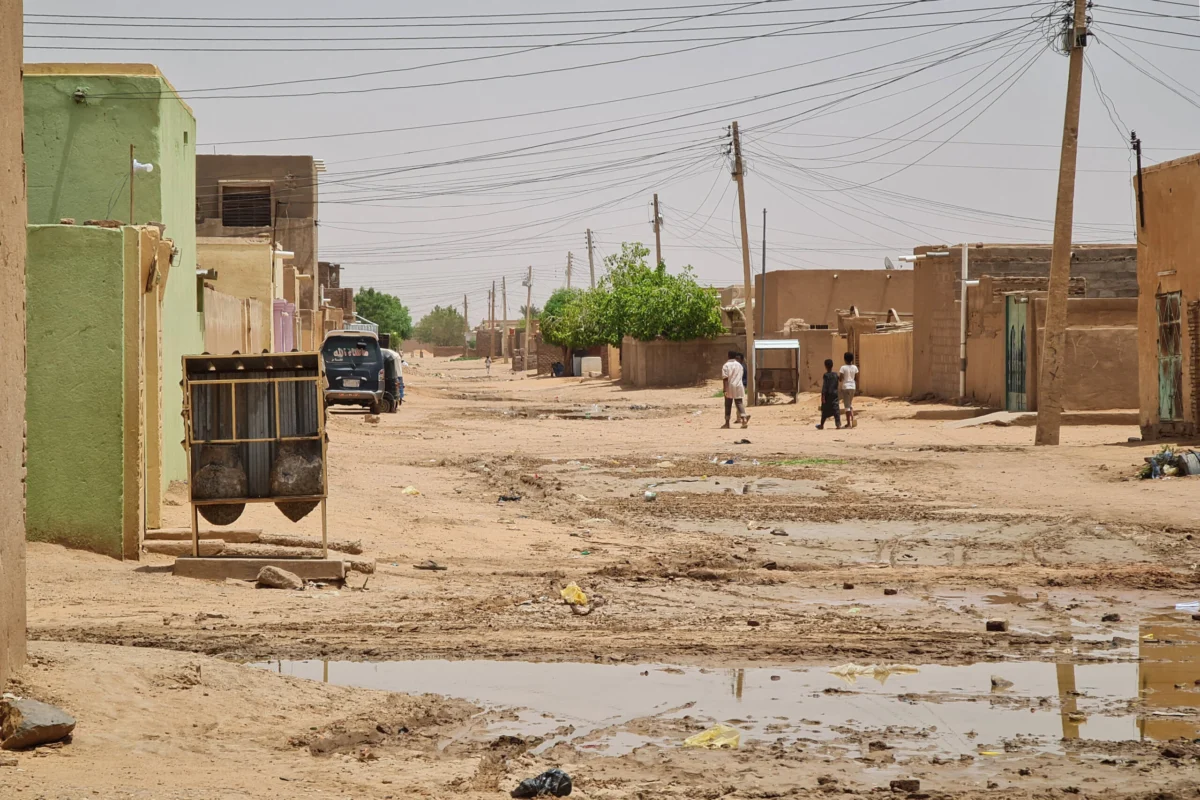
A devastating airstrike struck the Yarmouk neighborhood of southern Khartoum on Saturday, resulting in the deaths of at least 17 civilians, including five children. This latest escalation in the Sudanese capital underscores the intensifying violence between the Sudanese Armed Forces (SAF) and the paramilitary Rapid Support Forces (RSF), a conflict that has transformed densely populated urban centers into active war zones since it erupted in mid-April. Health officials and local volunteer groups reported that the strike, which occurred in an area housing a strategic military facility, destroyed at least 25 residential homes, leaving many families buried under rubble and forcing dozens of wounded survivors into local hospitals.
The Yarmouk district has become a focal point of the fighting in recent weeks due to its proximity to key military installations. While the SAF, led by General Abdel Fattah al-Burhan, possesses air superiority and has frequently utilized fighter jets and drones to target RSF positions, the RSF, commanded by General Mohamed Hamdan "Hemedti" Dagalo, has responded with anti-aircraft weaponry and its own growing fleet of unmanned aerial vehicles. The Saturday attack remains shrouded in the fog of war, with neither side taking responsibility for the civilian casualties, though the RSF issued a statement claiming they had successfully downed a military MiG fighter jet during the engagement—a claim that has not been independently verified.
The Deadly Strike in Yarmouk and Immediate Aftermath
The Ministry of Health in Sudan confirmed the casualty count via a statement on social media, detailing a grim scene of destruction. Among the 17 confirmed dead were five children and a significant number of women and elderly residents. The "Emergency Room" group—a grassroots network of local volunteers and activists who have stepped in to provide humanitarian aid where international NGOs have been unable to reach—reported that at least 11 others were severely injured. Images circulated by the group depicted residents desperately clawing through the debris of pulverized concrete homes, searching for survivors.
The strike highlights the increasing peril faced by the millions of residents who remain trapped in Khartoum. As the SAF attempts to dislodge RSF fighters from residential neighborhoods, the use of heavy artillery and aerial bombardment has increasingly resulted in "collateral damage." Conversely, the RSF has been accused by residents and international human rights organizations of occupying private homes, hospitals, and schools, using them as shields against airstrikes, thereby turning civilian infrastructure into legitimate military targets in the eyes of the army.
A Chronology of Escalation: From Partnership to Civil War
To understand the current carnage in Khartoum, one must look back at the fragile political transition that preceded the violence. The conflict is the culmination of months of simmering tensions between General Burhan and General Dagalo, two men who were once allies in the 2019 ousting of longtime autocrat Omar al-Bashir and the subsequent 2021 military coup that derailed Sudan’s transition to democracy.
- October 2021: Burhan and Hemedti lead a coup that dissolves the civilian-led transitional government, drawing international condemnation and the suspension of foreign aid.
- December 2022: Under immense domestic and international pressure, the military leaders sign a "framework agreement" to return the country to civilian rule. However, a key sticking point emerges: the timeline for integrating the RSF into the regular army.
- Early 2023: Tensions sharpen. The SAF demands a two-year integration period, while the RSF insists on a ten-year timeline. Both sides begin mobilizing troops toward the capital.
- April 15, 2023: Heavy gunfire and explosions erupt in Khartoum. The RSF claims control of the presidential palace and the airport, while the SAF launches airstrikes on RSF bases.
- May 2023: Despite multiple "short-term" ceasefires brokered by the United States and Saudi Arabia in Jeddah, fighting spreads to the Darfur region and North Kordofan.
- June 2023: The conflict evolves into a war of attrition. The Saturday airstrike in Yarmouk represents one of the deadliest single incidents in the capital since the start of the month.
The Humanitarian Catastrophe: Displacement and Infrastructure Collapse
The scale of the crisis in Sudan is staggering. According to the United Nations and the International Organization for Migration (IOM), more than 2.2 million people have been displaced within the first two months of the conflict. Of these, approximately 1.7 million are internally displaced persons (IDPs), while over 500,000 have crossed the borders into neighboring Chad, Egypt, South Sudan, and Ethiopia.
The healthcare system in Khartoum has effectively collapsed. The World Health Organization (WHO) estimates that nearly 80% of hospitals in the conflict zones are out of service. Those that remain open are operating with severe shortages of medical supplies, blood, and fuel for generators. The "Emergency Room" volunteers in Yarmouk noted that the wounded from Saturday’s strike were taken to facilities that are already overwhelmed and understaffed.
Beyond the immediate physical danger of airstrikes, the population faces a breakdown of essential services. Electricity and water supplies are intermittent at best, and the banking system has largely failed, leaving millions without access to cash to buy food. The prices of basic commodities have tripled in some areas, leading to widespread food insecurity.
The Siege of Darfur and the Ethnic Dimension
While the world’s attention is often focused on the capital, the situation in the western region of Darfur has taken an even more ominous turn. El Geneina, the provincial capital of West Darfur, has seen some of the most brutal violence of the entire conflict. The fighting there has shifted from a purely military struggle between the SAF and RSF into a localized ethnic conflict.
Reports from activists and residents indicate that Arab militias, known as the Janjaweed—from which the RSF originally emerged during the Darfur genocide of the early 2000s—have joined the fray on the side of the paramilitary group. These militias have been accused of targeting the non-Arab Masalit community in what many observers fear is a return to ethnic cleansing.
The gravity of the situation in Darfur was underscored by the assassination of West Darfur Governor Khamis Abdalla Abkar on Wednesday. Just hours before his death, Abkar had given a televised interview in which he accused the RSF and allied militias of "genocide" against civilians in El Geneina. He was subsequently abducted and killed. While the RSF denied responsibility for the slaying, the UN and various human rights groups have called for an independent investigation, citing the event as a dangerous turning point that could ignite a wider civil war across Sudan’s ethnic fault lines.
Official Responses and the Failure of Diplomacy
The international community has struggled to find a lever to stop the fighting. The "Jeddah Talks," mediated by the U.S. and Saudi Arabia, have yielded several humanitarian truces, but none have been fully respected. Both General Burhan and General Dagalo appear to believe they can achieve a decisive military victory, rendering diplomatic negotiations secondary to battlefield gains.
In the wake of the Yarmouk strike, the RSF’s propaganda machine was quick to blame the SAF. "The extremist military leadership continues to target innocent civilians in residential neighborhoods," the RSF stated, attempting to frame themselves as protectors of the people despite widespread reports of their own abuses. Conversely, the SAF has remained largely silent regarding specific civilian casualty figures, typically framing their operations as "surgical strikes" against "rebel hideouts."
UN Secretary-General António Guterres has expressed "deep concern" over the escalating violence and the ethnic dimension of the killings in Darfur. However, without a peacekeeping mandate or a unified stance from the UN Security Council—where interests are divided—the international response has been limited to rhetoric and humanitarian appeals that remain woefully underfunded.
Tactical Shift: Urban Warfare and the Use of Airpower
The Saturday airstrike illustrates a tactical shift in the SAF’s strategy. Having lost control of many ground-level streets to the more mobile RSF, the military is increasingly relying on its air force to break the stalemate. However, this strategy is fraught with risk. The RSF’s tactic of embedding itself within civilian neighborhoods means that any attempt to strike them from the air inevitably leads to high civilian tolls.
Furthermore, the RSF’s claim of downing a MiG fighter jet suggests that the paramilitary group is successfully acquiring or deploying more sophisticated anti-aircraft technology. If the SAF loses its air advantage, the conflict could devolve into an even more protracted and bloody street-by-street battle, which would likely result in the total destruction of Khartoum’s urban core.
Implications for Regional Stability
The implications of the Sudanese conflict extend far beyond its borders. Sudan occupies a strategic position in Africa, bordering seven countries and the Red Sea. A total state collapse would create a power vacuum that could be exploited by extremist groups and human traffickers.
Neighboring Chad is already struggling to cope with the influx of tens of thousands of refugees from Darfur. Egypt, which has historically close ties to the Sudanese military, faces its own economic and security concerns as it absorbs hundreds of thousands of displaced Sudanese. Meanwhile, the involvement of the Wagner Group—a Russian private military company—has been frequently rumored, adding a layer of geopolitical complexity to an already volatile situation.
Conclusion: A Nation on the Brink
The strike in Yarmouk is more than just a tragic news headline; it is a symptom of a nation being torn apart by the ambitions of two rival generals. As the death toll rises and the infrastructure of the state dissolves, the window for a peaceful resolution is rapidly closing. For the families in southern Khartoum who spent Saturday searching for their children in the rubble of their homes, the political nuances of the "framework agreement" or the "Jeddah talks" matter little. Their reality is a harrowing struggle for survival in a city where the sky brings death and the streets offer no sanctuary.
As the conflict enters its third month, the international community faces a choice: intensify pressure on both factions through targeted sanctions and a unified diplomatic front, or watch as Sudan—once a beacon of hope following the 2019 revolution—spirals into a multi-generational catastrophe that could destabilize the entire Horn of Africa. For now, the sound of fighter jets over Khartoum remains the dominant soundtrack of a country in agony.
