

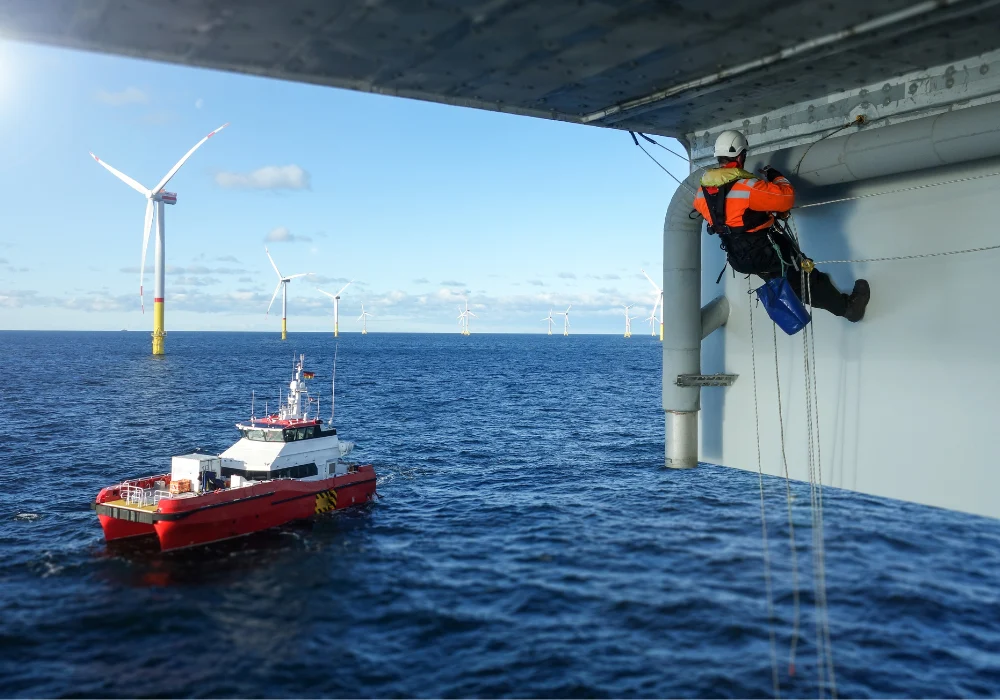
For Gerard Mullin, a specialized structural laborer known as a pile driver, the transition to the offshore wind industry was supposed to be the defining chapter of a stable, middle-class career. After years of traditional onshore construction, the allure of the sea offered something rare in the modern economy: a predictable schedule of five weeks on and five weeks off, exceptional pay, and the opportunity to participate in a burgeoning sector billed as the future of American energy. During his first eight weeks working on projects off the coast of Massachusetts, Mullin earned more than he had managed to save in the previous five years combined. This newfound financial security allowed him to purchase a condominium in Boston even after a devastating fire destroyed his belongings. However, the industry that provided this lifeline has rapidly contracted, leaving Mullin and thousands of other highly trained union workers in a state of professional limbo as political shifts and federal mandates dismantle the U.S. offshore wind pipeline.
The sudden reversal of the industry’s fortunes reached a breaking point when Mullin, prepared for a five-week stint on the Empire Wind project in New York, was told to stay home. A federal stop-work order issued by the administration of President Donald Trump effectively paralyzed the project. This move was part of a broader, aggressive campaign to curtail renewable energy development in favor of traditional fossil fuels. Over the course of the last year, the administration has halted future permitting and canceled 12 major offshore wind leases, citing concerns over costs and energy security. For workers like Mullin, the consequences are immediate and personal. The steady, well-paying careers they were promised have evaporated, replaced by a desperate scramble for the few remaining maintenance positions or a reluctant return to lower-paying onshore construction roles.
A Chronology of Policy Reversals and Market Decline
The trajectory of the U.S. offshore wind industry has been marked by extreme volatility over the last decade. While Europe has utilized offshore wind for decades, the United States only began exploring its potential in earnest in 2011. An Obama administration study that year suggested that a robust offshore wind sector could meet a significant portion of the nation’s energy needs while creating thousands of infrastructure and construction jobs. The first small-scale success occurred in 2016 with the Block Island Wind Farm off Rhode Island.
By 2021, the Biden administration had elevated offshore wind to a central pillar of the national climate strategy, setting an ambitious target to deploy 30 gigawatts of offshore wind by 2030. This led to record-breaking lease sales and a surge in state-level incentives throughout the Northeast and Mid-Atlantic. However, this momentum collided with the political shift following the return of Donald Trump to the White House. Trump, a long-standing critic of wind energy, has frequently characterized the industry as a "Green New Scam."
The timeline of the industry’s recent contraction is stark:
- Late 2024: The administration begins railing against offshore wind during the election cycle, citing alleged impacts on wildlife and high consumer costs.
- Early 2025: A series of executive orders targets clean energy grants, and a major stop-work order is issued for New York’s Empire Wind project.
- Spring/Summer 2026: The federal government cancels 12 major offshore wind leases, effectively stalling the development pipeline for the next decade.
- August 2026: Cancellation of a $34-million grant for the Salem offshore wind terminal, resulting in the immediate loss of 800 projected construction jobs.
Data Analysis: The Collapse of Market Confidence
The impact of these political maneuvers is reflected in the dramatic downgrading of industry forecasts. According to data from market research firm BloombergNEF (BNEF), the outlook for the U.S. offshore wind market has been slashed by more than 80%. At the peak of industry optimism, BNEF forecast that the U.S. would build 39 gigawatts of offshore wind capacity by 2035—enough to power approximately 13 million homes. By the end of last year, that prediction was revised downward to a mere six gigawatts.
This collapse in market confidence has led to a mass exodus of private investment. Harrison Sholler, a wind analyst at BNEF, notes that the uncertainty surrounding federal permitting makes it nearly impossible for international energy companies to justify the massive upfront capital expenditures required for offshore projects. Beyond the projects themselves, the domestic supply chain is also withering. In January 2025, the Italian manufacturer Prysmian Group abandoned plans for a major subsea cable plant near New Bedford, Massachusetts, which would have anchored the regional manufacturing economy.
The financial loss extends to the workers who invested in their own specialization. Union training programs for offshore wind are notoriously expensive, often costing between $10,000 and $30,000 per person. Unions like Millwrights Local 1121 and Piledrivers Local 56 invested millions of dollars into specialized facilities, including heavy-lift training and safety certifications. These investments were made on the premise of "decades of work," a promise that now appears hollow.
Official Responses and Political Rhetoric
The administration has defended its actions as a necessary correction to protect the American economy. White House spokeswoman Taylor Rogers stated that the President is delivering on a promise to "reverse the Left’s costly Green New Scam" in order to lower energy prices and restore "U.S. energy dominance." The administration argues that prioritizing "reliable, affordable, and secure energy sources" like coal and natural gas will ultimately create more sustainable energy jobs than the "subsidized" wind industry.
However, former economic development officials and union leaders dispute this logic. Tim Sullivan, the former CEO of the New Jersey Economic Development Authority, expressed bafflement at the administration’s celebration of project cancellations. "I’ve never seen people cheering for job destruction, particularly elected officials," Sullivan said, noting that thousands of potential jobs in some of New Jersey’s poorest counties, such as Salem County, have been sacrificed for political signaling.
Union representatives, while typically cautious in political matters, have expressed a sense of betrayal. Andy Benedetto, business manager for Millwrights Local 1121, noted that his members feel like "middle-class workers being used as pawns." The sentiment is echoed by Esther Rosario of Climate Jobs New York, who pointed out the impossibility of apprenticing workers into an industry that is being systematically dismantled. "You can’t apprentice somebody into a job that doesn’t exist," she remarked.
Regional Economic Fallout and Infrastructure Atrophy
The disappearance of offshore wind projects has left "ghost projects" across the Eastern Seaboard. Port cities like Salem and New Bedford in Massachusetts, and Paulsboro in New Jersey, had positioned themselves as the hubs of the new green economy. These municipalities invested years in planning, rezoning, and infrastructure upgrades, expecting a windfall of tax revenue and local employment.
In Salem County, New Jersey, the local economy was poised to gain 1,500 new jobs—a transformative number for a county of only 65,000 residents. With the federal pullback, those opportunities have vanished. In Massachusetts, the cancellation of the $34-million Salem terminal grant not only stopped construction but also signaled to other developers that the region was no longer a safe harbor for investment.
The loss of these projects also means a loss of "financial freedom" for individual workers. Anthony Hibbard, an ironworker who rose to the rank of foreman on the Coastal Virginia Offshore Wind project, reported that his income dropped by 80% upon returning to onshore work in Portland, Maine. While many workers have successfully found employment in traditional construction, they describe these roles as "gigs" rather than the stable, long-term careers they had envisioned at sea.
Broader Implications: A Workforce in Retreat
The long-term implications of the offshore wind collapse extend beyond energy statistics; they represent a significant setback for the "just transition" movement, which aims to move fossil fuel workers into renewable sectors. The current situation has created the opposite effect, forcing renewable energy specialists back into traditional sectors or onto unemployment rolls.
For younger workers like 28-year-old Zaheer Razi, the experience has been a lesson in the fragility of policy-driven industries. Razi, who is currently finishing a job on the Revolution Wind project near Rhode Island, expects a "silent" period of at least two or three years once the current farm is completed. The specialized skills he and his peers acquired—diving, heavy-lift rigging, and maritime safety—are not easily transferable to standard onshore construction without a significant pay cut.
The psychological impact is also profound. Workers describe the offshore environment as a unique, international community where crews from across the globe collaborated on complex engineering feats. Benjamin Hawkins, a rigger from Massachusetts, lamented the loss of the "leverage" he felt over his life when he had access to offshore wages. "Offshore wind was the reason I could improve my life," Hawkins said. "To have the president affect my life, just as an average American—it was not on my bingo card."
As the few remaining projects move toward completion, the U.S. offshore wind industry faces an uncertain future. Without a clear federal permitting path and a stable investment climate, the "dream" sold to thousands of union workers has been deferred indefinitely. The skilled workforce that was built to construct the next generation of American energy infrastructure now stands as a cautionary tale of how quickly political headwinds can capsize an entire industrial sector.
