

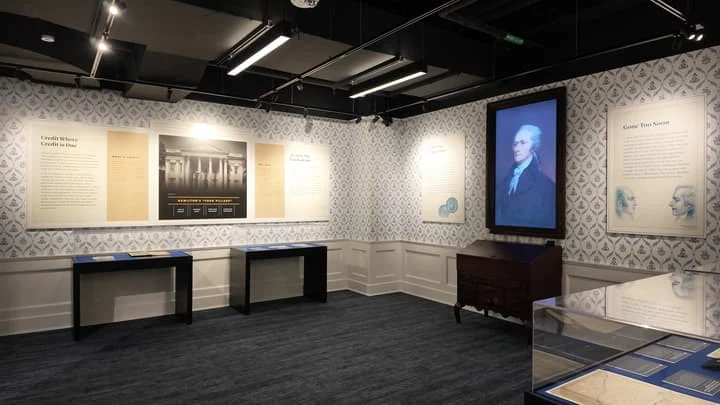
Nearly a decade after an unforeseen disaster displaced it from its long-standing home, the Museum of American Finance (MoAF) has officially opened its new headquarters to the public, just in time for the nation’s 250th anniversary. Located on Commonwealth Pier in the bustling Boston Seaport, this 5,400-square-foot institution, an affiliate of the prestigious Smithsonian Institution, marks a significant return to a permanent physical presence for the museum dedicated to illuminating the nation’s financial history and promoting financial literacy.
A Decade-Long Journey to Re-Establishment
The journey to this grand reopening has been protracted and challenging. The museum, which had occupied 48 Wall Street in New York City for many years, was forced to terminate its lease in 2018 following severe damage from a flood. This incident left the museum without a permanent home, operating through online initiatives and temporary exhibits while it sought a suitable new location. The decision to relocate to Boston, a city steeped in American financial history and a burgeoning hub for fintech and innovation, was a strategic one, announced with the signing of a new lease just 16 months ago. The rapid turnaround from lease signing to the grand opening of seven inaugural exhibits underscores a remarkable effort by the museum’s leadership and partners.
The choice of Boston’s Commonwealth Pier is particularly symbolic. The Seaport District itself is a testament to economic evolution, transforming from industrial waterfront to a vibrant center of commerce, technology, and culture. This setting provides a dynamic backdrop for a museum dedicated to the evolution of finance. The move also positions the museum closer to significant historical sites that shaped America’s economic foundations, including those connected to figures like Alexander Hamilton, whose influence permeates the new exhibits.
Revolutionizing Financial Education with AI and Immersive Experiences
Among the most anticipated features of the new museum is a groundbreaking interactive exhibit developed in partnership with the Fidelity Center for Applied Technology (FCAT). This innovative display leverages artificial intelligence to "resurrect" Alexander Hamilton, the first U.S. Secretary of the Treasury, allowing visitors to engage in real-time conversations with a multilingual AI-generated persona of the historical figure.
"We’re bringing him back to life in a way that truly connects with a modern audience," explained Erich Umar, head of technology strategy & planning at FCAT, during a press conference held at the museum ahead of its opening. "History doesn’t just live in the past; it interacts with the future, and this exhibit perfectly encapsulates that philosophy."
Visitors can converse with the AI Hamilton in over 50 languages, posing unique questions that range from his views on historical economic policies to contemporary financial concepts. For instance, a visitor might ask him to elucidate the principles of compound interest using an analogy of a soccer game, demonstrating the adaptability and educational potential of the technology. This interactive element transcends traditional museum experiences, offering a personalized and deeply engaging learning opportunity.
Umar further elaborated on the broader implications of this technological integration. "Advances in technology are providing opportunities that we could only have imagined just a few short years ago," he told CNBC. "It’s enabling us to scale financial education and reach more Americans where they are, regardless of geography, language, or their preferred modality of learning." This sentiment highlights the museum’s commitment not only to preserving financial history but also to leveraging cutting-edge tools to address contemporary challenges in financial literacy.
Starting with the Familiar: "America in Circulation"
The museum’s thoughtfully curated visitor journey begins with "America in Circulation," an exhibit designed to ease visitors into the complex world of finance through a universally recognizable concept: money. As guests enter, they are immediately immersed in a display showcasing the evolution of American currency, from its earliest forms to modern-day examples.
"We wanted the currency gallery to be the first exhibit visitors explore because everyone is familiar with money," stated Kristin Aguilera, the museum’s deputy director. "By starting with a topic that is inherently accessible, we aim to build a foundational understanding before delving into more intricate financial concepts."
The exhibit features rare and historically significant pieces, including pine tree shillings from 1652, which represent some of the earliest forms of coinage in colonial America, and 18th-century paper currency that tells stories of a nascent nation. Interactive touchscreens accompany these physical artifacts, allowing visitors to zoom in on intricate details, explore the symbolism embedded in each design, and understand the historical context behind their creation.
Rahul Arora, a financial historian and guest curator of "America in Circulation," emphasized the profound connection between currency and pivotal historical events. "A lot of this paper money was due to major events in our history like the Revolutionary War," Arora explained. "Some of these notes wouldn’t exist without those defining moments." For instance, Continental Currency, issued by the Continental Congress during the American Revolution, played a critical role in financing the war effort, though its eventual depreciation led to the famous phrase "not worth a Continental."
Arora expressed hope that the exhibit would cultivate a deeper appreciation for currency, particularly from an artistic and historical perspective. This appreciation, he believes, is increasingly vital in an era where physical money is slowly receding. With the federal government having already halted the manufacturing of new pennies and a future where digital transactions dominate, Arora anticipates a time when the physical dollar itself might be phased out. "Nowadays you’re shopping online, all you see is amounts," he noted. "You go on Amazon, you buy something, and you just see the amount. You don’t think about the money transactions happening." This observation underscores the museum’s role in preserving the tangible history of finance even as its future becomes increasingly intangible.
From Awareness to Action: Addressing the Financial Literacy Crisis
Central to the Museum of American Finance’s mission is the democratization of financial education. In a bold move to ensure broad accessibility, admission to the museum is free, removing a significant barrier for anyone seeking to enhance their financial understanding. This initiative comes at a critical juncture for the United States, as existential fiscal anxiety continues to plague a significant portion of the population.
Recent data paints a stark picture of public concern regarding the nation’s financial health. According to a Pew Research poll conducted in April, a substantial 64% of Americans identified the federal deficit as a "very big problem" for the U.S. This figure represents a notable increase from 57% just over a year prior in February 2025, signaling growing apprehension. The scale of the problem is indeed immense: the national deficit for the fiscal year-to-date currently exceeds $1.2 trillion, and the national debt has surpassed an astonishing $39 trillion. These figures, constantly updated by resources like fiscaldata.treasury.gov, highlight the urgent need for a more financially literate populace capable of understanding and engaging with these complex issues.
Richard Sylla, professor emeritus of economics at the NYU Stern School of Business and former chairman of the museum, expressed concern over current fiscal trends. "We’re getting away from the principles that Hamilton put in place," Sylla remarked. Still an active member of the museum’s board of trustees, Sylla curated three of the inaugural exhibits, including "A Financial Revolution," which meticulously traces the founding of the U.S. financial system under Hamilton’s guidance.
Sylla believes the museum offers a crucial historical perspective amidst contemporary anxieties. "There’s a lot of negative things about the state of the country now," he acknowledged in an interview. "I think this is a nice positive reminder that as bad as you might think things are now, there’s actually a glorious history in how we got to be the richest country in the world." He pointed to the challenges faced by the nascent United States under Hamilton, where the nation was actually defaulting on its debts to both domestic and international creditors. "When Hamilton came into office, we were in a bigger mess than we are now because we were actually defaulting on our debts. Now we’re just running up the debts and heading toward default possibly, but we were actually in default," Sylla explained, offering a glimmer of optimism that current problems, while severe, have historical precedents of being overcome through sound policy.
"The museum is full of things that were left out of the musical [‘Hamilton’]," Sylla humorously added, emphasizing the depth and detail of the historical context offered beyond popular culture.
The Future of Finance and Personal Empowerment
Beyond historical narratives, the museum also looks to the future with exhibits like "The Future of Finance." This section explores the rapidly evolving landscape of financial technology, delving into concepts such as blockchain, cryptocurrency, tokenization, and the broader impact of fintech innovations on global markets and individual financial lives. It serves as a bridge between the historical foundations and the cutting-edge developments that are reshaping how money is created, exchanged, and managed.
The visitor’s journey culminates in "Personal Finance," the final exhibit, designed to synthesize the themes explored throughout the museum. This section aims to equip visitors with practical tools and knowledge to improve their own financial well-being. It reinforces the understanding of the U.S. financial system not as an abstract entity, but as a framework within which individuals must navigate their personal economic decisions.
Bob Pisani, former CNBC senior markets correspondent and a member of the museum’s board of trustees, underscored the dual purpose of the institution. "The museum is not just about financial history but also financial literacy," Pisani stated. He drew a direct line from historical figures like Alexander Hamilton to contemporary personal finance. "Alexander Hamilton helped invent the first bank of the United States that helped stabilize the finances of the United States and set the country on a course of innovation," Pisani said. "Financial literacy is about understanding that kind of history, but it’s also about understanding your own personal finances. It’s about setting a budget."
Pisani eloquently articulated the parallel between individual and national financial management. "A personal budget and a federal budget are not that far apart," he contended. "Financial literacy teaches people to understand how to invest. It teaches people how to save money wisely. It teaches people about the value of compounding interest and how you can have your money work for you." This connection between macroeconomic principles and personal financial habits is a core message the museum strives to impart, recognizing that an informed citizenry is crucial for both individual prosperity and national stability.
The Museum of American Finance, in its new Boston Seaport home, stands as a vibrant testament to the enduring power of financial history and the critical necessity of financial education. By blending engaging narratives, cutting-edge technology, and a commitment to accessibility, it aims to inspire a new generation to understand, appreciate, and actively participate in the financial world that shapes their lives and the nation’s future. Its reopening is more than just a new address; it’s a renewed call to action for financial enlightenment in an increasingly complex economic landscape.
