

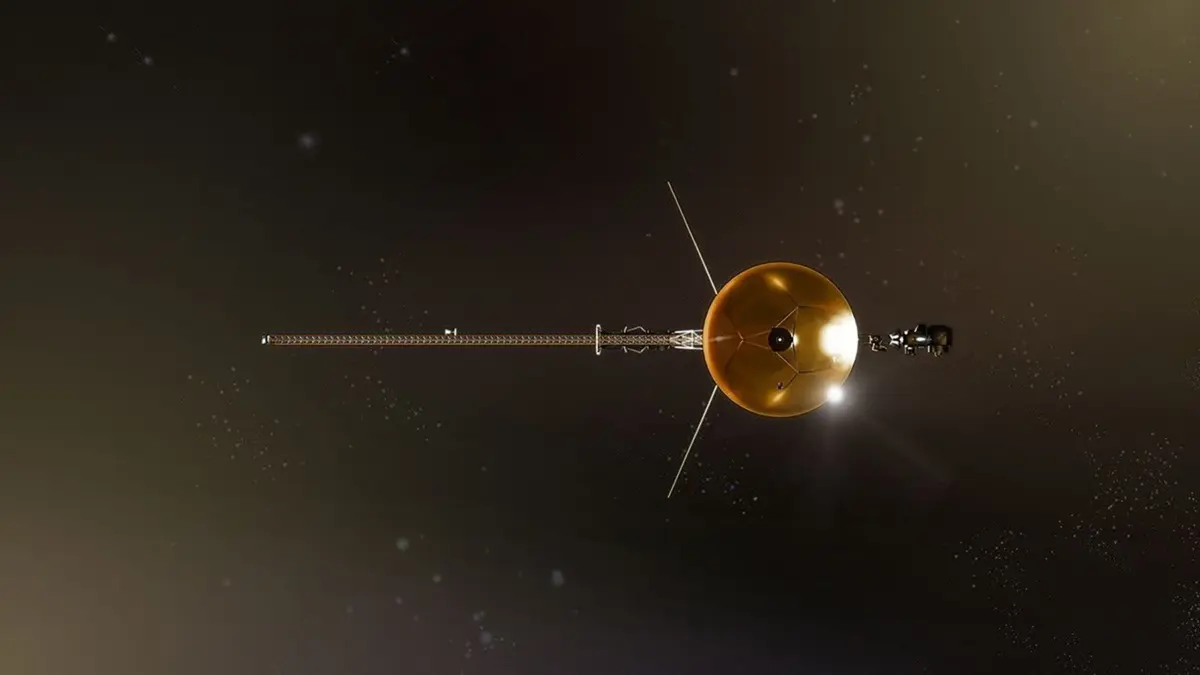
The Voyager 1 spacecraft, a marvel of 1970s engineering and a persistent messenger for the human race, currently drifts through the cold vacuum of interstellar space at a distance so vast it challenges the traditional limits of human comprehension. Launched by NASA in September 1977, the probe has transitioned from a planetary explorer to an interstellar pioneer, becoming the first human-made object to cross the heliopause—the boundary where the sun’s solar wind is superseded by the interstellar medium. As of late 2024, Voyager 1 has reached a staggering milestone: it is now more than one light-day away from Earth. This means that a command sent from mission control at the Jet Propulsion Laboratory (JPL) in California takes over 22.5 hours to reach the craft, and the response takes an equal amount of time to return, creating a nearly two-day communication loop for every interaction.
The Metrics of the Infinite: Measuring Distance in the Cosmos
To understand the magnitude of Voyager 1’s journey, one must first reconcile the units of measurement used to describe the universe. In the terrestrial realm, the meter serves as the standard unit of length, often conceptualized through the physics of a pendulum; a one-meter string produces a swing of approximately one second. However, as humanity ventured into orbit and beyond, the meter and even the kilometer became cumbersome. While the distance to the International Space Station (roughly 400 kilometers) or the Moon (384,400 kilometers) can still be visualized using these units, the scale of the solar system demands a larger yardstick.
Astronomers rely on the Astronomical Unit (AU), defined as the average distance between the Earth and the Sun, approximately 150 million kilometers (93 million miles). This unit was historically determined with precision by observing the transit of Venus across the solar disk from multiple points on Earth, using the principles of parallax to calculate the Sun’s distance. Voyager 1 currently resides more than 160 AU from the Sun.
When measuring the gaps between stars, even the AU fails to provide a convenient scale. For these distances, scientists use the parsec and the light-year. A parsec, equivalent to about 31 trillion kilometers or 206,265 AU, is derived from "parallax second." It represents the distance at which one AU subtends an angle of one arcsecond. While the light-year is more common in popular culture—representing the distance light travels in a vacuum in one Julian year (9.46 trillion kilometers)—the "light-day" has become the most poignant descriptor for Voyager 1. At one light-day away, Voyager 1 is approximately 26 billion kilometers from its home planet, a distance that no other human endeavor has ever approached.
A Chronology of the Grand Tour and Beyond
The voyage of Voyager 1 was made possible by a rare geometric alignment of the outer planets—Jupiter, Saturn, Uranus, and Neptune—which occurs only once every 175 years. This alignment allowed for a "Grand Tour," where a spacecraft could use the gravity of one planet to "slingshot" toward the next, significantly reducing the fuel requirements and travel time.
- September 5, 1977: Voyager 1 launches from Cape Canaveral, Florida, aboard a Titan IIIE-Centaur rocket. Though launched after its twin, Voyager 2, it was put on a faster trajectory.
- March 1979: Voyager 1 makes its closest approach to Jupiter, discovering active volcanism on the moon Io and complex structures within Jupiter’s clouds.
- November 1980: The craft reaches Saturn, providing high-resolution images of the ring system and a close look at the moon Titan. Because the Titan flyby was a priority, the craft’s trajectory was bent upward, sending it out of the plane of the planets (the ecliptic) and toward interstellar space.
- February 14, 1990: At the request of astronomer Carl Sagan, Voyager 1 turns its camera back toward Earth to capture the "Pale Blue Dot" photograph from a distance of 6 billion kilometers.
- August 25, 2012: NASA officially confirms that Voyager 1 has entered interstellar space, leaving the heliosphere behind.
- 2023-2024: Despite aging hardware and a series of technical glitches involving its Flight Data System (FDS), engineers successfully perform remote "brain surgery" on the craft’s 47-year-old computers, restoring its ability to send science data from 24 billion kilometers away.
The Physics of Motion: Gravity, Speed, and Escape Velocity
The movement of Voyager 1 through the cosmos is governed by the fundamental laws of motion established by Sir Isaac Newton. After its initial rocket boosts and planetary gravity assists, the spacecraft has been coasting. However, it is not moving in a vacuum devoid of influence. The primary force acting upon it remains the gravitational pull of the Sun.
Gravity is an attractive force that exists between all objects with mass. While the gravitational pull between a human and their smartphone is mathematically present (roughly 4 x 10^-9 Newtons at a 50-centimeter distance), it is negligible. For Voyager 1, which has a mass of approximately 722 kilograms, the Sun’s massive presence (2 x 10^30 kilograms) continues to exert a pull even at a distance of 160 AU. This force is currently calculated at approximately 1.4 x 10^-4 Newtons—roughly equivalent to the weight of 78 grains of salt on Earth.

Though this force seems minuscule, it causes a constant, slight deceleration. Currently, Voyager 1 is slowing down by about 0.012 meters per second every day. This leads to a critical question: Will the Sun’s gravity eventually pull Voyager 1 back? The answer lies in the concept of escape velocity. To leave the Sun’s influence forever, an object must maintain a speed higher than the local escape velocity. At its current distance, the escape velocity is approximately 3.2 kilometers per second. Since Voyager 1 is traveling at roughly 17 kilometers per second (about 38,000 mph), it possesses more than enough kinetic energy to overcome the Sun’s gravitational well. It is, for all intents and purposes, free of the solar system’s shackles.
Interactions with the Interstellar Medium
Beyond gravity, Voyager 1 interacts with the "environment" of space. For the first 35 years of its mission, it bathed in the solar wind—a stream of charged particles (plasma) ejected by the Sun. As it moved further away, the intensity and density of these particles decreased.
Upon crossing the heliopause, Voyager 1 began detecting a significant increase in galactic cosmic rays—high-energy particles from outside our solar system—and a change in the surrounding magnetic field. The "interstellar medium" it now traverses is not a perfect vacuum but contains traces of dust, gas, and magnetic fields from distant supernovae. While these elements provide data for the craft’s remaining functional instruments, such as the Magnetometer and the Cosmic Ray Subsystem, they also present a long-term drag. Over millions of years, the impact of interstellar dust will likely erode the craft and further slow its progress, though it will remain in motion long after the Sun has evolved into a red giant.
Engineering Resilience and the Deep Space Network
The continued operation of Voyager 1 is a testament to the ingenuity of the NASA/JPL engineering teams. The craft is powered by Radioisotope Thermoelectric Generators (RTGs), which convert the heat from the decay of Plutonium-238 into electricity. Because the fuel decays, the power output drops by about 4 watts per year. To keep the craft alive, engineers have systematically turned off non-essential heaters and scientific instruments.
Communication is maintained via the Deep Space Network (DSN), a global array of massive radio antennas. The signal received from Voyager 1 is incredibly faint—billions of times weaker than the power of a modern digital watch battery by the time it reaches Earth. It requires the DSN’s 70-meter dishes to capture the 23-watt transmission. Recent efforts to fix a corrupted memory chip in the FDS required engineers to relocate code within the craft’s archaic memory system, a task complicated by the 45-hour round-trip delay in signal verification.
Broader Implications and the Golden Record
Voyager 1 represents more than a collection of sensors and plutonium; it is a time capsule. Fastened to its side is the Golden Record, a gold-plated copper phonograph record containing sounds, images, and greetings in 55 languages, intended to tell the story of Earth to any extraterrestrial intelligence that might encounter it.
The implications of Voyager 1’s journey are both scientific and philosophical. Scientifically, it provides our only "in situ" data of the space between stars, helping researchers understand the protective bubble of our heliosphere. Philosophically, it serves as a reminder of humanity’s capacity for exploration.
In approximately 40,000 years, Voyager 1 will pass within 1.6 light-years of the star AC +79 3888 in the constellation Camelopardalis. While it will likely be a "dead" hulk by then, its radioisotope power long extinguished, it will continue to drift through the Milky Way as a silent monument to the civilization that launched it. As it moves deeper into the dark, one light-day at a time, it remains the ultimate proof that the reach of human curiosity is, quite literally, astronomical.
