

The European Union stands at a critical juncture in its quest for industrial autonomy, as internal political negotiations over the Industrial Accelerator Act (IAA) threaten to undermine the continent’s battery value chain. For years, the European Commission has signaled a strategic shift toward reducing dependence on foreign powers, particularly China, for the essential technologies of the energy transition. However, a series of recent legislative proposals and a controversial bilateral agreement between France and Germany have sparked concerns that the EU may be surrendering its strategic advantage to international competitors. At the heart of the debate is the tension between immediate cost-concerns for automakers and the long-term necessity of building a self-sufficient, high-value industrial ecosystem within Europe’s borders.
The Industrial Accelerator Act was designed as Europe’s answer to the United States’ Inflation Reduction Act (IRA), introducing Union content incentives to ensure that public subsidies and corporate tax breaks are funneled into domestic manufacturing. By creating a "demand-side pull," the IAA aims to secure high-value industrial jobs and mitigate geopolitical risks. Yet, according to a recent assessment by the Brussels-based group Transport & Environment (T&E), the current trajectory of the legislation risks diluting these requirements to the point of irrelevance. If the criteria for "Made-in-Europe" batteries are weakened, the strategic value chain for electric vehicle (EV) batteries—a sector Europe has fought hard to establish—could be ceded entirely to China.
The Franco-German Deal: A Significant Strategic Retreat
A central point of contention is the joint automotive deal announced by France and Germany on October 16, 2026. While both nations have historically been the twin engines of European industrial policy, this latest agreement has been characterized by analysts as a major blow to the local battery industry. The deal proposes a tiered timeline for battery sourcing requirements that many experts believe is out of step with current market realities.
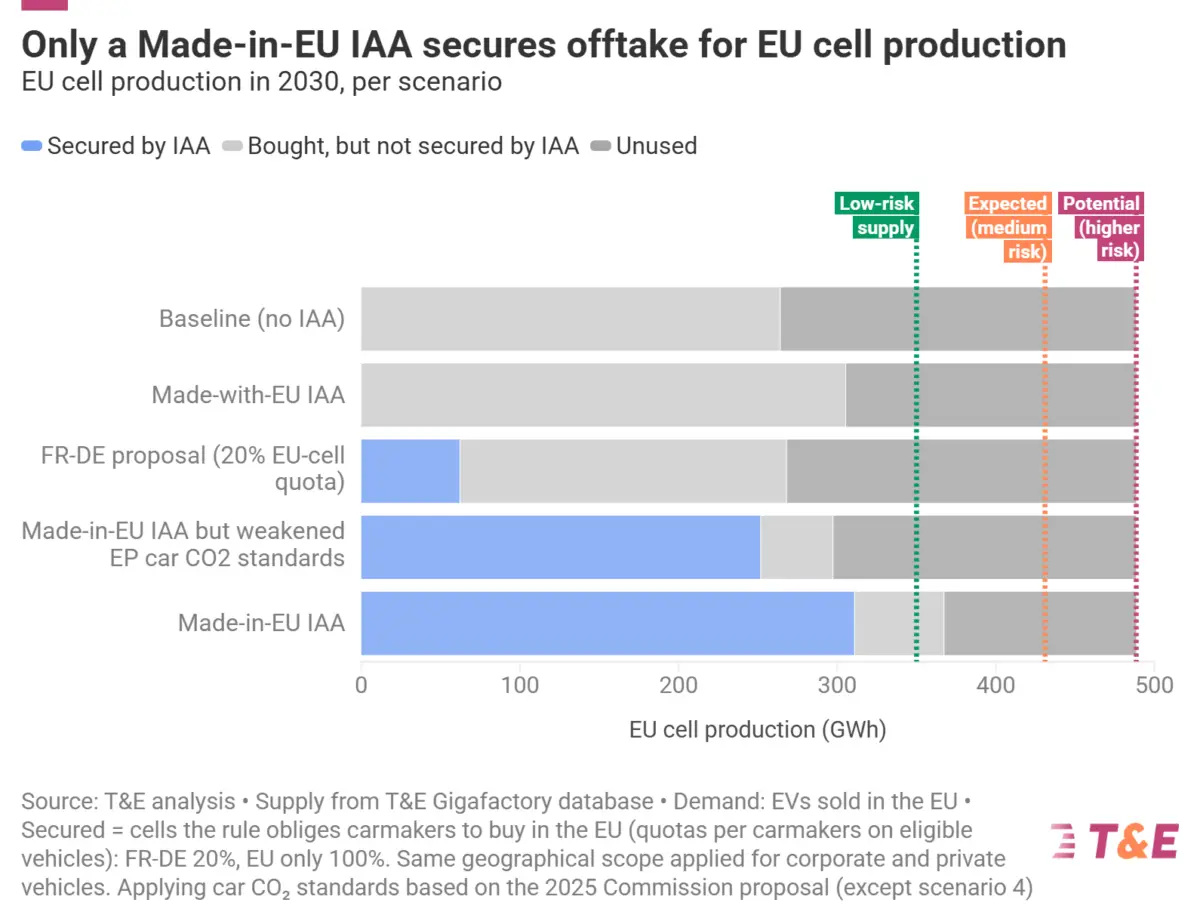
Under the proposal, eligible electric vehicles would only be required to source 10% of their battery components from within the EU in 2028 and 2029. This figure would rise to 20% in 2030 and 2031, finally jumping to 70% in 2032. Critics argue that these thresholds are shockingly low, considering that more than 50% of the battery cells in EVs currently sold in the European Union are already manufactured on the continent. By setting the 2030 target at a mere 20%, the deal would effectively secure only 62 gigawatt-hours (GWh) of Europe’s announced cell production—a paltry 13% of the projected total.

The implications for investment are severe. Without guaranteed demand, an estimated 220 GWh of potential European cell production would have no secured market, while another 206 GWh would be left in a state of commercial uncertainty. Even the 70% requirement slated for 2032 would only cover approximately 45% of Europe’s potential production capacity, leaving the majority of the continent’s industrial infrastructure vulnerable to cheaper imports from dominant global players.
The Risks of a Broad Geographical Scope
Beyond the sourcing percentages, the geographical definition of "Made-with-EU" has become a legislative battlefield. There is a strong push from some member states and automotive lobbyists to expand the scope of the IAA to include countries with which the EU has Free Trade Agreements (FTAs). While this may seem like a move toward "friend-shoring," data suggests it could lead to significant industrial leakage.
A strict "Made-in-EU" scope is seen as the only way to ensure that the massive investments made in European gigafactories yield domestic returns. If the scope is widened to include all FTA partners, an estimated 100 GWh of cell demand and 250 GWh of demand for Cathode Active Materials (CAM) could be lost to external markets by 2030. Even a more restricted "trusted partners" scope—which would limit sourcing to a smaller group of allied nations—would still leave nearly a third of potential EU cell supply without guaranteed buyers. For CAM, the situation is even more precarious; a trusted-partners scope could leave 30% of expected EU supply without a market, a figure that rises to 50% under an extended scope.
Strengthening the Midstream: CAM and pCAM Requirements
The most vulnerable segment of the European battery supply chain is the midstream—specifically Cathode Active Materials (CAM) and their precursors (pCAM). Currently, this segment is heavily concentrated in China, creating a bottleneck that exposes European automakers to supply chain disruptions and potential export controls. Diversifying this segment is essential for the continent’s industrial resilience.
Technical assessments indicate that reaching robust CAM requirements under a strict "Made-in-EU" framework is both commercially and technically viable by 2030. Reaching these targets would require only minimal sourcing from trusted external partners in the interim. By 2032, domestic production could realistically cover the demand for all EVs supported by public schemes. Implementing a strict IAA would generate an additional 323 GWh of demand for European-made CAM by 2032—roughly equivalent to the output of six mid-sized manufacturing plants. This would secure 94% of the expected EU supply, totaling 407 GWh.

The precursor materials (pCAM) are equally vital. To ensure that European refiners and recyclers have a local market for their products, a 28% EU pCAM requirement has been proposed for 2032. Critically, experts suggest this requirement should apply to a manufacturer’s entire fleet, rather than just the vehicles receiving public subsidies. This would provide the market certainty needed for companies to reach Final Investment Decisions (FID) on new refineries and processing facilities.
While onshoring these processes does come with a "sovereignty premium," the costs are relatively modest. Estimates suggest that localizing CAM and pCAM production adds approximately $10.60 per kWh for Nickel Manganese Cobalt (NMC) batteries and $6.50 per kWh for Lithium Iron Phosphate (LFP) batteries. Proponents of the IAA argue that this is a necessary investment that will decrease as the European supply chain matures and achieves economies of scale.
The Interplay with CO2 Standards and Fleet Boosters
The success of the IAA is inextricably linked to the EU’s CO2 standards for cars and vans. These standards act as the primary driver for EV adoption, and any softening of these targets directly impacts battery demand. In November 2026, the European Parliament’s leading committee approved a position that some analysts fear will lead to a sharp decline in expected EV sales. If these standards are diluted, EU cell demand could drop by as much as 247 GWh between 2027 and 2032—a loss equivalent to approximately 3.7 million European-made electric vehicles.
Furthermore, the proposed "fleet booster" mechanism—a tool intended to incentivize manufacturers to exceed their electrification targets—could become a loophole if not properly regulated. Automotive manufacturers have lobbied for a compliance trigger below 85%, which would allow them to receive regulatory credit while continuing to source the majority of their components from China. A lower threshold would essentially provide a "stamp of approval" for sourcing strategies that bypass European workers and factories. To prevent public subsidies from inadvertently benefiting foreign competitors, experts insist that the fleet booster trigger must remain at or above 85%.
Chronology of the IAA and Battery Policy Development
The current crisis is the culmination of several years of intensive policy development and shifting geopolitical realities:
- 2023-2024: The EU observes the rapid success of the US Inflation Reduction Act and begins drafting the Net-Zero Industry Act (NZIA) to prevent the flight of green capital to North America.
- Early 2025: The concept of the Industrial Accelerator Act (IAA) is introduced to provide more specific demand-side incentives for the battery sector.
- Mid-2026: Reports emerge of slowing EV demand growth in Europe, leading to increased pressure from legacy automakers to delay or weaken CO2 standards.
- October 16, 2026: France and Germany release their joint statement on the future of the European automotive industry, proposing the controversial 10-20-70 sourcing timeline.
- November 2026: The European Parliament’s ENVI committee approves a compromise on CO2 standards that critics claim will reduce the number of EVs on the road and stifle battery demand.
- Late 2026: Industry analysts and NGOs like T&E issue urgent briefings, warning that the "last chance" to secure Europe’s battery industry is fast approaching.
Broader Impact and Industrial Implications
The outcome of the IAA negotiations will determine whether Europe remains a leader in the global energy transition or becomes a mere consumer of foreign technology. If the Franco-German deal’s weak sourcing requirements are adopted, the message to investors will be clear: Europe is not yet committed to its own industrial capacity. This could lead to a "hollowing out" of the European automotive sector, where vehicles are assembled in the EU using foreign-made "black box" technologies, leaving the highest-value parts of the supply chain elsewhere.
Conversely, a robust, "Made-in-EU" focused IAA would catalyze a massive wave of industrialization. It would secure the future of the dozens of gigafactories currently planned or under construction across the continent, from Sweden and Germany to France and Hungary. It would also foster a secondary industry in recycling and raw material refining, creating a "circular" battery economy that reduces the need for new mining.
The "sovereignty premium" of slightly more expensive batteries in the short term is seen by many as a small price to pay for the security of not being dependent on a single dominant supplier. As the EU co-legislators move toward a final decision, the stakes could not be higher. The decision made in the coming months will resonate through Europe’s industrial landscape for decades, deciding whether the continent’s roads are powered by European innovation or by technologies imported from across the globe.
